

Zuha Tariq
“The problem is not that girls do not want to learn. It is that we have not always created enough opportunities for them to do so.”
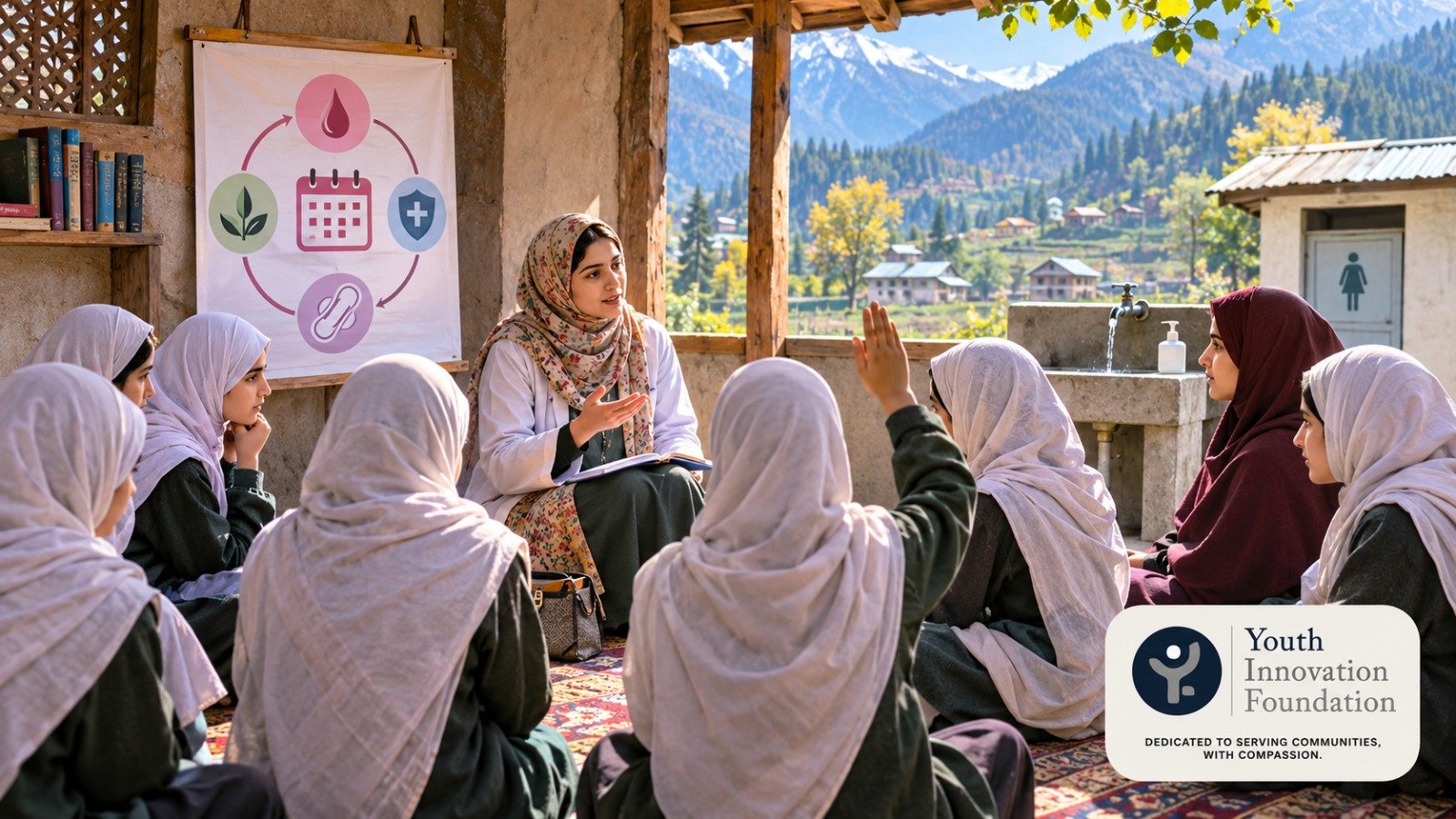
Some experiences leave you with more questions than answers. Conducting a menstrual health workshop at a madrasa in Kashmir was one such experience for me. I went there to speak about menstruation, personal hygiene and bodily health. What I did not anticipate was how deeply the experience would make me reflect on the gaps in our approach to health education, particularly for girls growing up in remote and underserved communities.
What stayed with me most was not simply the number of questions the girls asked, but the realisation that many of these questions had remained unanswered for years.
Some girls who had already begun menstruating were still unaware of the biological process behind it, how to manage their periods safely or whom to approach for reliable information. Their curiosity was evident, but opportunities to learn had not always been available. It made me wonder how many girls across Kashmir continue to experience menstruation with uncertainty, relying on fragments of information, inherited beliefs and misconceptions rather than scientific knowledge.
The digital age and the reality beyond our screens
We live in a world where information is increasingly accessible through the internet, social media and artificial intelligence. It is easy to assume that, in an age of Google and ChatGPT, basic health information must have reached everyone. However, this assumption overlooks the realities of girls living in Kashmir’s remote and hilly areas, where digital connectivity, educational resources and access to healthcare may remain limited.
Even where the internet is available, access to information does not automatically translate into understanding. Girls need accurate, age-appropriate information, guidance from trustworthy sources and safe environments in which they can ask questions without embarrassment.
A girl should not have to discover what menstruation means only after experiencing her first period. Nor should she have to depend on rumours to understand a normal biological process. Menstrual education must begin before menarche, equipping girls with the knowledge and confidence to manage this transition with dignity.
The workshop reminded me that while society has made progress in discussing menstrual health, that progress has not reached everyone equally. We must look beyond the conversations happening in cities and accessible institutions and ask whether the same opportunities exist for girls in more isolated communities.
When biology becomes a source of stigma
Menstruation is a normal physiological process involving hormonal changes and the shedding of the uterine lining. Yet, in many communities, it continues to be surrounded by restrictions and misconceptions that can affect girls’ confidence, participation and emotional well-being.
Some girls and women are told to stay away from kitchens, avoid ordinary household activities or consider themselves impure during their periods. When such beliefs are repeatedly reinforced, a natural bodily process can become a source of shame. Girls may begin to feel uncomfortable discussing their health, asking for menstrual products or seeking medical attention when something does not feel right.
Menstrual blood does not make a person morally or physically impure, and menstruation does not make someone unhygienic. Hygiene depends on appropriate care, access to clean materials, handwashing and suitable sanitation facilities—not exclusion from everyday spaces.
The continued use of cloth for menstrual management also highlights the importance of practical, non-judgemental education. Reusable cloth can be used safely when it is thoroughly washed, completely dried and stored in a clean, dry place. However, without adequate water, privacy and washing facilities, maintaining these practices can become difficult. Girls also need access to suitable menstrual products and clear information about their safe use and disposal.
The issue, therefore, is not simply what girls use during menstruation, but whether they have the resources and knowledge to make informed choices.
National evidence reflects these inequalities. UNFPA India’s analysis of the National Family Health Survey-5 (2019–21) reported that 73 per cent of rural women aged 15–19 used hygienic menstrual protection, compared with 90 per cent of their urban counterparts. These figures reflect progress while also highlighting a persistent rural–urban gap in access and practices.
Behind these numbers are girls whose experiences are shaped by geography, affordability, social attitudes and the availability of reliable health education.
Ten kilometres for the opportunity to learn
One of the most moving aspects of the workshop was learning that some girls had travelled approximately ten kilometres on foot to attend.
They arrived with enthusiasm, curiosity and a remarkable number of questions. Their eagerness to participate stayed with me long after the session ended. I kept thinking about what it meant for these girls to travel such a distance simply to learn about their own bodies.
Their journey made me reflect on how easily we underestimate the need for basic health education. We often assume that people will seek information when they need it, forgetting that seeking information requires access, encouragement and, sometimes, the courage to speak about subjects that society has taught them to keep private.
How many other girls might have wanted to attend but could not? How many are still waiting for someone to visit their school, madrasa or village and give them the opportunity to ask questions freely?
Their enthusiasm was a powerful reminder that awareness initiatives must go beyond accessible urban settings. We cannot expect every underserved community to find its way to educational opportunities. Sometimes, the responsibility lies in taking those opportunities directly to them.
Menstrual education is also about self-worth
Menstrual education must extend beyond explaining the menstrual cycle and hygiene practices. Girls need to understand their bodies, recognise when medical advice may be necessary and feel confident discussing their concerns without fear or embarrassment.
They also need to learn about self-care, emotional well-being and bodily autonomy. During adolescence, when identity, confidence and body image are developing, the way girls are taught to understand their bodies can influence how they relate to themselves.
When a girl learns that menstruation is natural, that her concerns deserve attention and that seeking help is not something to be ashamed of, she gains more than biological knowledge. She gains the confidence to advocate for her own health.
Self-care should never be presented as a luxury reserved for those with access to resources. Every girl deserves to know that her health matters, that her questions are valid and that she is entitled to accurate information.
Taking awareness where it is needed most
This is where the work of Youth Innovation Foundation (YIF) becomes relevant. Through its menstrual health awareness initiatives, the Foundation is reaching girls and women in underserved communities, including remote and hilly areas where access to structured health education may be limited.
According to the Foundation, its outreach has reached more than 2,000 girls and included three doctor-led sessions, creating opportunities for menstrual health education and engagement with medical professionals.
The involvement of doctors can be valuable because awareness should be supported by reliable medical guidance. Girls need opportunities to understand not only menstruation and hygiene but also menstrual irregularities, hormonal changes and the circumstances in which professional healthcare may be necessary.
Equally important is the need to approach communities with sensitivity and respect. Effective health education should challenge harmful misconceptions without humiliating the people who have grown up believing them. It should encourage dialogue, build trust and make scientific knowledge accessible in a language and setting that girls understand.
The purpose of such initiatives should not be merely to conduct workshops or count participants. It should be to make reliable information accessible, encourage informed health practices and create environments where girls can discuss their bodies without stigma.
Reaching more than 2,000 girls is an important milestone, but the larger objective is sustained change: a girl who understands her first period, a family that can discuss menstruation without shame, and a community that recognises menstrual health as an essential part of overall well-being.
A responsibility we cannot ignore
Menstrual health is not merely a private matter or a question of personal hygiene. It intersects with public health, education, sanitation, gender equity and social inclusion. Addressing it requires the collective efforts of families, educators, healthcare professionals, community institutions and organisations working at the grassroots.
My experience at the madrasa reinforced a simple truth: a girl’s lack of knowledge should never be mistaken for a lack of curiosity, and her silence should never be mistaken for a lack of need.
The girls who travelled ten kilometres on foot reminded me that the desire to learn is already there. What is needed is a greater commitment to ensuring that reliable knowledge reaches them, regardless of where they live or the resources available to them.
No girl should have to experience menstruation in fear or confusion. No girl should be made to feel impure because of a natural biological process. And no girl should be denied basic knowledge about her health simply because she lives in a community that is difficult to reach.
For me, the workshop was more than an awareness activity. It was a reminder that meaningful social change begins when we recognise an unmet need and take responsibility for addressing it.
“The true measure of menstrual awareness is not how often we speak about it, but whether the girls who need it most are finally being heard, informed and empowered”
Comments are closed.