
In the Shadows of Memories

(This story explores the loneliness of the elderly, memory loss, and family attitudes, highlighting the importance of love, patience, and respect.)


Yousuf Mir


“Memories may grow weaker, but as long as respect survives within relationships, a person is never truly alone. The elderly need more than care and assistance; they need to feel that they remain valued members of their families.”


Zaid Alam Bahadur was a retired senior police officer. From his college days, he had been known for his fearless nature. His habit of stepping forward in difficult situations had earned him the nickname “Bahadur” among his friends, which later became a part of his name.


During his service, his life had remained busy. Meeting people, fulfilling responsibilities, and keeping himself occupied with one task or another had become his way of life. About a year and a half before retirement, he had occasionally begun to experience minor lapses in memory. Sometimes he would fail to recall someone’s name or ask the same question twice. His family did not attach much importance to the matter.

After retirement, circumstances changed. His office, colleagues, and daily engagements were left behind. His circle of acquaintances gradually shrank, and the four walls of his home began to define his world.

His wife, Khalida, was with him. Their son had gone abroad for higher education. When he returned home after completing his studies several years later, the house was filled with happiness.

One day, their son was driving the car himself. His mother, Khalida, and his wife, Zulaikha, were sitting with him. Suddenly, an accident occurred on the way.

The son died on the spot. Khalida was seriously injured, and her legs were affected so severely that she became permanently disabled. Walking was now almost impossible for her, and her life became confined to the four walls of her room.

Zulaikha was also injured, but miraculously survived. After recovering, she sat beside her mother-in-law, Khalida, one day. She gently held her hand and said, “Ammi, perhaps Allah has spared my life so that I can stand by both of you.”

From that day onward, Zulaikha never allowed her parents-in-law to feel alone. Sometimes, she affectionately called her father-in-law “Abu,” sometimes “Abu Zaid,” and sometimes “Abu Bahadur.” Whenever she felt that a situation called for greater seriousness or a special degree of respect, she would address him by his full name, “Zaid Alam Bahadur.” For her, each way of addressing him expressed love and respect according to the occasion.

One day, Zaid Alam Bahadur was trying to recall the name of a close female relative.

“That… that gentleman’s wife… what is her name?”

Zulaikha promptly replied,

“Yes, Abu, her name is Nasreen.”

She did not say, “You remembered it just a little while ago. How could you forget?”

One morning, Zaid Alam Bahadur had breakfast at around nine o’clock. A little later, he came out of his room again.

“Daughter, serve me breakfast.”

With a smile, Zulaikha asked,

“Abu Bahadur, what would you like to eat today? An egg, meat, vegetables, or cheese?”

He thought for a while.

“Prepare a chicken leg and some cheese.”

“Of course, Abu. I’ll prepare it right away.”

Zulaikha knew that repeatedly reminding him, “You have just had breakfast,” could become an emotional burden for him. She had established a routine at home. There was a fixed time for meals, a time for changing clothes, a time for bathing and walking, and a time for medicines. She also involved him in small household tasks and arranged routine medical check-ups from time to time.

None of this was a cure for any illness; it was simply an effort to bring some order and stability into his life.

Meanwhile, Mushtaq Ibn Faizan, an old acquaintance of Zaid Alam Bahadur, lived in a distant village in the same area. The two had known each other for many years. Mushtaq’s life, too, had taken a different turn in old age.

Mushtaq was an elderly man. His son, Makhmoor, was a successful businessman. He earned well, but his business commitments and constant haste had made him increasingly impatient with his father.

Makhmoor’s wife, Takhleema, was also occupied with household affairs. She did not consider everything Mushtaq said or did to be wrong, but she too failed to show him the patience and gentleness that people need at this stage of life.

One day, Mushtaq returned home from outside. As he crossed the courtyard and entered the veranda, he forgot that he was supposed to leave his slippers outside.

Takhleema stopped him halfway. Mushtaq was about to say something when, without a word, Takhleema took off his slippers with her own hands, threw them outside, and said as she walked in,

“How many times do I have to explain this to you?”

Mushtaq fell silent. Sometimes, when he coughed, Takhleema would immediately say, “Abba, please cover your mouth when you cough.”

At other times, if he forgot to put something back in its proper place, he would be reminded again. These were not major issues, but the repeated scoldings had gradually silenced Mushtaq from within.

One day, he left the house, but after a while, he could no longer remember where he had intended to go. He stood by the roadside, looking around uncertainly. As he tried to make his way back, his foot slipped, and he fell. He was injured.

A neighbour recognised him and immediately called Makhmoor.

Makhmoor took his father to the hospital. He remained silent throughout the journey.

That night, for the first time, he felt a gap between his father’s behaviour and the demands of his own busy life.

A few days later, an occasion arose that brought the two families together.

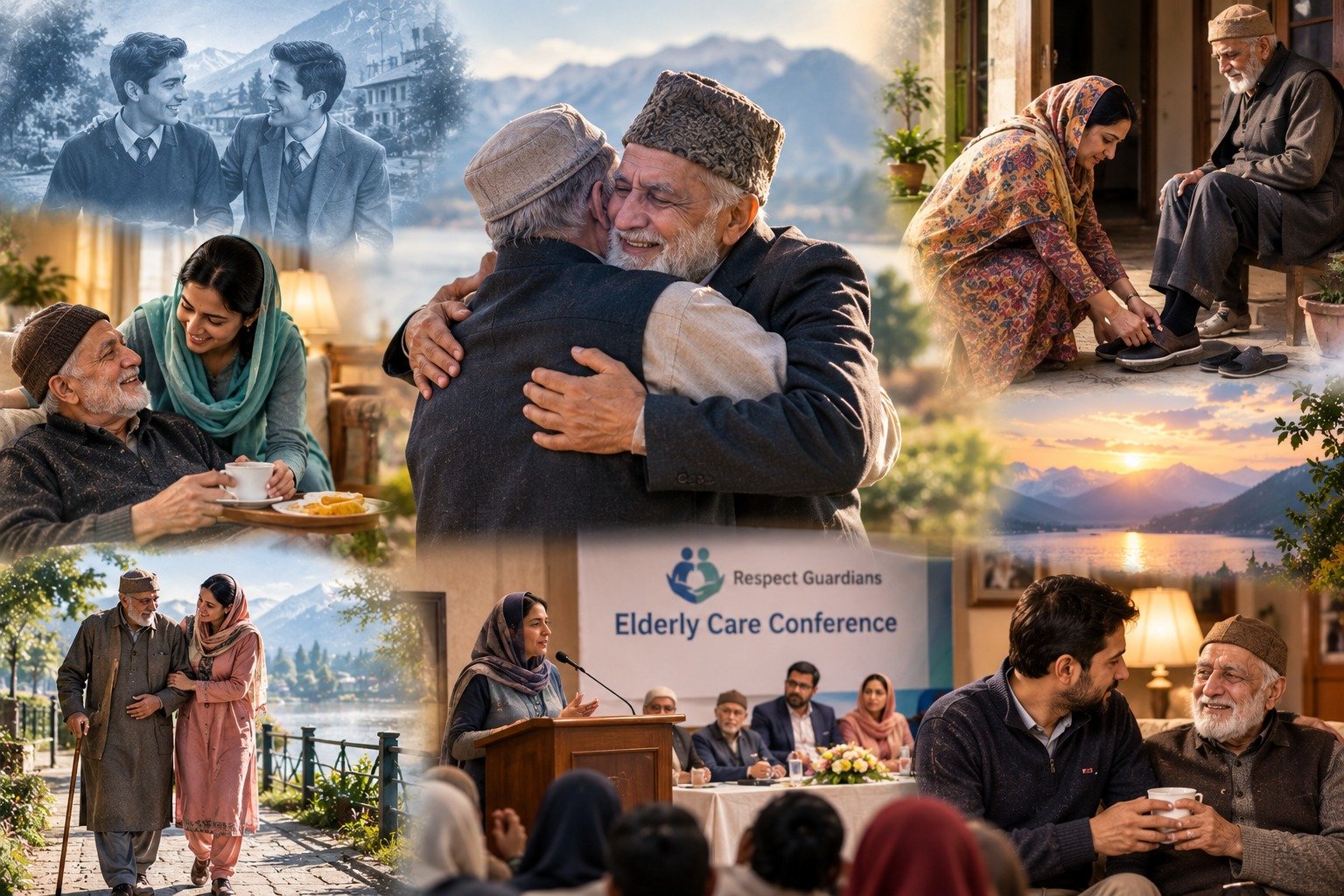
On Sunday, 7 May, an NGO called Respect Guardians had organised a conference on the elderly at Guri Marg. The event had also invited the elderly people’s caregivers, children, and others associated with their care.

Zulaikha arrived with her parents-in-law. Mushtaq, Makhmoor, and Takhleema arrived as well. As people were taking their seats, Zaid Alam Bahadur suddenly spotted Mushtaq.

“Mushtaq!”

Mushtaq turned around.

“Zaid Alam Bahadur!”

The two walked towards each other and embraced. Memories of their college days and years of service came flooding back. They talked about old times for a long while. People sitting nearby watched them with surprise.

Makhmoor looked at his father. He remembered how Mushtaq would forget even an ordinary thing at home, yet here he was, recalling events from decades earlier and laughing as he spoke.

During one session of the conference, the discussion turned to caring for the elderly. Zulaikha was also present.

She said, “Constantly telling elderly people that they have forgotten something can sometimes make them feel disconnected from their own selves. It is better to establish a routine for them. Fixed times for meals, sleep, walking, medicines, changing clothes, and small daily tasks. Above all, they should be made to feel that they are not a burden on their families.”

Makhmoor listened quietly. Takhleema was sitting beside him. She remembered the day in the veranda when she had taken off Mushtaq’s slippers and thrown them outside.

After the conference ended, the two walked quietly for a while.

When they reached home, Makhmoor said to his father for the first time, “Abba, it is time for tea. Come, let me sit with you.”

Mushtaq looked at him. A faint smile appeared on his face. The next day, when Mushtaq placed his slippers in the wrong spot, Takhleema did not scold him. She picked them up, placed them to one side, and simply said, “Abba, please keep them here. It will be easier for you, too.”

Mushtaq nodded. With time, small changes began to appear in Makhmoor and Takhleema’s behaviour. Instead of immediately correcting every lapse, they now tried to help Mushtaq manage it with greater understanding.

Zaid Alam Bahadur, too, continued to move through the changing days of his life, supported by Zulaikha and guided by a daily routine.

Sometimes he was “Abu Zaid,” sometimes “Abu Bahadur,” and sometimes simply Zaid Alam Bahadur.

Names changed, time changed, and people changed, but one thing remained constant: respect.

Memories may grow weaker, but as long as respect survives within relationships, a person is never truly alone.


Author is a former  District Information Officer, He can be mailed at yousufmir555@gmail.com


Comments are closed.