

Tamanna Hazarika
The histories of Malikah Nahrasiyah, Ratu Kalinyamat, Sultanah Siti Aisyah, and Sultanah Shafiyatuddin show that Muslim women were important rulers in Indonesian history. They did not merely stand beside male rulers as wives or mothers; in several cases, they ruled independently and took major political decisions.
Muslim women played an important role in the political history of Indonesia, although their stories are often less well known than those of male sultans and kings. In many Islamic kingdoms of the Indonesian archipelago, women could become rulers in their own right.
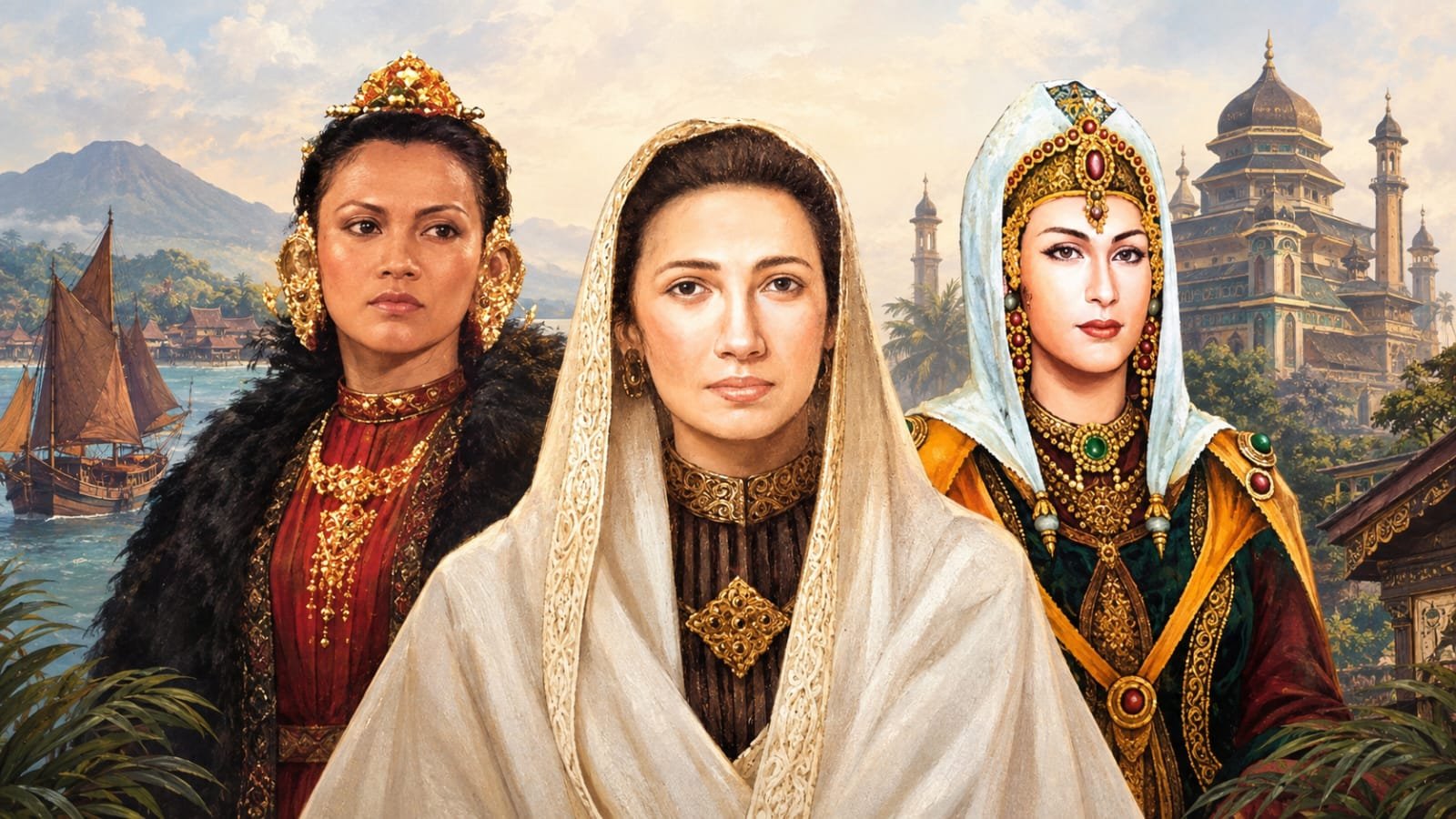
This article discusses four Muslim female rulers from different parts of Indonesia, apart from the four famous female rulers of Aceh. They are Malikah Nahrasiyah of Samudra Pasai, Ratu Kalinyamat of Jepara, Sultanah Siti Aisyah of Sumbawa, and Sultanah Shafiyatuddin of Sumbawa. These rulers lived in different centuries and ruled very different kingdoms, but together they show the wide presence of women in Indonesian Islamic political life.
Malikah Nahrasiyah:
Malikah Nahrasiyah was a female ruler of the Samudra Pasai Sultanate, in present-day Aceh, Indonesia. The most secure facts about her life come from the Arabic inscription on her grave “she belonged to the ruling family descended from Sultan Malik al-Salih and died in 831 AH/1428 CE.” Malikah Nahrasiyah was a royal woman of the Samudra Pasai Sultanate, one of the earliest important Islamic kingdoms in the history of Indonesia.
Her tomb inscription records her as the daughter of Sultan Zainal Abidin, son of Sultan Ahmad, son of Sultan Muhammad, son of Sultan Malik al-Salih. Thus, she was a descendant of Malik al-Salih, the founder of the ruling dynasty of Samudra Pasai.
She is remembered as a sultanah or malikah, meaning a woman ruler or queen. Her rule is generally placed in the early fifteenth century. Some later historical accounts give the period 1406–1428 CE. During Nahrasiyah’s time, the kingdom had become an important centre of Islam, commerce, and contact between Southeast Asia, India, West Asia, and China.
Many popular accounts state that Nahrasiyah was the “first female ruler in Southeast Asia,” that Samudra Pasai reached its greatest glory during her reign, or that she ruled exactly from 1406 to 1428. Her tomb is itself evidence of the cultural prosperity of Samudra Pasai. The National Museum of Indonesia notes that the stone carries Arabic and Old Malay writing and uses Kufic-style Arabic calligraphy.
Ratu Kalinyamat:
Ratu Kalinyamat was a brave woman ruler of Jepara in Central Java during the sixteenth century. She ruled Jepara from about 1549 to 1579 and made it an important centre of trade, shipbuilding, and naval power.
Ratu Kalinyamat was the daughter of Sultan Trenggana, the ruler of Demak. She was also the granddaughter of Raden Patah, who established the Demak Sultanate. Her name before becoming queen was Retna Kencana. She married Sultan Hadlirin. He ruled Jepara before her. During a political conflict in Demak, Sultan Hadlirin was killed. After his death, Retna Kencana became deeply involved in the struggle for justice and power in the Demak royal family.
In 1549, she became the ruler of Jepara and received the title Ratu Kalinyamat. During Ratu Kalinyamat’s rule, Jepara became a strong coastal kingdom. Jepara traded rice, spices, cloth, and other goods. Rice came from the fertile inland areas of Java, while spices came from eastern Indonesia, especially the Maluku Islands. She is also connected with the Mantingan Mosque built in 1559 and the Mantingan tomb complex in Jepara.
These historical places were built during her period and show the Islamic culture of 16th century Jepara. Ratu Kalinyamat also developed Jepara’s navy. Her government built ships and organised soldiers for sea warfare. Because of this naval strength, Jepara became known as one of the strongest maritime powers on the north coast of Java. Portuguese writers called her the “Queen of Jepara, a powerful and wealthy lady.”
Ratu Kalinyamat strongly opposed the Portuguese in Malacca. The Portuguese had captured Malacca in 1511 and tried to control trade in the Straits of Malacca. This harmed the trade interests of many Asian and Indonesian merchants. In 1551, Ratu Kalinyamat sent ships and soldiers to help Johor attack the Portuguese in Malacca.
Her fleet reportedly had about 40 ships and 4,000–5,000 soldiers. The attack did not succeed, so in 1574, she sent another larger naval expedition to Malacca. The Jepara fleet reportedly had about 300 ships and nearly 15,000 soldiers. The Portuguese were not defeated but it showed the military strength of Jepara.
Sultanah Siti Aisyah:
Sultanah Siti Aisyah was a woman ruler of the Sumbawa Sultanate in West Nusa Tenggara, Indonesia. Her full title was Dewa Masmawa Sultanah Siti Aisyah, and she ruled from 1759 to 1761. Sultanah Siti Aisyah belonged to a royal family connected with both Sumbawa.
She first married Karaeng Bontolangkasa VI, a ruler of Gowa in South Sulawesi. This marriage ended in divorce in 1730. Later, in 1733, she married Sultan Muhammad Kaharuddin I of Sumbawa. Their marriage did not produce children.
When Sultan Muhammad Kaharuddin I died, the traditional council of Sumbawa decided that his widow should become the ruler. She then took the royal title Dewa Masmawa Sultanah Siti Aisyah. Sultanah Siti Aisyah became Sultan of Sumbawa in 1759. Her rule lasted only about two years, until 1761. Some sources write 1759–1762, but the official Ensiklopedia Sumbawa gives her rule as 1759–1761.
During her short rule, she faced serious conflict with the ministers and senior officials of the sultanate. The traditional sources say that she often disagreed and quarrelled with them over matters of government.
Because of this conflict, the customary council removed her from the throne in 1761. After her removal, Lalu Onye Datu Ungkap Sermin was appointed as the next Sultan of Sumbawa. Sultanah Siti Aisyah then left Sumbawa and settled in the Bima Sultanate. She lived there until her death.
Sultanah Shafiyatuddin:
Sumbawa sultanat saw another female ruler in 1791, whose name was Sultanah Shafiyatuddin. Her full title was Dewa Masmawa Sultanah Shafiyatuddin. She ruled Sumbawa from 1791 to 1795 and was the twelfth ruler of the sultanate. She was the daughter of Sultan Harunurrasyid II of Sumbawa. Her father died on 9 July 1791. After his death, Shafiyatuddin was brought from Bima to Sumbawa to take the throne.
She was married to Sultan Abdul Hamid Muhammad Syah of Bima, who ruled Bima from 1767 to 1811. Because of this marriage, Sultanah Shafiyatuddin was both the Sultanah of Sumbawa and the queen consort of the Bima Sultanate. In 1795, Sultanah Shafiyatuddin’s rule ended. She was succeeded by Sultan Nuruddin Abu Bakar Ali Syah.
The histories of Malikah Nahrasiyah, Ratu Kalinyamat, Sultanah Siti Aisyah, and Sultanah Shafiyatuddin show that Muslim women were important rulers in Indonesian history. They did not merely stand beside male rulers as wives or mothers; in several cases, they ruled independently and took major political decisions.
The study of these female rulers is valuable because it restores women to their proper place in the history of Indonesia. It also helps us understand the diversity of Islamic political traditions in the archipelago.
Bibliography:
-
Kaka Alvian Nasution (2025). Sejarah Ringkas Kerajaan Samudra Pasai: Sejarah Peradaban Luhur Nusantara. DIVA Press.
-
Ichsan, Agus Jumaidi, and Muhammad Hamzah (2024). Membaca Pesan, Tanda dan Makna Nisan Sultanah Nahrasyiah: Nisan Termegah di Indonesia. Deepublish Digital.
-
Binuko Amarseto (2015). Ensiklopedia Kerajaan Islam Di Indonesia. Istana Media.
-
Bambang Sulistyanto (2019). Ratu Kalinyamat: Sejarah atau Mitos? Pusat Penelitian Arkeologi Nasional.
-
Tim Penyusun (2022). Ratu Kalinyamat: Perempuan Perintis Antikolonialisme 1549–1579. Media Indonesia Publishing.
-
Sri Wintala Achmad (2019). Ratu Kalinyamat: Kisah Cinta, Dendam dan Tahta. Araska Publisher.
-
Chusnul Hayati (2010). Ratu Kalinyamat: Figur Pemimpin Kerajaan Maritim. Universitas Diponegoro.
-
Pemerintah Kabupaten Sumbawa (2024). Ensiklopedia Sumbawa. Dinas Kebudayaan Kabupaten Sumbawa.
-
A. Ligtvoet (2013). Sumbawa Tahun 1876: Catatan tentang Pemerintahan, Ekonomi dan Etnografi Kesultanan Sumbawa. Perpustakaan Nasional Republik Indonesia.
-
Gerrit Knaap and Gerrit J. Held (2013). Held’s History of Sumbawa: An Annotated Translation. Amsterdam University Press.
-
Abdul Rahman (2003). Bo’ Sangaji Kai: Catatan Kerajaan Bima. École française d’Extrême-Orient (EFEO) and Yayasan Obor Indonesia.
Comments are closed.