

Yamin Mohammad Munshi
The Hammer of Witches is a reminder of what happens when prejudice is taken for truth and authority is permitted to silence doubt. Its historical warning remains clear: “whenever a belief system makes human dignity subordinate to unquestionable doctrine, the people most vulnerable to its power are the ones who have the most to lose.”
How a fifteenth-century witch-hunting manual transformed misogyny into theological authority: and why its history remains a warning about the dangers of unquestionable belief.
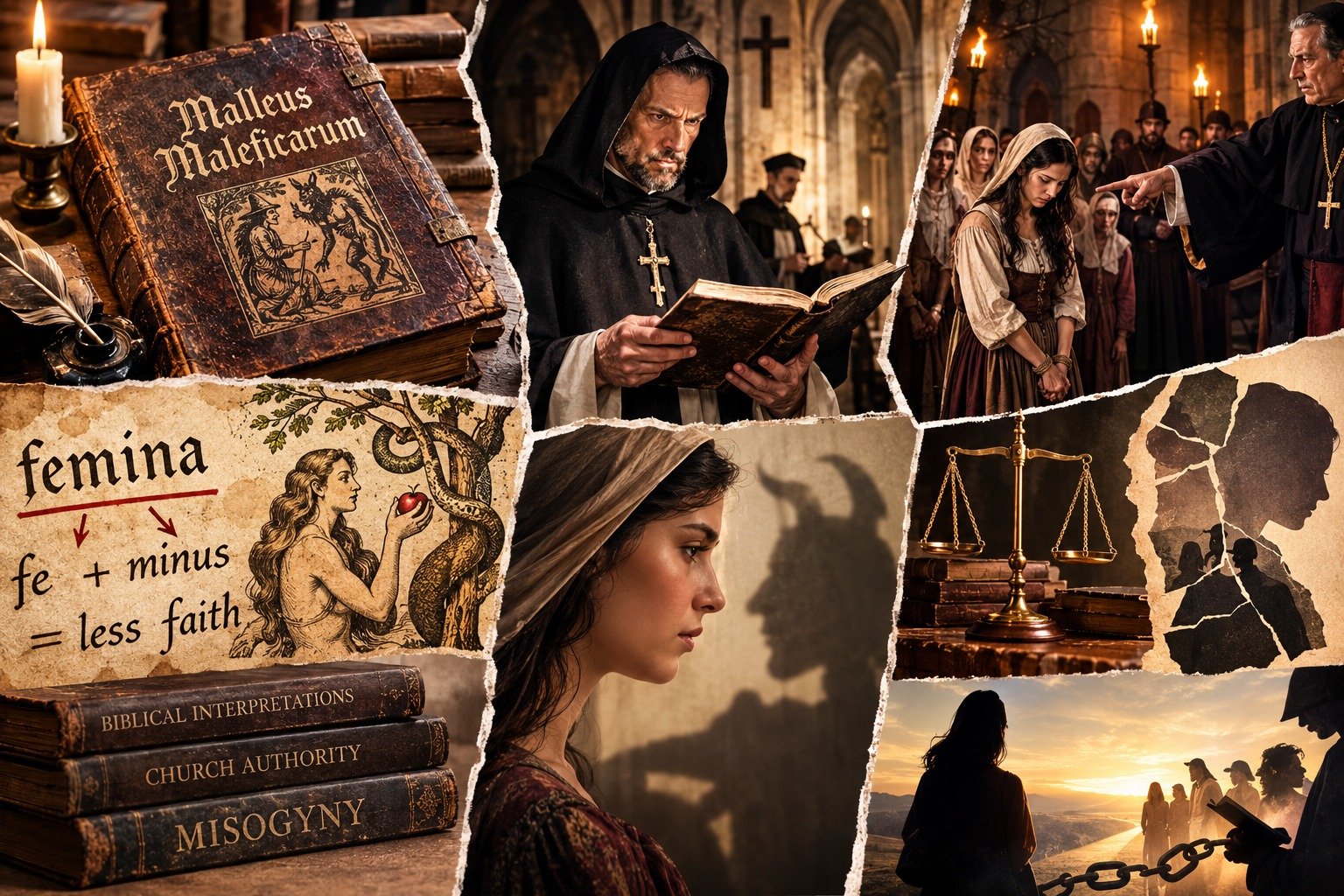
In 1486–1487, a work appeared in Europe that would become one of the most notorious texts associated with the persecution of alleged witches. Its title was “Malleus Maleficarum” or “The Hammer of Witches”. Written by the Dominican inquisitor Heinrich Kramer and traditionally associated with Jacob Sprenger, the treatise attempted to establish the reality of witchcraft, explain why women were supposedly particularly susceptible to it, and provide arguments for the prosecution of suspected witches. Its most disturbing feature was not its belief in the supernatural alone. It was the extraordinary confidence with which its author transformed misogynistic prejudice into something resembling theological knowledge.[1]
Kramer’s argument was brutal in its simplicity: women were supposedly weaker in mind and body, less steadfast in faith, more susceptible to temptation and consequently more likely to become instruments of the Devil. These conclusions were dressed in the robes of scholarship, reinforced by biblical interpretations and inherited authorities, and presented as explanations of human nature.
The historical significance of the “Malleus Maleficarum” lies in this transformation. It illustrates how an assumption about a group can become more dangerous when an institution grants it the authority of sacred truth.
I. When Misogyny Masqueraded as Knowledge
The sixth question of the “Malleus Maleficarum” asks why women are supposedly more inclined towards evil superstitions than men. Kramer’s answer draws upon familiar misogynistic traditions: women are represented as intellectually deficient, emotionally unstable, sexually excessive and more easily deceived. He writes that women are supposedly “feebler both in mind and body,” using that assertion to explain their alleged susceptibility to witchcraft.[2]
The logic is revealing. Rather than establish that women possessed any special capacity for witchcraft, Kramer begins with a stereotype and uses it to explain the supposed prevalence of female witches. The accusation and the explanation reinforce one another. Women are considered more likely to be witches because they are supposedly weak; the supposed abundance of female witches is then offered as confirmation of their weakness.
Such reasoning is circular, but circular reasoning can become formidable when protected from criticism by institutional authority. The premise is accepted before the evidence is examined, and every subsequent observation is interpreted to support the original belief.
Kramer did not invent all these prejudices. As historian Michael Bailey and other scholars of medieval witchcraft have demonstrated, the demonological tradition drew upon earlier religious and intellectual writing. Research on the “Malleus” specifically identifies the influence of Antoninus of Florence on its notorious account of women’s supposed defects.[3] Misogyny, in other words, was inherited and reproduced through established authorities. Kramer’s contribution was to incorporate such material into an influential treatise devoted to witchcraft and its prosecution.
This is precisely why the text deserves serious historical scrutiny. Its author did not merely express hostility towards women. He assembled inherited prejudices into a framework that could make the suspicion of women appear rational, religiously justified and socially necessary.
II. The Latin Word That Became an Indictment
Perhaps the most revealing example of this method is Kramer’s treatment of the Latin word “femina”, meaning “woman.”
In his discussion, he proposes a supposed derivation involving “fe” and “minus”, interpreting the word as an indication that women possess “less faith.” He then invokes Eve’s encounter with the serpent in Genesis to argue that women are naturally more inclined to doubt divine authority and consequently more likely to abandon the faith. From there, he constructs a supposed connection between female nature, religious infidelity and witchcraft.[4]
The linguistic claim is false. “Femina” does not genuinely derive from a combination of words meaning “less faith.” Kramer’s argument is an example of fanciful medieval etymology: a word is divided and interpreted in a way that supports a conclusion already desired by its author.
There is an additional complication that makes the episode historically more interesting. The wordplay was not necessarily Kramer’s original invention. Scholarship has traced it to Antoninus of Florence’s earlier “Summa theologica”, where a similar explanation appears in a discussion of women’s supposed vices. Kramer reproduced this material without adequately acknowledging its source.[3]
The distinction matters. The point is not that one man invented an entire tradition of religious misogyny. Rather, a dubious argument circulated through an intellectual culture in which inherited authority could make a false proposition appear credible.
Consider what happened to language in this instance. A Latin word became an accusation. An invented etymology became supposed evidence of an entire sex’s spiritual deficiency. A story about Eve became a theory of female psychology. That theory, in turn, helped support the proposition that women were especially vulnerable to demonic influence.
No linguistic evidence established this conclusion. The wordplay merely provided the appearance of proof.
The episode offers a wider lesson about intellectual honesty: an argument does not become true because it appears in an old book, invokes a respected authority or employs the language of scholarship. Claims must be examined on their merits, especially when they are used to justify the unequal treatment of human beings.
III. From Theological Suspicion to Human Suffering
The “Malleus Maleficarum” did not invent witchcraft accusations, nor did it single-handedly cause the European witch hunts. Beliefs about harmful magic existed long before its publication, and witchcraft prosecutions varied considerably across time and place. The most intense waves of European witch trials occurred primarily during the sixteenth and seventeenth centuries, under different combinations of religious, political, judicial and social pressures.[5]
Nevertheless, the “Malleus” became an influential contribution to the literature that explained witchcraft and argued for its prosecution. It helped reinforce a worldview in which alleged supernatural crimes could be understood through assumptions about gender, sexuality and religious obedience.
The consequences of such thinking becomes clear when we examine the structure of an accusation. A misfortune occurs; a neighbour is suspected; inherited beliefs supply an explanation; and an authority interprets ambiguous circumstances through an existing theory of guilt. In such an environment, evidence can become secondary to expectation.
Women were particularly vulnerable in many European regions because cultural assumptions about female weakness, sexuality and religious susceptibility shaped the stereotype of the witch. Across much of continental Europe and the British Isles, women constituted the majority of those prosecuted for witchcraft, although the proportions differed by region and men were also accused and executed.[6]
It would be simplistic to explain every trial as a direct attack on women or to attribute every prosecution to religious doctrine. Local disputes, economic tensions, judicial institutions and political circumstances also mattered. Yet it would be equally misleading to ignore the role of religious demonology in making gendered suspicions appear legitimate.
The deeper problem was a system of interpretation in which certain women could be viewed as dangerous before any credible wrongdoing had been established. Their alleged weakness became a reason to distrust them, and their supposed capacity for evil became a reason to investigate them. The framework was capable of turning social prejudice into a justification for coercion.
IV. The Female Body and the Policing of Morality
The misogyny of the “Malleus” was also inseparable from its preoccupation with female sexuality. Kramer repeatedly associates women with carnal desire, temptation and moral instability. His discussion of witchcraft is not simply an account of supernatural fears; it is also an attempt to explain and regulate the supposed dangers of female sexuality.[7]
This matters because the policing of women’s bodies has frequently been justified through claims about morality. Women’s clothing, sexual conduct, reproductive choices and public behaviour have been treated as measures of communal honour or religious obedience. Such judgments are not identical to the accusations of medieval witchcraft, and historical differences must be respected. But they reveal a recurring question: why are women so often made responsible for preserving moral order while being denied equal authority to define it?
The answer cannot be reduced to religion alone. Patriarchal arrangements can survive in religious and secular societies alike. Yet religious arguments can become especially powerful when they portray a particular social hierarchy as divinely ordained rather than historically constructed.
Once a social rule is presented as the command of an unquestionable authority, challenging it may be treated not merely as disagreement but as moral rebellion. Women who resist their assigned roles can consequently be portrayed as threats to a larger order.
The lesson of the “Malleus” is not that every believer shares Kramer’s hostility. It is that claims about divine authority can be used to protect assumptions that would otherwise collapse under critical examination.
V. The Problem of Unquestionable Belief
The “Malleus Maleficarum” remains a powerful example of how theological reasoning can be recruited to legitimise harmful assumptions.
The essential question is not whether every believer would endorse Kramer’s conclusions. It is how those conclusions could be presented as authoritative, and what happens when the people affected by them lack the power to challenge the authority behind them.
No claim should be exempt from scrutiny merely because it is described as sacred. No interpretation should become immune to criticism simply because it has been repeated for centuries. And no human being should be regarded as inherently inferior because an institution declares that inferiority to be part of the natural or divine order.
This principle extends beyond religion. Political ideologies, racial hierarchies and authoritarian systems can also transform inherited prejudices into unquestionable truths. Whenever a doctrine begins by classifying a group as naturally dangerous, inferior or morally suspect, discrimination can be presented as protection and cruelty as duty.
The safeguard is not a rival dogma. It is the insistence that claims remain open to evidence, criticism and revision, and that the rights of individuals do not depend upon their conformity to religious or ideological expectations.
VI. The Women Behind the Accusations
The history of witch persecution is often narrated through theologians, inquisitors, legal codes and spectacular descriptions of trials. But behind those records were human beings whose lives could be destroyed by accusations they had little chance of defeating.
The surviving evidence cannot reconstruct the experiences of every accused woman, and it would be wrong to assume that every case followed the same pattern. What can be said is that witchcraft prosecutions exposed people to imprisonment, coercion, torture and execution, and that women formed the majority of the accused in many regions.
They were not merely illustrations in a theological argument. They were individuals with families, relationships, fears and ambitions. The theories that classified women as especially susceptible to evil made it easier for their persecutors to treat them as embodiments of a supposed threat rather than as human beings entitled to justice.
Their history forces us to confront an uncomfortable truth: a society can describe itself as morally righteous while inflicting terrible injustice upon people who lack the power to defend themselves.
VII. A Verdict on the Hammer
The “Malleus Maleficarum” belongs to a particular historical world, but its method of reasoning remains recognisable. It begins with a prejudice, recruits authoritative texts to support it, interprets uncertain circumstances through that prejudice, and presents the resulting conclusions as grounds for punishment.
Its false etymology of “femina” captures the method in miniature. A word is manipulated to suggest that women possess an inherent spiritual defect. The supposed defect is then used to explain their alleged susceptibility to witchcraft. An assertion masquerades as evidence, and the evidence is used to justify an accusation.
The most important lesson is therefore not simply that people in the past could be cruel. It is that cruelty becomes particularly dangerous when it acquires the vocabulary of scholarship, the prestige of religious authority and the protection of institutions.
A society demonstrates its moral seriousness not by how fiercely it defends its sacred beliefs, but by whether it permits those beliefs to be questioned when human beings suffer in their name.
The women condemned by the logic of the witch hunts deserved something more than the certainty of their persecutors. They deserved evidence, justice and recognition of their humanity.
No book, priest, theologian or institution should possess the authority to make that humanity conditional.
The Hammer of Witches is a reminder of what happens when prejudice is taken for truth and authority is permitted to silence doubt. Its historical warning remains clear: “whenever a belief system makes human dignity subordinate to unquestionable doctrine, the people most vulnerable to its power are the ones who have the most to lose.”
Footnotes:
-
Heinrich Kramer, Malleus Maleficarum, trans. Montague Summers (London: John Rodker, 1928), pt. 1, question 6; see also the historical discussion in [“‘Where There Are Many Women There Are Many Witches’: The Social and Intellectual Understanding of Femininity in the Malleus Maleficarum (1486),” Reinvention: An International Journal of Undergraduate Research](https://warwick.ac.uk/fac/cross_fac/iatl/research/reinvention/archive/volume6issue1/oleary/).
-
Kramer, Malleus Maleficarum, pt. 1, question 6. The English translation of the passage is available in “Question VI,” Internet Sacred Text Archive, [https://sacred-texts.com/book/malleus-maleficarum/shell/question-vi](https://sacred-texts.com/book/malleus-maleficarum/shell/question-vi).
-
“‘Where There Are Many Women There Are Many Witches.’” The study discusses Kramer’s use of material from Antoninus of Florence, including the femina wordplay, and traces several of the text’s misogynistic claims to earlier sources.
-
Kramer, Malleus Maleficarum, pt. 1, question 6. For the Latin passage and the corresponding English translation, see the Internet Sacred Text Archive, [https://sacred-texts.com/book/malleus-maleficarum/shell/question-vi](https://sacred-texts.com/book/malleus-maleficarum/shell/question-vi).
-
Hans Peter Broedel, The Malleus Maleficarum and the Construction of Witchcraft: Theology and Popular Belief (Manchester: Manchester University Press, 2003). See also Broedel’s chapter “Witchcraft as an Expression of Female Sexuality.”
-
Broedel, The Malleus Maleficarum and the Construction of Witchcraft. Estimates of the proportion of women among those prosecuted vary by geographical region and historical period; the predominance of women in many European witch trials is well established, but men were also prosecuted.
-
Broedel, “Witchcraft as an Expression of Female Sexuality.” The chapter examines how the Malleus connected its conception of witchcraft to anxieties about female sexuality and social disorder.
Comments are closed.