

Tamanna Hazarika
During the medieval period, many Muslim scholars studied astronomy, made instruments like astrolabes, and wrote books on astronomy. Most of this work happened during the Islamic Golden Age (roughly the 9th to 13th centuries), but some important figures lived later, when political power had changed but learning still continued.
During the medieval period, many Muslim scholars studied astronomy, made instruments like astrolabes, and wrote books on astronomy. Most of this work happened during the Islamic Golden Age (roughly the 9th to 13th centuries), but some important figures lived later, when political power had changed but learning still continued.
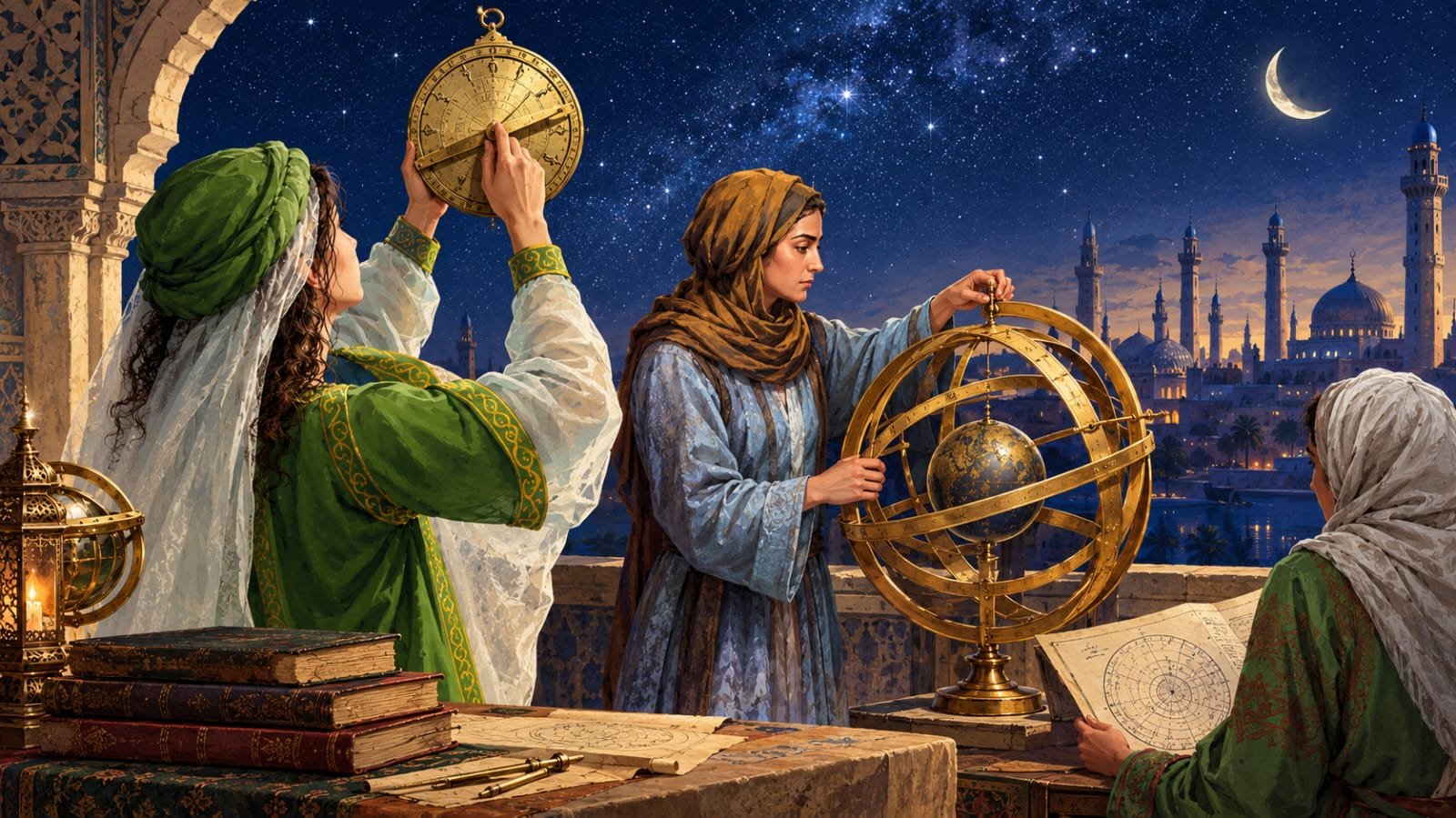
This article looks at four Muslim women connected with astronomy; Mariam al-Asṭurlābiyya (10th century), Fátima de Madrid (said to be 10th–11th century), Rayhana bint al-Hasan (early 11th century), and Dahma bint Yahya (died 1434). Only the first three belong to the classic Golden Age, Dahma lived much later, in the 15th century.
Mariam al-Asṭurlābiyya:
Al-ʻIjliyyah bint al-ʻIjliyy was a 10th-century astrolabe maker from Aleppo, in what is now northern Syria. She is also sometimes called Mariam al-Asṭurlābiyya in modern writing. According to Ibn al-Nadim, Mariam al-Asṭurlābiyya was the daughter of another astrolabe maker, al-ʻIjliyy, and both of them learned their craft from a Baghdad astrolabe maker named Nasṭūlus.
She made astrolabes in the 10th century and worked for Sayf al-Dawla, the first emir of Aleppo, who ruled from 944 to 967. That is almost all that is known about her. The name “Mariam” is probably not historical, and “al-Asturlabiyy” just means “the astrolabe maker,” not a personal name.
Fátima de Madrid:
Fátima de Madrid is the name given to a supposed Muslim astronomer and mathematician who is said to have lived in Islamic Spain around the late 900s and early 1000s. People claim she was the daughter of the well-known astronomer Maslama al-Majriti and that she worked with him on several mathematical and astronomical writings. Her best-known attributed work is called the “Corrections from Fátima,” but no copy has been found. She is also said to have co-written a short guide about using the astrolabe with her father; that manuscript is allegedly in the El Escorial library.
According to the stories, Fátima helped change al-Khwarizmi’s tables from a Persian solar calendar to the Islamic lunar calendar, adjusted them for Córdoba’s location and meridian, translated dates between Persian and Arabic systems, and recalculated planetary positions for the year of the Hijra. She is also credited with correcting errors in Ptolemy’s Almagest and writing several astronomical handbooks about calendars, planetary tables, and eclipses.
Reports say she knew several languages, including Arabic, Spanish, Hebrew, Greek, and Latin. However, historians doubt whether she was a real historical person; the first known mention of her appears only in the 1924 Enciclopedia Espasa-Calpe.
Rayhana bint al-Hasan:
Rayhana bint al-Hasan was as a medieval woman connected with astronomy. Al-Biruni dedicated an important scientific work to her. Her name appears in history but very little, so she remains a mysterious figure. She is usually described as the daughter of al-Hasan of Khwarazm.
She seems to have lived in the early 11th century in the Persianate world, in the land of Khwarazm. Rayhana’s main historical importance comes from her mention in al-Biruni’s famous treatise, the Kitab al-Tafhim — a book that deals with astronomy and astrology.
Dahma bint Yahya:
Dahma bint Yahya (died 1434) was a Yemeni scholar and poet known for her wide knowledge in grammar, Islamic law, philosophy, chemistry and astronomy. She was the daughter of the scholar Yaḥyā Ibn al-Murtaḍā and the sister of Imam al‑Mahdī Aḥmad ibn Yaḥyā. After studying with her brother, she became a writer and taught at schools.
Her known works include Sharh al-Azhar (4 volumes), Sharh al-Manzuma, al-Kufi, and Sharh Mukhtasar al-Muntaha. She died in 837 A.H., which corresponds to 1434 A.D.
The role of women in medieval Islamic astronomy was real but limited. These four women show that interest in astronomy among Muslim scholars lasted beyond the Golden Age.
Comments are closed.