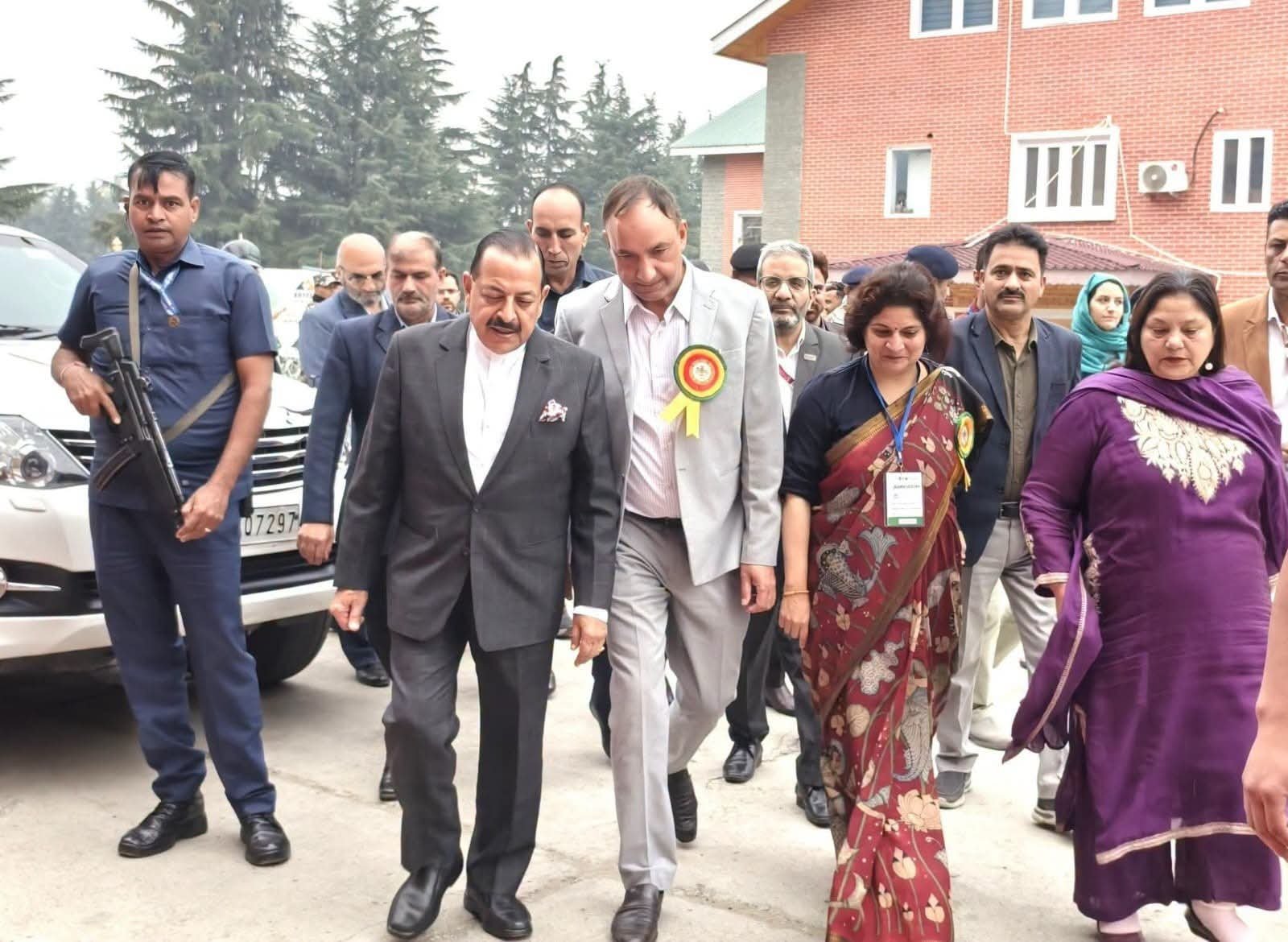
Srinagar, October 13: The seeds of what is now called the ‘Purple Revolution’ were first sown in Jammu and Kashmir, and the Aroma Mission that began in the Valley is now being replicated far beyond it, Union Minister Dr Jitendra Singh said Tuesday at the Sustainable Mountain Development Summit at SKUAST-K.
“Today Jammu and Kashmir’s identity has been made throughout India by the birthplace of the Purple Revolution,” Dr Singh said on the sidelines of the 13th edition of the summit.
Lavender, once a crop associated with European perfumeries, is now being cultivated in Himachal Pradesh, Uttarakhand, and as far away as Nagaland and Mizoram. According to the Minister, the expansion has translated into employment for about 7,000 to 8,000 young people, many of whom, he said, now earn a “very good income”.
Dr Singh’s pitch was deliberately practical. For those interested in the technology, he said, “the entire funding comes from the government, even the market linkage is of the government.” He sought to dismantle what he described as a misconception that such ventures require advanced academic credentials. “All of it, this technology will be provided to you by the government,” he said, adding that with “full confidence and hand-holding,” the mission has produced “three to four examples” in Jammu and Kashmir of young people who quit corporate jobs in Bengaluru and other cities to return and join the work.
The Minister’s remarks come against the backdrop of a broader push to position J&K as a hub for Himalayan research. He noted that India’s first capacity-building programme in glaciology had been initiated from the University of Kashmir, with the Wadia Institute of Himalayan Geology in Dehradun beginning work in three locations—Sikkim, Tezpur in the North-East, and Kashmir.
But Dr Jitendra Singh also struck a cautionary note, invoking the region’s vulnerability to extreme weather. “The beauty of the Himalayas, whether it is the beauty of the springs, or the beauty of Sindh, Jhelum and Chenab, that same beauty sometimes becomes heavy by taking the form of flash floods or by taking the form of a flood,” he said, recalling the 2014 deluge that drowned Srinagar and last year’s cloudburst in Kishtwar.
In response, he said, the government has installed a series of automatic weather stations from Leh and Ladakh to Kishtwar, with additional stations added after the Kishtwar incident. Radar stations, he noted, have increased from 17 before 2014 to 50 today, with 50 more planned under Mission Mausam, announced by Prime Minister Narendra Modi.
For now, though, it is the lavender fields that have captured the imagination—a crop that has turned a Himalayan disadvantage into an economic opportunity, and one that Singh was keen to present as proof that the region’s future need not be defined solely by its geography.


Comments are closed.