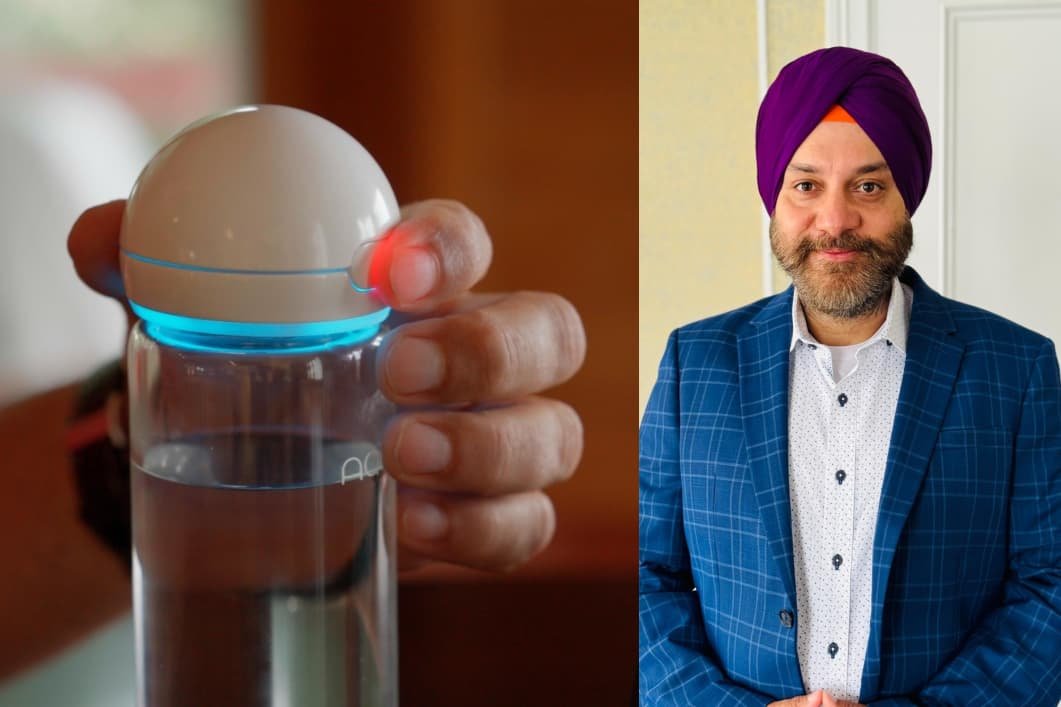
Srinagar, Oct 13: A young innovator from Tangmarg in North Kashmir has developed what is being described as the world’s first intelligent water bottle a device that does not merely count how much water you drink, but measures how hydrated your body actually is.
Gurbinder Singh Bali, now based in the United States, has built the device under his company Denver Life Sciences. Named ‘Akor: The Intelligent Water Bottle,’ it is being launched globally this week on the crowdfunding platform Kickstarter.
Existing smart bottles in the market either log daily water intake or buzz at fixed intervals to remind users to drink. Akor, Bali claims while speaking to Kashmir Convener breaks from both approaches. Sensors and algorithms embedded in the bottle analyse the user’s internal biological state and indicate how hydrated the body actually is—and when it biologically needs water.
The technology, according to Bali, works on the principle of a pulse oximeter. Just as a pulse oximeter shines light through blood vessels to read oxygen levels, Akor uses optical sensing to estimate hydration. While doing so, it also tracks blood pressure, blood oxygen and heart rate.
Bali said the human body is roughly 60 per cent water, but this remains invisible to most people. By the time normal thirst sets in, he said, the body is already dehydrated. In medical literature, dehydration is linked to headaches, migraines, fatigue, joint pain, muscle cramps, urinary tract infections, premature ageing of the skin and renal stress.
Citing data from the United States, he said nearly 55,000 people land in hospital emergency rooms every month simply because their bodies have become severely depleted of water without their realising it. The absence of an easy way to measure hydration, he said, was the gap he set out to fill.
Bali said he was surprised that neither medical device companies nor consumer tech giants such as Apple and Samsung had worked in this direction. Recalling a lesson from a teacher—that until a task is completed it seems impossible—he said the ‘hydration engine’ has so far been put through about 1,200 hours of human testing and an analysis of 350 million pulse data points, with further testing continuing.
The device, he said, is aimed at athletes, sports professionals, corporate employees in high-stress environments and ordinary citizens—positioning it within preventive healthcare, or catching a problem before it becomes one.


Comments are closed.