

Laiba Khan
Rather than relying on its reputation, Kashmir will have to be efficient regarding productivity, grading, storage and processing of apples, branding, logistics and access to market. Ultimately, apples are approved by foreign consumers when it comes to their quality but they do not earn much money for Kashmir.
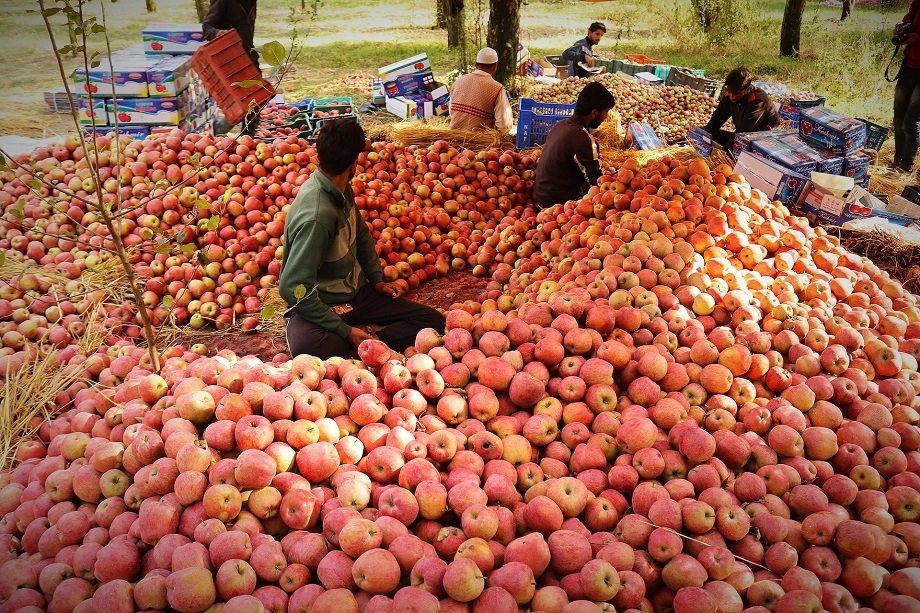
In Kashmir, the apple is more than a fruit. It is a livelihood, a business, a source of employment and, for thousands of families, the economic foundation of an entire household. From the orchard to the mandi, the apple economy sustains nursery growers, farm workers, packers, transporters, traders, cold-storage operators and retailers. Its significance extends far beyond the boundaries of an orchard.
Jammu and Kashmir’s horticulture sector generates approximately ₹10,000 crore annually and supports around 35 lakh people directly and indirectly, according to the J&K Economic Survey 2024–25 this sector extends its support to nearly seven lakh families. Apple is considered the key crop in this sector, which is interlinked with the overall economy of rural Kashmir.
There is ample evidence of this fact in the volume of production itself. The scale of production illustrates the point. Government-linked agricultural data places J&K’s apple production at around 2.1 million tonnes in 2024–25, making it India’s largest apple-producing region.. The highest apple production is in Shopian, Baramulla, Anantnag, Pulwama, Kulgam and Kupwara districts where the state of the orchard determines the financial situation of an entire family.
Nevertheless, the real economic importance of Kashmir apples lies not only in the amount of apples produced, but also in what happens after the harvest.
Growers have always worked within a tight window of time for harvesting. Lack of proper grading, storing, and marketing would sometimes compel farmers to hurry into selling their produce amidst an abundance of apples in the market. As a result, good quality apples would sometimes be sold at prices that didn’t fully reflect their quality. The perishable nature of apples made time the greatest enemy of the farmer.
This is now changing. Under the HADP programme, the apple industry is being treated in its totality as a value chain and not just farming. Under Project 21, which seeks to produce “designer plants” for dense planting and orchard revitalization, there have been over 10,000 applications for funding, with 4,500 approved and over 1,500 units already established after the programme has only been running for two years.
High-density orchards should be another focus area. With the use of modern rootstocks and improved planting and orchard designs, the yield per acre of land could be increased with some reduction in the constraints of conventional plantations. There has also been an increased number of distribution of high-density plantation recorded in the J&K Economic Survey, rising from 6.41 lakh trees in 2021-22 to 32.49 lakh trees in 2023-24.
Post-harvest management will be the next stage. A large amount of apples from Kashmir do not meet the criteria for inclusion in the premium fresh fruits market. This doesn’t mean that these apples should go to waste. These can be used for making juices, concentrates, ciders, and other processed foods. Thus, increasing capacity of the processing sector will create a secondary economy around apples.
Transport and storage are equally important with Controlled-atmosphere storage allowing farmers to stock their crops and not to sell them using the current prices. Another aspect has been the introduction of the train network in India as in September 2025 Indian Railways introduced parcel services managing transportation of apples from Kashmir Valley towards the city of Delhi providing initially with two coaches required for the service and adding more according to demand. On the year-end in 2025 it was reported that over 20,000 tonnes of apples have been transported from Kashmir over the railways.Technology has also started changing the relationship between farmers and market. Information systems giving access to harvesting, storage and marketing information for farmers could lead to more accurate management decisions.
But Kashmir’s apple economy now faces a larger question: can it remain competitive in an increasingly open market?
India removed the additional 20 per cent retaliatory duty imposed on US apples in 2023, although the 50 per cent MFN duty remained in place, alongside a minimum import price of ₹50 per kilogram for apples from most countries. Current India-US trade negotiations have again placed agricultural market access under scrutiny, although no final arrangement should be assumed at present. The issue facing Kashmir doesn’t merely lie with the fact that foreign actors present the economy with a challenge. The problem is that inefficiency has become more costly than ever before.
In order for farmers to compete with efficient foreign producers, the whole production process will need to change. Rather than relying on its reputation, Kashmir will have to be efficient regarding productivity, grading, storage and processing of apples, branding, logistics and access to market. Ultimately, apples are approved by foreign consumers when it comes to their quality but they do not earn much money for Kashmir.
Comments are closed.