Srinagar, Oct 12: For decades, the apple growers of Kashmir raced against time every harvest — loading their produce onto trucks that crawled down weather-beaten highways, often stalled by landslides, snow or the unpredictability of the Pir Panjal. This season, the journey is being measured differently — in hours saved, and in mandis newly reached.
The completion of the Udhampur-Srinagar-Baramulla Rail Link (USBRL) has opened a faster, cheaper and — crucially — all-weather route for the Valley’s signature horticultural produce. Apples from Kashmir are now reaching Delhi in 20-22 hours by rail, against 30-35 hours by road, railway officials said on Monday. Cherries, the more perishable of the two, are reaching Mumbai in 30-32 hours, down from 46-47 hours.
The rail link has provided an opportunity to transport these products to other parts of the country faster and at a lower cost, Vineet Abhishek, Western Railway Chief Public Relations Officer, said. Kashmir Valley is a horticultural hotspot, but transporting perishable produce had been difficult.
Since September 2025, more than 20,000 tonnes of apples have been transported out of Kashmir by rail, according to railway officials — a figure that signals how quickly the new corridor is being adopted.
For apple growers, the problem was never the fruit. It was the road.
Kashmir produces nearly 20 lakh metric tonnes of apples annually, accounting for roughly 75 per cent of the country’s apple output and contributing over ₹8,000 crore to the region’s economy. Horticulture supports nearly 33 lakh people in Jammu and Kashmir, directly or indirectly, with apples alone covering about 1.62 lakh hectares.
Yet for years, growers in Sopore, Shopian, Anantnag and Kupwara bore losses that had little to do with the quality of their produce and everything to do with connectivity. The Jammu-Srinagar National Highway — the Valley’s only all-weather surface link — was prone to frequent closures. Landslides at Panthyal, Ramban and Digdol, shooting stones in the Nashri-Banihal belt, and heavy snowfall in the Jawahar Tunnel area routinely shut the road for days, sometimes weeks, between December and March.
The numbers tell the story. In 2019, the highway remained closed for over 60 days cumulatively. In 2020, the figure crossed 90 days. In 2022, repeated closures between January and April alone held up thousands of trucks carrying apples, causing losses running into hundreds of crores.
The highway was our biggest enemy. Every year, we would lose a part of our harvest to the road — either to a landslide or to a shutdown. We had no choice but to accept whatever the trader offered,” said Bashir Ahmad Dar, a grower from Sopore in north Kashmir.
Traders in Delhi’s Azadpur mandi — Asia’s largest fruit market — often reported that Kashmiri apples arrived bruised, overripe or rotting, forcing distress sales. Even if the truck reached Delhi, the fruit would have lost its shine. The trader would open the box, look at it, and quote a price that barely covered our costs. What could we do? We had to sell, Dar said.
The pain was compounded by geography. The 111-km Katra-Banihal stretch — the last missing link in the USBRL — was among the most difficult railway projects undertaken anywhere in the world, cutting through the young, unstable geology of the Himalayas. For years, work on the section was delayed by tunnel collapses, water ingress and the sheer challenge of building in Seismic Zone V.
Because of this missing link, the Kashmir Valley was not connected to the rest of our country. Trains ran only up to Katra on the Jammu side and up to Banihal on the Srinagar side. Passenger and freight movement depended almost entirely on roads, Abhishek said.
The turning point was the completion of the 111-km Katra-Banihal section, including the final 63-km Katra-Sangaldan stretch, which overcame the barrier posed by the Pir Panjal range. Prime Minister Narendra Modi inaugurated the project on June 6, 2025, completing the rail connection between the Valley and the national network.
The 111-km Katra-Banihal section was the missing link. Because of this missing link, the Kashmir Valley was not connected to the rest of our country. By completing this project, full connectivity has now been established, Abhishek said.
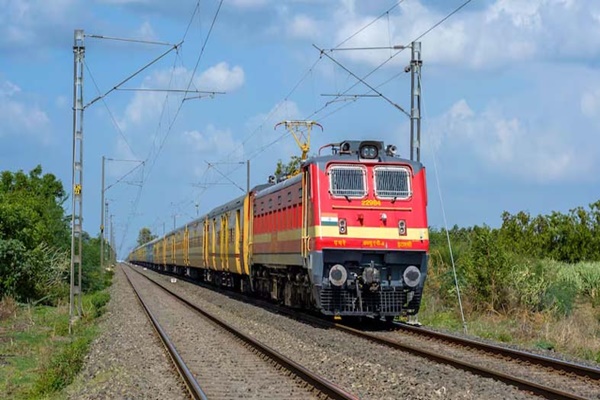
At least six goods trains — three in each direction — are now operating daily, besides two pairs of Vande Bharat trains between Jammu and Srinagar and DEMU services between Srinagar and Katra. The Valley received its first freight train on August 9 last year, carrying cement to the newly commissioned Anantnag Goods Shed.
Since then, industrial salt, automobiles, cement, foodgrains and petroleum products have begun arriving by rail, reducing dependence on road transport. More than 1.5 lakh tonnes of cement have been transported to the Valley.
This is not just about apples. It is about a whole economy getting a lifeline. Industrial salt, cement, foodgrains, petroleum products — everything is now moving by rail. The Valley’s dependence on a single highway is finally ending, Abhishek said.
The two-way flow is expected to expand markets for apples, cherries, apricots, vegetables and handicrafts, while supporting commercial and industrial activity in the Valley. Officials said the rail link would boost trade, tourism, agriculture, industry and logistics by providing a reliable transport alternative, particularly in winter.
Earlier, we could only dream of sending our fruit to Mumbai or Kolkata. Now, the railways have made it possible. The apple of Kashmir can reach every corner of the country,” said Ghulam Hassan Rather, a fruit trader based in Srinagar’s Parimpora mandi.
The corridor’s most visible symbol is the Chenab Rail Bridge in Reasi district — 359 metres above the riverbed, 1,315 metres long, with a designed service life of 120 years and built to support train operations at speeds of up to 100 kmph.
The bridge has a designed service life of 120 years and is built to support train operations at speeds of up to 100 kmph, Konkan Railway Senior Engineer Supreet Singh Rana told visiting media personnel.
Located in Seismic Zone V, the bridge has been designed to withstand wind speeds of up to 266 kmph, with a blast-resistant design certified to withstand a blast equivalent to 40 kg of TNT. The Anji Khad Bridge, India’s first cable-stayed railway bridge, is 725 metres long, stands about 331 metres above the riverbed, and was built at a cost of around ₹580 crore, with 96 cables and 189 instruments for structural health monitoring.
The Chenab and Anji bridges are among the most spectacular railway engineering achievements in India. But their significance goes beyond their extraordinary height, scale and technology, Abhishek said. They represent the resolve to connect a region that had waited for decades.”
The maximum speed of Vande Bharat Express trains between Srinagar and Jammu has recently been raised to 100 kmph from 70 kmph, officials added.
For growers like Dar, the change is already visible. Now the train leaves with our fruit and reaches Delhi the next day. We are no longer at the mercy of the highway. For the first time, we are thinking about Mumbai, Kolkata, even Guwahati — not just about whether the truck will make it out of the Valley, he said.
Rather, the trader, said the railways had also brought a measure of dignity to the trade. We used to beg truck operators to take our consignments. Now we book a train and know exactly when it will reach. The uncertainty is gone. The rates are better. The fruit reaches fresh. This is what we had been demanding for 30 years, he said.
Officials said the corridor is expected to handle a growing share of the Valley’s horticultural exports in the coming years. With the apple harvest peaking between August and November, the railways are looking at running additional special freight services to clear the rush.
The response from growers and traders has been overwhelming. We are prepared to scale up operations as demand increases. This is just the beginning, Abhishek said.
For a region where the apple is not just a fruit but a way of life, the sound of a freight train leaving the Valley may well be the sound of a new beginning.


Comments are closed.