
Saffron wilts in Kashmir, takes root in Ladakh’s cold desert
In Leh, 90,000 Iranian corms planted on land that was barren three months ago

Suhail Khan
Srinagar, Oct 03: A stretch of land in Leh, barren till three months ago, is set to grow some of the world’s finest saffron for the first time in Ladakh a pilot unfolding even as Kashmir, which produces nearly 90 per cent of India’s saffron, watches its famed Pampore fields slide towards what growers call an existential crisis.
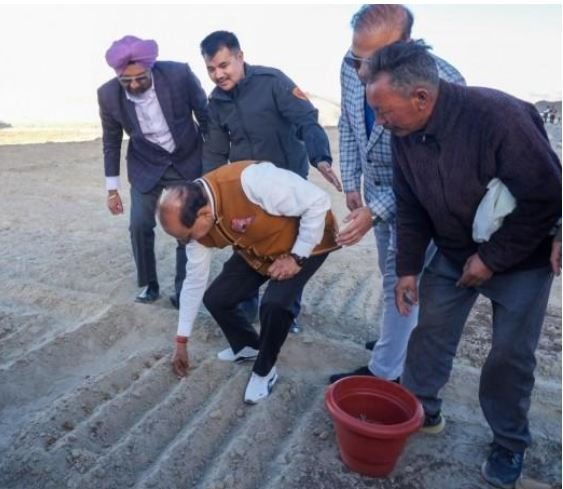
Nearly 800 kg of premium Iranian saffron corms 90,000 pieces have been planted over 4,000 square metres at Command Area Gate No. 27, Spituk Pharka in Leh, under Project Him Sarovar, guided by Lieutenant Governor Vinai Kumar Saxena. The corms were selected to exacting specifications — 8 to 10 cm in circumference, 2.5 to 3 cm or larger in diameter, and 10 grams or more in weight — the grade considered best suited for high-quality saffron.
An official familiar with the project told Kashmir Convener that the site was barren until three months ago. It was restored by channelling unutilised water from the recently operationalised Igoo–Phey irrigation canal to raise soil moisture. Four water ponds under Project Him Sarovar, with a combined storage capacity of around 24 million litres, stand adjacent to the fields.
In Kashmir, a harvest in free fall
The contrast with Kashmir could not be sharper. In Pampore — the “Saffron Bowl of Kashmir” growers this season report a production collapse of up to 90 per cent.
The corms haven’t sprouted properly at all, said Abdul Majeed Wani, president of the Saffron Growers Association J&K. Production was hardly 15 per cent. It isn’t even half of last year’s crop, which itself was only about 30 per cent of normal.
The decline is neither sudden nor accidental. The area under saffron cultivation has shrunk from 5,707 hectares in 1996–97 to 2,387 hectares by 2019–20 — a 65 per cent reduction in under three decades.
Speaking to Kashmir Convener, several farmers affiliated with the saffron trade in south Kashmir’s Pampore said the reasons are layered. Prolonged dry spells and declining snowfall have left the saffron belt moisture-starved. Under the National Saffron Mission, sprinkler systems and bore-wells were installed but a government committee found 77 bore-wells non-functional for long periods, leaving fields without dependable water. Repeated cycles of poor field management and illegal corm extraction have weakened the seed stock itself. And with yields falling and costs rising, younger growers are abandoning saffron for horticulture and construction work, they said.
Growers put it starkly, “Saffron is more than a crop for Pampore it’s our heritage, our livelihood, our identity. If urgent steps aren’t taken, there may be no saffron left here by 2030.”
The Leh pilot builds on the Administration’s earlier success with high-value floriculture — the mass cultivation of Lilium and Gladiolus in Leh — which has already opened new livelihood avenues for farmers, Self-Help Groups and local entrepreneurs. It draws directly on Prime Minister Narendra Modi’s vision of diversifying traditional agriculture for financial sustainability and economic empowerment.
L-G Saxena on Friday said the plantation has immense potential to strengthen the local economy by introducing another high-value crop under Ladakh’s unique high-altitude agro-climatic conditions — and to “bust the myth that saffron cannot be grown in Ladakh and that barren or degraded land cannot be restored.”
“Our endeavour is to transform degraded and barren land into productive assets and create new opportunities for our farmers,” he said. “The introduction of saffron is another important experiment in crop diversification, which can open a new avenue for enhancing farmers’ incomes through a premium-value crop.”
The logic is straightforward. Saffron is a high-value crop with strong market demand and commands a premium price. Jammu and Kashmir, despite its troubles, still accounts for roughly 90 per cent of national production — meaning even a modest success in Ladakh would diversify India’s saffron supply for the first time. The pilot is explicitly designed to test whether the region’s cold, arid, high-altitude conditions can support the crop at scale.
For Kashmir, Leh’s experiment is both a warning and a mirror. A crop that has defined Pampore’s identity for centuries is being kept alive on life support, even as a region with no saffron history plants 90,000 corms on land that was dust three months ago.
For Ladakh, the saffron pilot is the latest step in a broader agricultural reinvention — flowers, now spice — that treats barren land as an asset and water as the key that unlocks it. Whether the corms flower into a viable industry will be known in the seasons ahead. But the direction of travel is no longer in doubt: while Kashmir’s saffron fights to survive, Leh’s is just getting started.
Comments are closed.