Chennai: What is today one of the major maritime gateways on India’s east coast began as an exposed stretch of coastline more than three centuries ago.
A team of 13-member journalists on Thursday visited the port to get a first-hand look at its cargo-handling operations, modern infrastructure, digital systems and plans to expand its capacity as a major maritime gateway on India’s east coast.
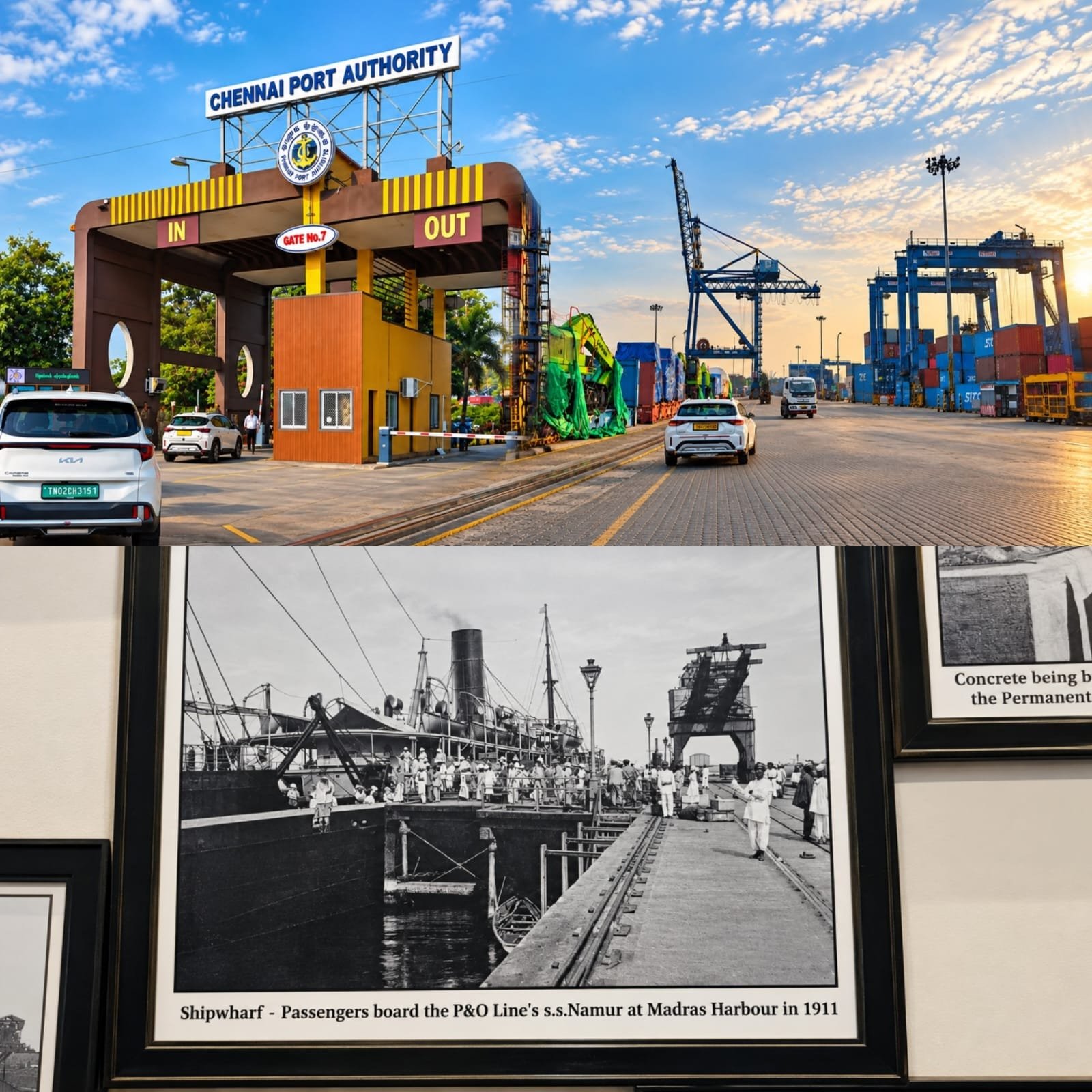
During the tour officers gave a detailed presentation about the functioning and informed about the history of the port. The maritime history of Chennai dates back to 1639, when Fort St George was established on the seashore of the then Madrasapatnam. The area functioned as an open roadstead until the early 19th century, with limited port activity.
The first piers were constructed in 1861, but storms in 1868 and 1872 damaged them and made them inoperative. This led to the construction of an artificial harbour, with commercial operations beginning in 1881.
In its initial years, the port handled comparatively modest volumes. During its first couple of years of operations, it recorded around three lakh tonnes of cargo handled by about 600 ships.
The port subsequently underwent a series of expansions. Sir Francis Spring, the first Chairman of the Madras Port Trust, developed a long-term plan to address both natural and man-made challenges. The entrance of the harbour was shifted from the eastern side to the north-eastern side, providing greater protection from natural vulnerabilities.
The post-Independence period brought another phase of expansion. The Jawahar Dock was commissioned in 1964 with capacity to berth six vessels and handle dry bulk cargo such as coal, iron ore and fertilisers, besides non-hazardous liquid cargo.
The Bharathi Dock followed as an outer harbour, with facilities for petroleum cargo commissioned in 1972 and mechanised iron-ore handling introduced in 1974.
A major transformation came in 1983 when Chennai Port commissioned the country’s first dedicated container terminal. Container traffic subsequently expanded rapidly, with a second container terminal commissioned in 2009.
The port has since diversified beyond conventional cargo handling. With automobile manufacturing companies located around Chennai, the port has developed significant potential for car exports through Pure Car Carriers. Cruise tourism has also become part of its long-term development plans.
The port now describes its long-term vision around four areas—Containers, Cars, Cruise and Clean Cargo.
Its infrastructure has expanded to include three docks, 27 berths, container terminals, oil-handling facilities and an internal railway network. The port has around 41 km of railway lines and eight sidings, allowing cargo to move between ships and the hinterland.
In March 2020, Chennai Port acquired Kamarajar Port Ltd, with the port authority stating that the move was intended to leverage operational and financial synergies and strengthen services.
The scale of the transformation is reflected in recent traffic figures. Chennai Port handled 54.96 million tonnes of cargo in 2024-25, while container handling reached more than 1.81 million TEUs.
The port is now looking towards another major phase of expansion through the proposed Outer Harbour Project and improved road and logistics connectivity.
From an exposed coastline where ships once depended on limited harbour facilities to a complex network of docks, container terminals, rail links and digital systems, Chennai Port’s history mirrors the wider transformation of India’s maritime infrastructure.


Comments are closed.