

Khalid Rasool
Afghanistan has spent centuries at the crossroads of empires. Its greatest diplomatic achievement yet may be to become something altogether different: not the prize of competing powers, but the partner of all of them; not the battlefield of Eurasia, but its bridge; not another country’s Afghanistan, but, finally, its own.
Some victories are decided on battlefields. Others unfold quietly, across diplomatic tables, over years rather than days. Five years after the Taliban returned to Kabul, Afghanistan offers a striking case of the second kind. When the movement entered the capital in August 2021, most of the international community expected the government that followed to remain isolated, economically starved and diplomatically marginal. Five years on, the picture is considerably more complicated — and considerably more instructive for anyone thinking seriously about how legitimacy is actually built in international politics.
The Taliban still face sharp international criticism and remain far from universal recognition. Yet they have achieved something their opponents once thought unlikely: they have survived, consolidated control over the country, and steadily expanded relationships with some of the world’s most consequential regional powers. Russia went furthest, formally recognising the Taliban government in July 2025. India has deepened its practical engagement while holding firmly to its own concerns and principles; New Delhi’s Ministry of External Affairs frames its Afghanistan policy around historical friendship, humanitarian assistance, education and capacity-building, and has maintained a technical presence in Kabul alongside substantial aid since 2021. China, Iran, the Central Asian republics and several Gulf states have all sustained their own varying degrees of engagement.
The question, then, is no longer whether the Taliban exist as a political fact. They plainly do. The more interesting question — the one worth asking from Delhi, Moscow, Brussels or Washington alike — is whether the Taliban’s diplomacy has itself become a form of victory. Increasingly, the answer is yes. But with important qualifications.
From Military Victory to Diplomatic Survival
The Taliban’s first victory was military and political: the return to Kabul after two decades of war and the withdrawal of the United States and NATO. Their second challenge was harder to see and harder to win — could they survive without broad international recognition at all?
For years the answer looked uncertain. Afghanistan sat suspended between political reality and diplomatic legitimacy: the Taliban controlled the state, but much of the world refused to recognise their government. Isolation, however, did not remove them from power. Instead, they began building an alternative diplomatic strategy, turning toward the region rather than waiting for the West to decide Afghanistan’s place in the international order.
Russia, China, Iran, Central Asia, the Gulf, and eventually India, all became part of this emerging landscape. That strategy is now bearing fruit, transforming Afghanistan from an isolated problem into a country that regional powers increasingly treat as a diplomatic and strategic reality in its own right.
Russia Breaks the Diplomatic Wall
The most consequential breakthrough came from Moscow. On 3 July 2025, Russia formally recognised the Taliban government — the first state to do so. The significance runs well beyond symbolism. Russia is a permanent member of the UN Security Council, a major Eurasian power, and a decisive actor in Central Asia. Its decision signalled that Afghanistan could no longer be understood purely through the lens of post-2021 Western policy.
Moscow’s calculation was strategic rather than sentimental. Afghanistan’s security bears directly on Russia’s Central Asian periphery, and terrorism, trade, transport, energy and regional connectivity all require some working relationship with whoever governs Kabul. For Russia, the Taliban are no longer simply an insurgent movement or an ideological project; they are the government in effective control, and therefore the government with which Moscow believes it must do business.
That is a genuine diplomatic transformation. More importantly, it signals that the politics of indefinite isolation is giving way, region by region, to a more pragmatic calculus.
The Taliban’s Real Achievement: Becoming Difficult to Ignore
The Taliban’s most important diplomatic achievement may not be Russian recognition itself, but something broader: they have become difficult to ignore.
A government survives political isolation only if it continues to hold territory, institutions and the mechanisms of state power. Five years on, the Taliban have done exactly that. Rather than the vacuum some observers expected, Kabul is increasingly conducting diplomacy with multiple regional capitals at once.
This is not international legitimacy in the traditional sense. It is something more subtle: the gradual adjustment of regional diplomacy to the political reality that already exists in Kabul. That, historically, is how normalisation tends to begin — engagement precedes acceptance, and practical relations usually arrive well before formal recognition does.
India: From Caution to Pragmatic Engagement
India’s role in this shift deserves particular attention. For New Delhi, Afghanistan is not merely a foreign-policy file; it sits inside India’s historical, cultural, economic and strategic relationship with the wider region, following decades of Indian investment in Afghan infrastructure, education, healthcare and humanitarian assistance.
Even after 2021, India did not withdraw from the Afghan people. According to its Ministry of External Affairs, New Delhi has continued to provide major humanitarian assistance — wheat, medicines and other essential supplies — while sustaining educational and capacity-building programmes and maintaining a technical presence in Kabul since 2022.
This matters because India’s Afghanistan policy is increasingly shaped less by ideology than by national interest and regional realism. A stable Afghanistan serves India’s security; an Afghanistan connected to the wider Indian economic space is strategically valuable; and an Afghanistan capable of sustaining independent relations with India, Russia, Iran and Central Asia is preferable, from New Delhi’s vantage point, to an Afghanistan captured by any single external power.
For Kabul, closer ties with New Delhi supply something equally valuable: another diplomatic and economic option, and proof that Afghan foreign policy need not be hostage to Islamabad, Beijing, Moscow or Washington.
India and Russia: Two Different Partners, One Regional Reality
The emerging triangle between Afghanistan, India and Russia rewards closer attention. India and Russia do not share identical foreign-policy objectives, and Afghanistan should not be read as part of some artificial geopolitical bloc between them. But there is real convergence: both New Delhi and Moscow want a stable Afghanistan that does not become a sanctuary for transnational terrorism, and that does not fall exclusively into any single power’s orbit.
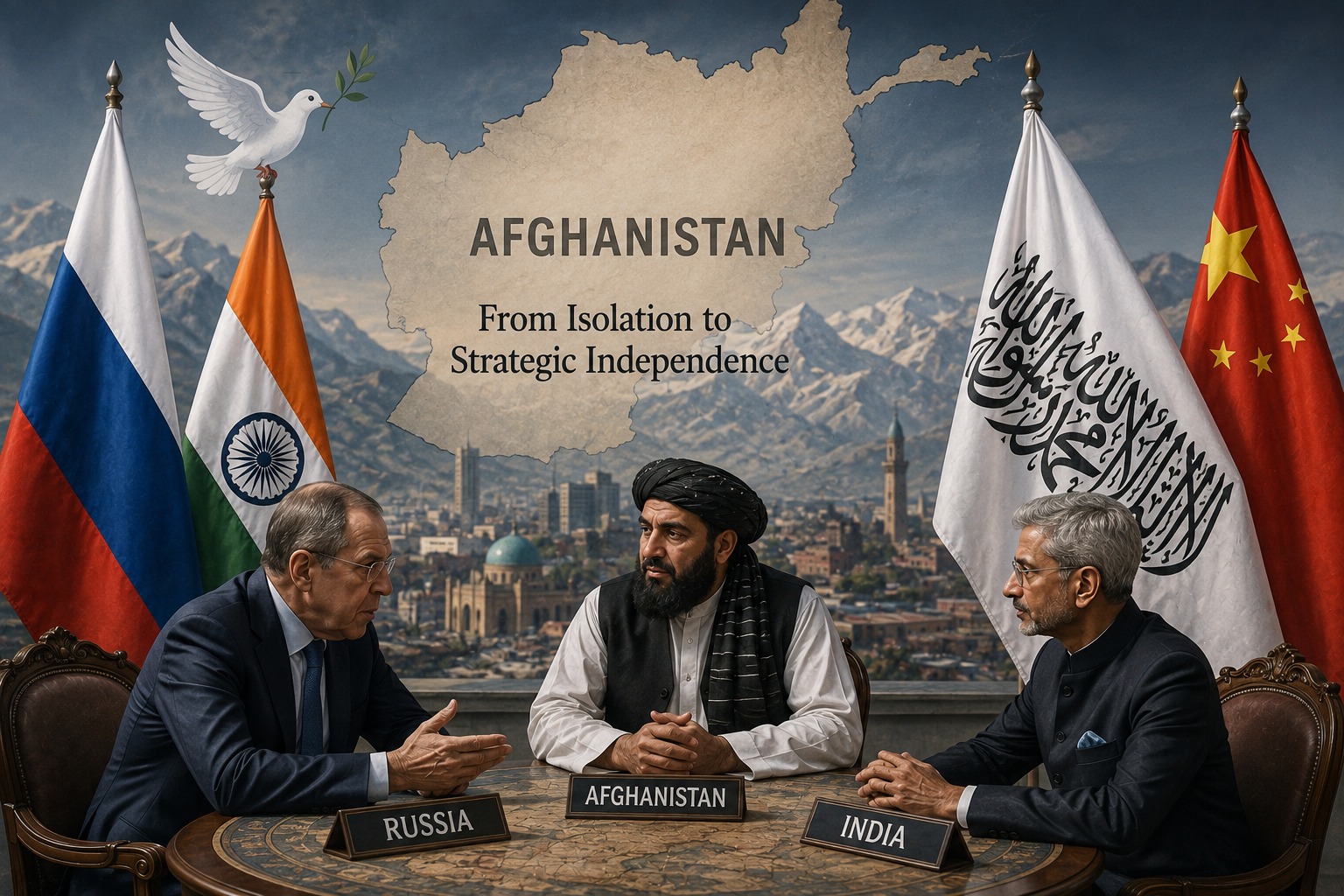
For India, Afghanistan represents connectivity, security, historical engagement and regional influence. For Russia, it represents Central Asian security, counter-terrorism and Eurasian connectivity. For Afghanistan itself, relations with both create something rarer than either alone: diplomatic alternatives. And states with alternatives possess greater strategic autonomy.
This is why the emerging Afghanistan-Russia-India relationship should not be mistaken for a formal alliance. Its real significance lies in the wider diplomatic space it opens — a space in which Kabul can engage multiple powers according to its own interests, rather than someone else’s.
A New Afghan Foreign Policy: Friends Without Masters
This may be the most consequential shift underway in Kabul. The Taliban appear increasingly unwilling to let Afghanistan become the permanent strategic possession of any outside power. The country need not choose between Russia and India, nor between China and Iran, Pakistan and Central Asia, the East and the West. Its most rational strategy is to maintain relations with all of them while avoiding dependence on any one.
The guiding principle might be summarised in three words: friends without masters.
The Taliban’s greatest strategic error would be to trade one dependency for another. Their greatest diplomatic achievement would be preventing exactly that. A genuinely independent Afghan foreign policy has to be able to cooperate with major powers without becoming subordinate to any of them — a distinction easier to state than to sustain, and one on which much will turn.
The Pakistan Factor
This transformation inevitably reshapes the calculus in Islamabad. For decades, Pakistan sought substantial influence over Afghan affairs, largely through the prism of its own security interests. Today’s Afghanistan is demonstrating, increasingly, that Kabul has alternatives — India is one, Russia another, China a further avenue, with Iran and the Central Asian republics offering additional strategic and economic options besides.
None of this need mean confrontation with Pakistan. Quite the opposite: a genuinely independent Afghan foreign policy should pursue normal, peaceful relations with Islamabad, but on the basis of sovereignty, mutual respect and reciprocity rather than dependence. Afghanistan does not need an enemy in Pakistan. Nor does it need a master. That distinction is fundamental, and a stable Afghanistan should ultimately serve Pakistan’s interests as much as it serves India’s, Russia’s, Iran’s or Central Asia’s.
Recognition Is Not the Same as Approval
Critics of Russia’s recognition argue that it legitimises Taliban policy. But international diplomacy has never operated on so simple a principle. States routinely engage governments whose domestic conduct they oppose, because diplomacy exists precisely to manage disagreement, not to reward virtue.
Recognition and engagement open channels through which governments can discuss security, terrorism, trade, humanitarian access and political disputes — channels that complete isolation tends to close, along with whatever influence might have travelled through them.
None of this means international concern should disappear; it should not. The rights of Afghan women and girls, access to education, minority protection, humanitarian access and political inclusion remain serious and legitimate subjects of international attention. But they are better pursued through sustained diplomacy than through the assumption that isolation, on its own, will transform Afghan politics. Engagement need not mean endorsement, any more than criticism need mean permanent exile from the international system.
The Taliban’s Unfinished Diplomatic Battle
Here lies the essential qualification. The Taliban have won the battle for political survival; they have not yet won the battle for broad legitimacy. Russia’s recognition is historic, but Russia remains a single state, and the Taliban government continues to face wide international reservation, not least over its restrictions on women and girls.
To call the Taliban’s diplomacy a complete victory, then, would be premature. A more accurate description is a significant breakthrough — and an unfinished one. The Taliban have moved Afghanistan from near-total isolation toward selective engagement and, in Russia’s case, formal recognition. What remains open is whether they can convert this diplomatic opening into something more durable.
That will depend less on how many governments establish relations with Kabul than on what the Taliban do with the political space they have already gained.
From Battlefield to Boardroom
For decades, Afghanistan was discussed almost entirely in the vocabulary of war: insurgency, occupation, terrorism, withdrawal. A different vocabulary is now slowly emerging — trade, transit, investment, energy, connectivity, regional security. That shift matters.
Sitting at the intersection of Central Asia, South Asia, Iran and China, Afghanistan holds real strategic potential. A country stable enough to support transport corridors, energy projects, mining, agriculture and regional trade could see its importance grow considerably; a country that once absorbed vast international military resources could yet become an economic bridge across Eurasia.
Geography alone cannot produce prosperity, though. Afghanistan will need political stability, infrastructure, investment, predictable relations with its neighbours, and institutions capable of sustaining long-term development. This is where diplomacy stops being symbolic and starts becoming instrumental — a tool of reconstruction rather than mere recognition.
The Taliban’s Greatest Test Begins Now
There is a profound difference between winning power and governing well. The Taliban have shown they can fight, survive and negotiate. What remains to be shown is whether they can govern in a way that produces stability, economic opportunity and a sustainable relationship with the outside world.
That requires answering difficult questions. Can Afghanistan attract long-term investment and integrate into regional trade? Can it guarantee security and prevent its territory from being used by international terrorist organisations? Can it improve relations with its neighbours and address international concern over women’s education and participation? And can the Taliban themselves complete the transition from a movement that captured power to a government capable of commanding wider international confidence?
The answers will determine whether their diplomatic gains prove permanent or merely provisional.
Five Years Later: Where Does Afghanistan Stand?
Five years after the Taliban returned to Kabul, Afghanistan occupies a very different position from the one many predicted in 2021. It is not fully integrated into the international system — but neither is it isolated in the way it once seemed destined to be. It has Russia’s formal recognition, India’s expanding engagement, China’s continuing interest, and working relationships with Iran and Central Asia. More significantly still, Afghanistan increasingly occupies an unavoidable position in regional diplomacy. That is a substantial achievement by any measure.
Yet the Taliban should understand that recognition is not a final destination; it is the beginning of a new set of responsibilities. International engagement creates opportunity, but it also creates expectation. Kabul will increasingly be judged not only by its ability to hold power, but by its ability to provide security, economic opportunity and responsible relations with its neighbours.
Afghanistan Must Become Afghanistan’s Afghanistan
Afghanistan has spent generations as the battlefield of others. The British Empire fought there; the Soviet Union fought there; the United States and NATO fought there; regional powers have long competed for influence within its borders. Throughout, it was ordinary Afghans who paid the price.
The next chapter should read differently. Afghanistan should not become Russia’s Afghanistan, or Pakistan’s, or India’s, or China’s — and it should certainly not become America’s Afghanistan again. It must become Afghanistan’s Afghanistan: a country capable of speaking to Moscow without becoming its satellite, cooperating with New Delhi without becoming its proxy, trading with Beijing without surrendering sovereignty, engaging Islamabad without accepting subordination, and dealing with the West without once again turning Afghan soil into the theatre of someone else’s great-power contest.
That, in the end, is what strategic independence actually looks like.
A Diplomatic Victory — but Not the Final One
So has the Taliban’s return to power become a diplomatic victory? Yes — but an incomplete one. Their military victory came in 2021; their diplomatic breakthrough came later. Russia’s recognition in 2025 stands as the most significant formal validation of their government to date, while India’s expanding engagement shows that even states with serious political differences with Kabul are prepared to deal with it according to their own national interests.
The broader pattern of regional engagement points to something larger still: Afghanistan is gradually escaping the assumption that its future can be decided exclusively from Western capitals. The centre of gravity in Afghan diplomacy is shifting, steadily, toward its own neighbourhood.
But the ultimate verdict will not be written in the number of states that recognise the Taliban. It will be written in whether Afghanistan becomes stable enough to prosper, sovereign enough to choose its own path, secure enough to serve as a regional bridge, open enough to join the global economy, and responsible enough to earn the confidence it still lacks. That is the real test still facing Kabul.
Five years after the Taliban returned to power, Afghanistan has moved from being a problem the world tried to isolate to a reality the region has to engage. Russia has opened one door; India, another; the wider region, several more. The question now is whether Kabul can walk through them without surrendering its independence in the process.
Afghanistan has spent centuries at the crossroads of empires. Its greatest diplomatic achievement yet may be to become something altogether different: not the prize of competing powers, but the partner of all of them; not the battlefield of Eurasia, but its bridge; not another country’s Afghanistan, but, finally, its own.
Comments are closed.