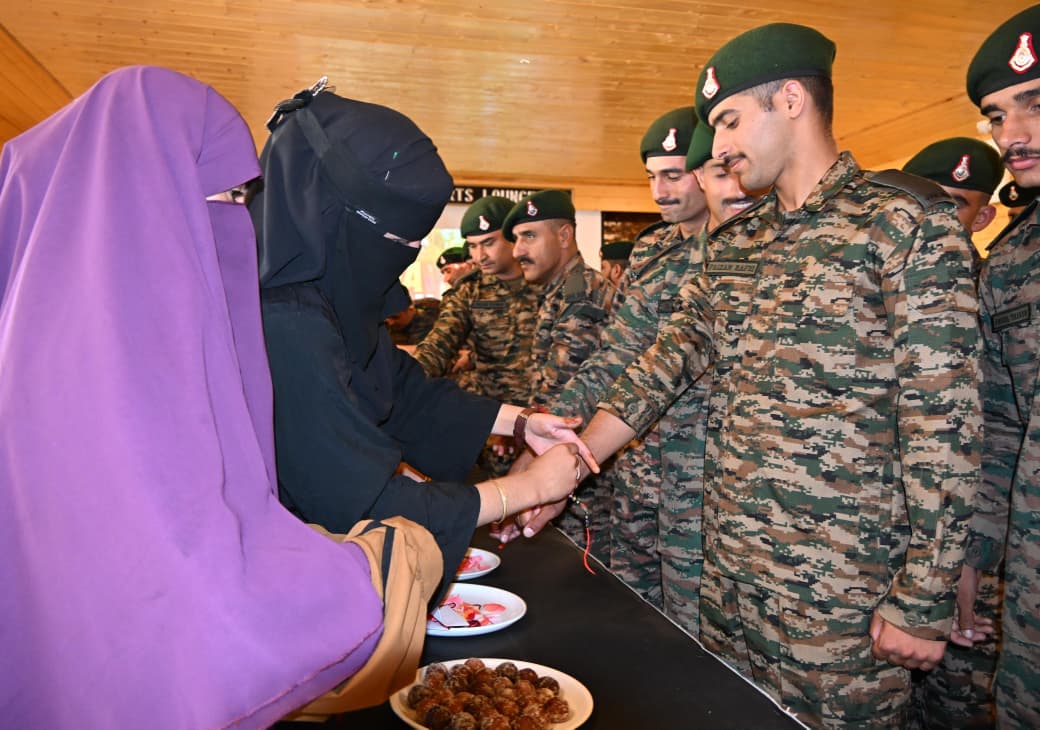
Srinagar, Aug 28: This Raksha Bandhan, the Valley witnessed something truly special. Across Jammu and Kashmir—from the forward posts along the Line of Control in Poonch to the International Border in the RS Pura sector, and from Banihal to Kupwara—local Kashmiri women and young girls stepped forward to tie rakhis on the wrists of Indian Army jawans.
It was not merely a festival ritual. It was a powerful symbol of a changing narrative—one where the uniform that once evoked fear has now come to represent trust, affection, and a sense of family.
For a region that has witnessed decades of turbulence, the post-Article 370 era has quietly ushered in a transformation that is perhaps best reflected in moments like these. Union Minister Dr. Jitendra Singh recently spoke of a “change in mindset” and an “aspirational surge” taking root in Jammu and Kashmir.
He noted that the abrogation of Article 370 has helped people feel a “feeling of belongingness” that was missing before, when they considered themselves different. The events of Raksha Bandhan seem to echo this shift—not through political rhetoric, but through the simple, heartfelt gestures of ordinary citizens.
In Banihal, local girls tied rakhis to soldiers, with one young woman expressing what many felt: “I don’t have a brother of my own, but today it felt like I do. We are their sisters, too. We are their family.”
In Poonch, sisters from border villages travelled to forward posts along the LoC to celebrate with soldiers deployed far from home.
In the RS Pura sector, families offered sweets and prayed for the long lives of the jawans guarding the nation’s borders. And in Kupwara, the army’s Kupwara Terriers hosted similar celebrations, with soldiers vowing to stand tall in all situations to protect their “sisters.”
The jawans, many of whom spend festivals away from their own families, were visibly moved. One soldier described the gesture as a reminder of home during a demanding deployment. The local women, in turn, received blessings and gifts—a reciprocal exchange of love and respect that transcends the usual boundaries between civilians and security forces.
Ayesha, a college student from Kupwara speaking to Kashmir Convener said, “I have never felt safer than I do today. These jawans are not just soldiers; they are our brothers who protect us day and night. Tying a rakhi to them is my way of saying thank you.” She added, “Earlier, we used to be scared of the uniform. But today, I see a brother behind that uniform. He smiled, he blessed me, and he promised to keep us safe. That is everything.”
Mehak, a social activist from Uri in chat with this newspaper said, “My father used to say that soldiers are our real protectors. Today, I finally understood what he meant. I tied a rakhi to a jawan who hasn’t seen his own sister in two years. He had tears in his eyes. I will never forget that moment.”
She said, “We came here with sweets and rakhis. The soldiers welcomed us like we were their own family. They gave us chocolates and gifts. For a moment, I forgot they were soldiers—they were just my brothers.” She further added, “This is not just a festival. This is a message to the world that Kashmir is changing. We are embracing our soldiers because they are ours. They bleed for us. They die for us. The least we can do is call them brothers.”
Naik Subedar, deployed in Kupwara, shared, “When a little girl tied a rakhi on my wrist, I felt like I was back home in my village. My own sister is far away, but today, I found a sister here. This is why we serve.” He added, “For years, we were seen as outsiders.
Today, we were seen as family. That changes everything. It makes us fight harder, protect better, and love deeper.”
Ghulam Nabi, a 70-year-old resident of a north Kashmir village, told Kashmir Convener, “I have lived through the worst of times in Kashmir. I have seen guns and tears. But today, I saw something I never thought I would see—our daughters tying rakhis to our soldiers with smiles.
This is the Kashmir I always dreamed of.” He said, “This is the real image of Kashmir—not stone pelting, not curfews, but love. These soldiers are our guests, and we treated them like our own. That is our culture. That is our ‘Insaniyat’.”
Notably, what we witnessed this Raksha Bandhan is a reflection of the deep-rooted bond between the people of Kashmir and the Indian Army. It is a bond built on trust, sacrifice, and shared humanity. These celebrations are not merely symbolic; they are evidence of a ground-level transformation. The people of Kashmir are no longer looking at the Army as an occupying force but as a protective presence.
What makes these celebrations significant is not just the festival itself, but what they represent. In a region where the presence of the armed forces has historically been met with suspicion, the growing willingness of local communities to embrace jawans as brothers signals a deepening bond. As one social media user put it, “A beautiful example of love and trust.”
The Indian Army has long played a role in preserving the rich traditions of Kashmir’s “Awaam,” but events like these suggest something deeper is at play. The thread of a rakhi, after all, is fragile—but the bond it symbolises is anything but. Across Jammu and Kashmir, daughters and sisters are increasingly seeing soldiers not as outsiders, but as protectors, as family.
The distance between Kashmir and the rest of the country—once measured in mistrust and isolation—is steadily narrowing. And in the hands of these women and jawans, the rakhi has become more than a thread. It is a bridge.


Comments are closed.