Heritage is often described as a bridge between the past and the present. But the metaphor is incomplete. Heritage does not merely connect one generation to another; it shapes how societies understand themselves, what they value and what they choose to carry into the future. A monument, manuscript, archaeological site, sacred landscape, traditional craft or natural ecosystem can therefore be much more than an artefact of history. It can be a repository of memory, knowledge and identity.
That is why the inscription of the Ancient Buddhist Site of Sarnath on the UNESCO World Heritage List is significant far beyond the addition of another name to an international register.
On the evening of 25 July 2026, at the 48th Session of the World Heritage Committee in Busan, South Korea, Sarnath received recognition as a site of Outstanding Universal Value. The inscription takes India’s total number of UNESCO World Heritage properties to 45, comprising 37 cultural, seven natural and one mixed property.
The achievement deserves celebration. But it should also prompt a more important question: What does World Heritage recognition actually require from India once the ceremony is over?
The answer is not simply more visitors, better publicity or another statistic in a global ranking. Recognition carries responsibility. It demands sustained conservation, scientific management, sensitive tourism, protection of authenticity and integrity, community participation and a willingness to treat heritage not as an obstacle to development but as an essential part of development itself.
Sarnath provides an especially powerful lens through which to examine that responsibility.
A site where history became a universal message
Sarnath occupies an extraordinary place in the history of Buddhism and in the intellectual and spiritual history of Asia. Known in Buddhist tradition as Rishipatana, Ishipatana and Mrigadava, it is associated with one of the defining moments in the life of Gautama Buddha.
After attaining enlightenment at Bodh Gaya, the Buddha came to Sarnath and delivered his first sermon in the sixth century BCE. This event, remembered as the Dharmachakra Pravartana, or the Turning of the Wheel of the Law, marked the beginning of the Buddhist Sangha and established the teachings associated with the Noble Eightfold Path.
Few places can claim such a direct association with an idea that subsequently travelled across civilisations and continents.
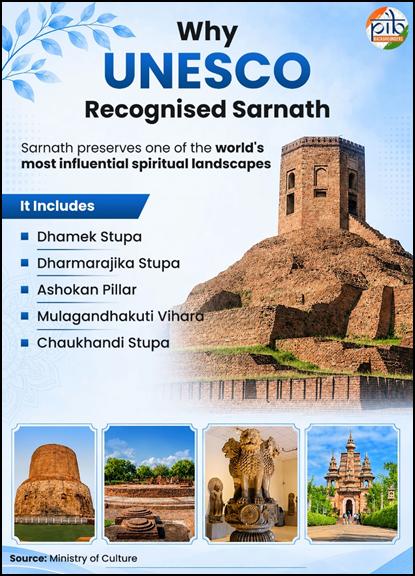
The UNESCO inscription covers two connected components: the Chaukhandi Stupa and the Archaeological Remains of Sarnath. The latter includes the Dhamek Stupa, Dharmarajika Stupa, Mulagandhakuti Vihara, the Ashokan Pillar and several other archaeological remains.
Taken together, these monuments do not represent a single historical moment frozen in stone. They represent nearly sixteen centuries of development, patronage, construction, religious practice and cultural exchange. The remains range from the pre-Mauryan period of the fourth and third centuries BCE to the 12th century CE, when Sarnath declined and was eventually destroyed.
Its rediscovery in the 18th century began another chapter in the site’s history.
This continuity is important. Sarnath is not valuable merely because it is old. It is valuable because of what happened there, what emerged from that moment and how generations subsequently preserved, rebuilt and interpreted the site.
That is precisely the kind of significance that the World Heritage Convention seeks to recognise.
World Heritage is a responsibility, not a trophy
The idea underlying UNESCO’s World Heritage system is fundamentally different from a conventional national heritage list. A monument can belong to one country while its significance belongs to humanity as a whole.
The 1972 World Heritage Convention established this principle by creating an international framework for identifying, protecting and preserving cultural and natural heritage considered to possess Outstanding Universal Value.
By July 2026, the World Heritage List contained 1,273 properties across 173 countries, including 991 cultural, 240 natural and 42 mixed properties. The Convention has been ratified by 196 States Parties.
The strength of the system lies in its premise: humanity inherits certain places collectively, even when their physical location remains within national borders.
Sarnath therefore belongs to India geographically, historically and administratively. But its meaning reaches far beyond India.
For millions of Buddhists across Asia and elsewhere, it is a sacred destination. Pilgrims from Japan, Thailand, Sri Lanka, Myanmar, Vietnam, South Korea, Cambodia, Mongolia and many other countries associate Sarnath with one of the foundational events of Buddhism.
Its World Heritage status consequently has a cultural and diplomatic dimension as well.
At a time when countries increasingly recognise the value of cultural diplomacy, heritage can become one of the most credible forms of international engagement. Unlike political declarations, heritage diplomacy is rooted in shared human experience. A pilgrimage route, an ancient manuscript, a monument or a philosophical tradition can create connections that transcend contemporary boundaries.
Sarnath embodies that possibility.
Recognition took years of preparation
The inscription did not happen overnight.
Sarnath was placed on India’s Tentative List of World Heritage Sites in 1998. The nomination for inscription was subsequently submitted in January 2025, followed by an 18-month process involving technical consultations with UNESCO’s advisory bodies and an evaluation mission by ICOMOS.
This process matters because World Heritage inscription is not simply a declaration of national pride. It requires a property to demonstrate Outstanding Universal Value against established criteria and to satisfy requirements concerning authenticity, integrity, protection and management.
Sarnath was nominated under criteria (iii) and (vi).
Criterion (iii) recognises its exceptional testimony to a cultural tradition and its continuing significance as one of the four principal destinations of Buddhist pilgrimage. Criterion (vi) reflects its direct and tangible association with events in the life of the Buddha that have outstanding universal significance for the Buddhist community.
In other words, UNESCO has not merely recognised Sarnath because it contains impressive ruins. It has recognised the relationship between place, history, belief and continuing human significance.
That distinction should guide what happens next.
India’s heritage story is much larger than 45 sites
Sarnath becomes the latest chapter in a World Heritage journey that began in 1983 with four inscriptions: Agra Fort, Ajanta Caves, Ellora Caves and the Taj Mahal.
Since then, India’s list has expanded dramatically.
It now includes temples and caves, forts and historic cities, railway systems and stepwells, archaeological sites and sacred landscapes, national parks and mountain ecosystems. From Kaziranga and the Sundarbans to Hampi, Khajuraho, Nalanda, Dholavira, Jaipur and Santiniketan, the list reflects the extraordinary diversity of the Indian civilisational experience.
The Maratha Military Landscapes of India, inscribed in 2025, were the most recent addition before Sarnath.
India now stands sixth globally in terms of the number of World Heritage properties and second in the Asia-Pacific region. Its Tentative List contains 69 properties, providing a pipeline for future nominations.
These numbers are impressive. Yet they should not become the principal measure of success.
The real test is what happens to a heritage site after recognition.
A country can have hundreds of internationally recognised properties and still fail to protect the cultural landscapes surrounding them. It can restore monuments while allowing insensitive construction nearby. It can attract millions of tourists while overwhelming fragile archaeological sites. It can digitise manuscripts without adequately building the scholarly institutions needed to interpret them.
Heritage conservation cannot therefore be reduced to the number of inscriptions.
The objective must be to create a culture in which conservation becomes part of everyday governance.
From preservation to participation
One of the most important shifts in heritage policy is the recognition that conservation cannot be the responsibility of archaeologists and government departments alone.
The Archaeological Survey of India has a central role. As India’s nodal agency for World Heritage-related matters, it is responsible for conserving and maintaining thousands of centrally protected monuments, including World Heritage properties. Its work extends from structural conservation to visitor facilities and enforcement of heritage legislation.
The Ministry of Culture provides the wider institutional and international framework.
But heritage sites exist within communities.
People live around monuments. Businesses depend on visitors. Religious traditions continue at sacred places. Local artisans, guides, transport operators and hospitality workers often form the informal economic ecosystem surrounding heritage destinations.
If these communities see heritage only as a restriction, conservation will always face resistance. If they see heritage as an asset that generates dignity, employment, knowledge and opportunity, they become natural custodians.
That is why programmes such as Adopt a Heritage 2.0 are important, provided partnerships remain guided by conservation principles rather than commercial interests.
The programme, launched in its revamped form in 2023, provides a framework for collaboration with companies, public sector organisations, NGOs, trusts and societies to improve visitor amenities at protected monuments. By March 2026, 30 MoUs had been signed.
The adopted monuments recorded a combined footfall of 13.59 million visitors during 2024–25.
The larger lesson is clear: visitor experience matters, but it must never come at the expense of the monument itself.
Tourism must serve heritage—not consume it
World Heritage status naturally creates tourism opportunities.
Sarnath can become an even stronger destination for Buddhist pilgrimage, cultural tourism, education and international exchange. Local economies can benefit. Artisans and guides can gain new markets. Hospitality and transport infrastructure can improve. Students can be encouraged to engage with archaeology and history.
But there is a danger in treating every heritage inscription primarily as a tourism opportunity.
The most popular heritage sites in the world demonstrate the tension. Large crowds, traffic, waste, unregulated construction, commercialisation and infrastructure pressure can gradually damage the very authenticity that attracts visitors.
Sarnath must therefore avoid the temptation to equate success with footfall alone.
The right question is not how many people can be brought to Sarnath, but how many people can experience Sarnath without compromising its archaeological and spiritual character.
That requires carrying-capacity assessments, regulated development, effective waste management, pedestrian planning, interpretation facilities, trained guides and careful protection of the buffer zone.
Sustainable tourism should mean that the local economy benefits while the monument remains protected.
If a heritage site has to be physically altered to accommodate uncontrolled tourism, then tourism has defeated its own purpose.
Digitisation is becoming another form of preservation
Heritage preservation is no longer confined to physical conservation.
India’s manuscript and archival initiatives demonstrate how technology can complement traditional preservation.
The Gyan Bharatam Mission, launched in 2025, seeks to preserve, digitise and disseminate India’s manuscript heritage. The National Manuscript Survey launched in March 2026 has reported more than 1.19 crore manuscripts, while more than eight lakh manuscripts have been digitised and over 4.40 lakh are currently accessible through the Gyan Bharatam portal in view mode.
Similarly, the National Archives of India has expanded digital access through Abhilekh Patal, which by February 2026 hosted 18.23 crore pages, 0.73 crore reference media and 0.38 crore digitised records.
These initiatives matter because physical preservation and intellectual access are inseparable.
A manuscript locked away but unavailable to researchers is only partially preserved. An archaeological site that visitors can see but cannot properly understand is similarly incomplete in its public purpose.
Digital technology can democratise access to heritage, allow scholars to collaborate across borders and create records that may become invaluable in the event of physical deterioration.
But digitisation should supplement—not replace—physical conservation.
A three-dimensional scan cannot replace an ancient monument. A digital image cannot substitute for the cultural landscape in which a manuscript, temple or archaeological site acquired its meaning.
Technology should be a tool of preservation, not an excuse for neglecting the physical heritage itself.
Recovering what was taken
Heritage protection also extends beyond monuments that remain in the country.
India’s efforts to retrieve antiquities taken abroad represent an important dimension of cultural preservation. The country has repatriated 669 antiquities, including 656 since 2014, with cooperation involving the Ministry of Culture, ASI, Indian missions and enforcement agencies.
The return of Indian art objects, including important Chola-period works, is more than a diplomatic success. It restores fragments of cultural memory to the context from which they originated.
Yet repatriation should ultimately be accompanied by a stronger preventive framework.
The protection of antiquities requires documentation, provenance research, museum security, trained personnel, international cooperation and public awareness. The National Mission on Monuments and Antiquities, which has documented 1.84 lakh monuments and 17.20 lakh antiquities as of March 2026, can play an important role in creating the information base necessary for this work.
What is not documented is difficult to protect.
An inventory is therefore not merely an administrative exercise. It is the foundation of heritage governance.
The unfinished challenge
India’s heritage success should make the country more ambitious—but also more self-critical.
There is an enormous difference between protecting a famous monument and protecting the countless lesser-known sites scattered across towns, villages, forests and archaeological landscapes.
Many of these places may never become World Heritage Sites. They may not attract international tourists. They may not have iconic photographs or generate significant ticket revenue.
They still matter.
A civilisation cannot be represented only by its most photogenic monuments.
The small shrine, the traditional settlement, the historic water structure, the manuscript collection, the craft tradition and the archaeological mound can all contain knowledge that may disappear silently if conservation remains concentrated on nationally prominent sites.
This is where heritage policy must move from a monument-centric approach towards a landscape and community-based approach.
Climate change adds another layer of urgency.
Extreme rainfall, flooding, heat, humidity, erosion and other environmental stresses can damage archaeological remains and historic structures. Natural heritage faces even greater pressures from ecological degradation.
The future of heritage conservation will therefore increasingly depend on climate-sensitive planning, scientific monitoring and resilient infrastructure.
The central challenge is to modernise without erasing.
A civilisational resource for the future
The inscription of Sarnath is ultimately a reminder that India’s heritage is not a burden inherited from history. It is a resource for the future.
It can strengthen education by allowing young people to encounter history beyond textbooks.
It can support scholarship by opening archaeological and manuscript resources to researchers.
It can strengthen cultural diplomacy by connecting India with communities across Asia and beyond.
It can generate livelihoods through responsible tourism and traditional crafts.
And perhaps most importantly, it can create a sense of continuity in a rapidly changing society.
Modernisation does not require forgetting.
A country can build airports, digital networks, industries and smart cities while protecting ancient landscapes. In fact, genuine development should make that coexistence possible.
The question is not whether India should develop or conserve its heritage. The real question is what kind of development is worthy of a civilisation with such an extraordinary inheritance.
Sarnath offers an answer.
The Buddha’s first sermon was not about possession. It was about a path, a discipline and a way of living. In a different but related sense, World Heritage recognition also demands discipline: the discipline to protect what cannot be recreated once destroyed.
The inscription should therefore not be treated as the conclusion of Sarnath’s journey. It is the beginning of a new responsibility.
India has reached 45 World Heritage properties. The achievement deserves pride. But the greater achievement will be measured decades from now—when future generations can still stand at Sarnath, see its ancient remains, understand its significance and experience the sense of continuity that makes heritage meaningful.
That is the real promise of World Heritage.
Not merely to remember where humanity has been, but to ensure that what is worth remembering survives long enough to guide where humanity goes next.
The article is based on the inputs and background information provided by the Press Information Bureau (PIB). Author is Writer, Policy Commentator. He can be mailed at kcprmijk@gmail.com


Comments are closed.