


A. R. Matahanji
There are things whose value cannot be measured by price alone. A Kashmiri Pashmina, a Kani shawl, a piece of Sozni embroidery, a walnut-wood carving, a papier-mâché masterpiece, a hand-knotted carpet, a Namda or a Gabba is one of them.
Because behind every such creation lies something far greater than a finished product, it carries the patience of an artisan, the memory of generations, the fragrance of Kashmir’s culture and the story of a civilisation expressed through human hands.
Kashmir’s handicrafts are therefore not merely an industry; they are a living heritage. Preserving them means protecting not only traditional designs and techniques, but also the artisans, their livelihoods, their dignity and the cultural identity embedded in every creation.
At the centre of this responsibility stands the Department of Handicrafts and Handloom, Kashmir, an institution entrusted with safeguarding a heritage that is simultaneously economic, cultural and deeply human. Its challenge is immense. Traditional craftsmanship faces imitation, changing consumer preferences, market pressures, declining interest among younger generations and the continuing struggle of artisans to receive fair value for painstaking handmade work.
Yet Kashmir’s crafts have shown remarkable resilience. In quiet homes and workshops, Sozni needles still move patiently across fabric; looms continue to transform yarn into intricate patterns; naqash hands continue to carve walnut wood; and carpet artisans continue to create masterpieces knot by knot. The responsibility of the Department is to ensure that this resilience is supported by quality, technology, training, market access and enlightened institutional leadership.
Artisan is the Soul of the Craft. No conversation about handicrafts can begin or end without the artisan. An artisan is not merely a producer; the artisan is the custodian of memory. Skills acquired over years of observation, practice and patience are often passed from one generation to another. When such a skill disappears, society loses far more than an occupation, it loses a piece of cultural knowledge.
An artisan-friendly policy must therefore ask fundamental questions: Is the artisan earning with dignity? Does the artisan have access to markets? Is handmade craftsmanship receiving its rightful value? Are younger generations being encouraged to inherit these skills? And is the genuine artisan protected from imitation and exploitation? The answers will determine whether Kashmir’s handicrafts merely survive or flourish.
One of the greatest threats to this heritage is the blurring of the distinction between genuine craftsmanship and imitation. A machine may reproduce an appearance, but it cannot reproduce generations of knowledge, patience and human skill.
When imitation products are marketed in the name of Kashmir, the damage extends beyond one transaction. Consumer confidence suffers, genuine artisans lose markets and the reputation painstakingly built over generations is weakened.
This makes GI registration, quality control and authentication indispensable. A Geographical Indication is not simply a label; for Kashmir’s crafts, it is a declaration of identity and a means of protecting the geographical and cultural association of the craft with its place of origin. Authenticity is this the New Frontline.
In this ecosystem, the Quality Control Division (QCD) of the Department assumes exceptional importance. The recent commencement of GI QR labelling at the Quality Control laboratory represents a significant step towards bringing modern traceability into an ancient craft economy. The idea is simple yet powerful: the technology may be new, but the heritage it protects is centuries old.
A QR-enabled GI label can give an authenticated product a digital identity, helping establish its credentials and enabling consumers to distinguish genuine craftsmanship from imitation. When supported by proper testing and field verification, such authentication creates a chain of trust: The artisan says, “I created this.” The laboratory says, “It has been examined.” The GI system says, “Its identity is protected.” And the QR code tells the consumer, “You can verify it.” This can make authenticity visible, quality credible and genuine craftsmanship more competitive.
These things are possible only when Leadership, Institutions and the Artisan-Friendly Market is created. The transformation of Kashmir’s handicraft sector requires committed institutional leadership. Under the present leadership of Director, Handicrafts and Handloom, Kashmir, Mr. Masrat-ul-Islam, JKAS, the Department’s emphasis on quality enhancement, GI-tagged products, design innovation and wider market and export opportunities reflects the direction required for a modern handicraft ecosystem. The strength of the Department, however, lies in team work. It is the collective contribution of officers, technical experts, QCD, CDI, PTQCC, IICT personnel, field staff, trainers, designers, institutions and, above all, artisans that keep this heritage alive.
Government support must complement this institutional effort through infrastructure, training, finance, technology, design development, welfare measures, market promotion and export opportunities. The objective should be clear: make craftsmanship economically attractive, authenticity easily recognisable, markets accessible and the artisan the principal beneficiary.
An artisan-friendly market must reward handmade work, combat counterfeiting, provide digital visibility, strengthen skills, facilitate finance and schemes, promote authentic Kashmir branding and connect artisans with domestic and international consumers.
Because a heritage cannot survive on sentiment alone. If an artisan’s family cannot sustain itself through craftsmanship, eventually the craft itself becomes vulnerable.
Kashmir’s handicrafts possess what many modern products cannot manufacture, a story. Every Pashmina, Sozni, Kani, carpet or walnut carving carries the story of material, mastery, patience, place and people. Today’s global consumer increasingly wants to know not only what a product is, but where it came from, who made it and whether it is authentic. This creates a historic opportunity.
GI, QCD, CDI, IICT, digital platforms, design interventions and market-development initiatives can collectively connect Kashmir’s artisan with the global consumer, preserving culture by making it economically sustainable.
A QR label may be tiny beside a magnificent Kashmiri carpet, Pashmina Shawl or Namdha or Gabba but the idea behind it is immense: when authenticity is protected, the artisan is protected; when the artisan is protected, the craft survives; when the craft survives, culture survives.
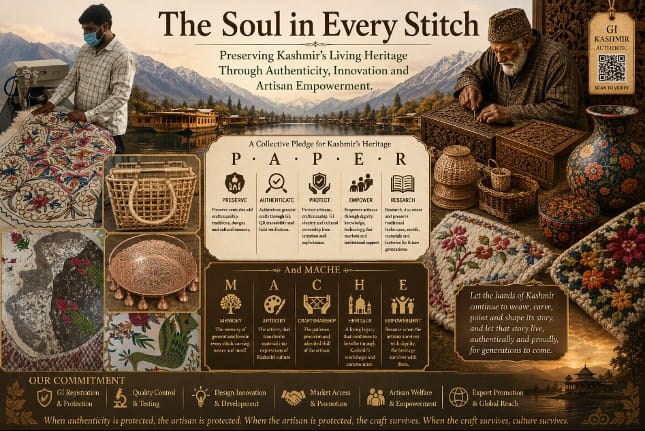
Let Us All Together PAPER–MACHE. Let PAPER–MACHE become a collective pledge for Kashmir’s heritage:
P- Preserve: Preserve centuries-old craftsmanship, traditions, designs and cultural memory. A-Authenticate: Authenticate genuine crafts through GI, QR traceability and field verification. P – Protect: Protect artisans, craftsmanship, GI identity and cultural ownership from imitation and exploitation. E – Empower: Empower artisans through dignity, knowledge, technology, fair markets and institutional support. R – Research: Research, document and preserve traditional techniques, motifs, materials and histories for future generations.
And MACHE: M – Memory: The memory of generations lives in every stitch, carving, weave and motif. A – Artistry: The artistry that transforms material into expressions of Kashmiri culture. C – Craftsmanship: The patience, precision and inherited skill of the artisan. H – Heritage: A living legacy that continues to breathe through Kashmir’s workshops and communities. E – Empowerment: Because when the artisan survives with dignity, the heritage survives with them.
Let the hands of Kashmir continue to weave, carve, paint and shape its story and let that story live, authentically and proudly, for generations to come.
Comments are closed.