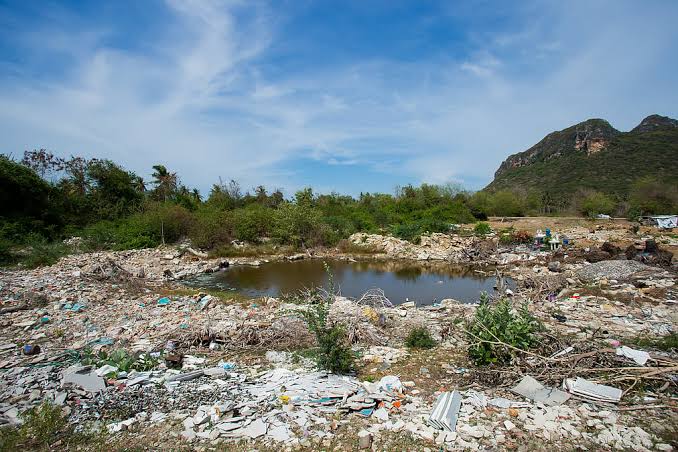
Srinagar, Aug 26: A massive pile of around 11.5 lakh metric tonnes of untreated legacy waste at the Achan dumping site in Srinagar has once again brought the city’s long-running waste-management crisis into focus, with toxic leachate from the site reportedly threatening groundwater and nearby water bodies.
A recent ground report highlighted the scale of the garbage accumulation at Achan, where waste has reportedly been dumped since 1986. The report said toxic leachate from the waste mountain has contaminated local groundwater and poses a threat to nearby lakes including Anchar, Gilsar and Khushalsar.
The concerns are not new. A joint committee constituted in proceedings before the National Green Tribunal inspected the Achan landfill in July 2024 and recorded concerns regarding Srinagar’s waste generation, the location of the landfill and its proximity to important water bodies, including Anchar, Khushal Sar and Gilsar.
The accumulation of legacy waste is the result of decades of dumping at the site. Officials have estimated that around 11.5 lakh metric tonnes of old waste have accumulated over the past four decades.
The scale of the problem is compounded by the continuing generation of fresh municipal waste in Srinagar. Reports have put the city’s daily waste generation at hundreds of tonnes, adding pressure on an already overburdened waste-management system
Environmental concerns centre not only on the visible garbage mountain but also on what is happening beneath and around it. Leachate generated when rainwater passes through decomposing waste can carry pollutants into soil and groundwater if it is not properly collected and treated.
A recent scientific study has also examined microplastic pollution in Khushal Sar and Anchar lakes, describing Achan as the main waste-disposal site for Srinagar and noting its proximity to the two interconnected water bodies.
The issue has also come under scrutiny from the Jammu and Kashmir Legislative Assembly’s Committee on Environment. During its visit to the Achan waste-management site and nearby wetlands in July, the committee reviewed legacy-waste remediation, leachate treatment and environmental safeguards and sought a scientific assessment of the health impact on people living around the landfill.
The government has initiated measures to deal with the legacy waste. According to officials cited in recent reports, biomining and bioremediation work has begun with the objective of clearing the 11.5 lakh metric tonnes of accumulated waste over the next two years.
The authorities have also announced plans for a modern integrated solid-waste management facility at Achan. A project estimated at around ₹361 crore has been sanctioned for waste treatment and remediation.
The Srinagar Municipal Corporation has also indicated that an Integrated Solid Waste Management Programme is being developed to handle fresh waste, while a construction and demolition waste facility is expected to be taken up separately.
For people living around Achan and the adjoining areas, however, the immediate concern remains the environmental and health impact of a waste mountain that has grown for nearly four decades.
The continuing accumulation of waste has also raised questions about the effectiveness of waste segregation, processing, leachate treatment and long-term planning in Srinagar.
The Achan crisis is therefore no longer simply a question of how Srinagar disposes of its garbage. With Anchar, Gilsar and Khushalsar forming part of the interconnected wetland system around the city, the failure to scientifically manage municipal waste carries consequences for water bodies, groundwater, agriculture, livelihoods and public health.
The challenge before the authorities, an Environmentalist told the news agency Kashmir News Trust is now to ensure that the promised remediation does not remain another project on paper, but results in the removal of the legacy waste, scientific treatment of fresh waste and effective protection of Srinagar’s vulnerable wetlands. [KNT]


Comments are closed.