Pampore, November 2: Sher-e-Kashmir University of Agricultural Sciences and Technology-Kashmir (SKUAST-K) organised a demonstration of advanced robotic and ICT-based solutions for saffron cultivation at the Advanced Research and Demonstration Station (ADR&SS), Dusoo Pampore, showcasing technologies aimed at addressing labour-intensive operations in the crop.
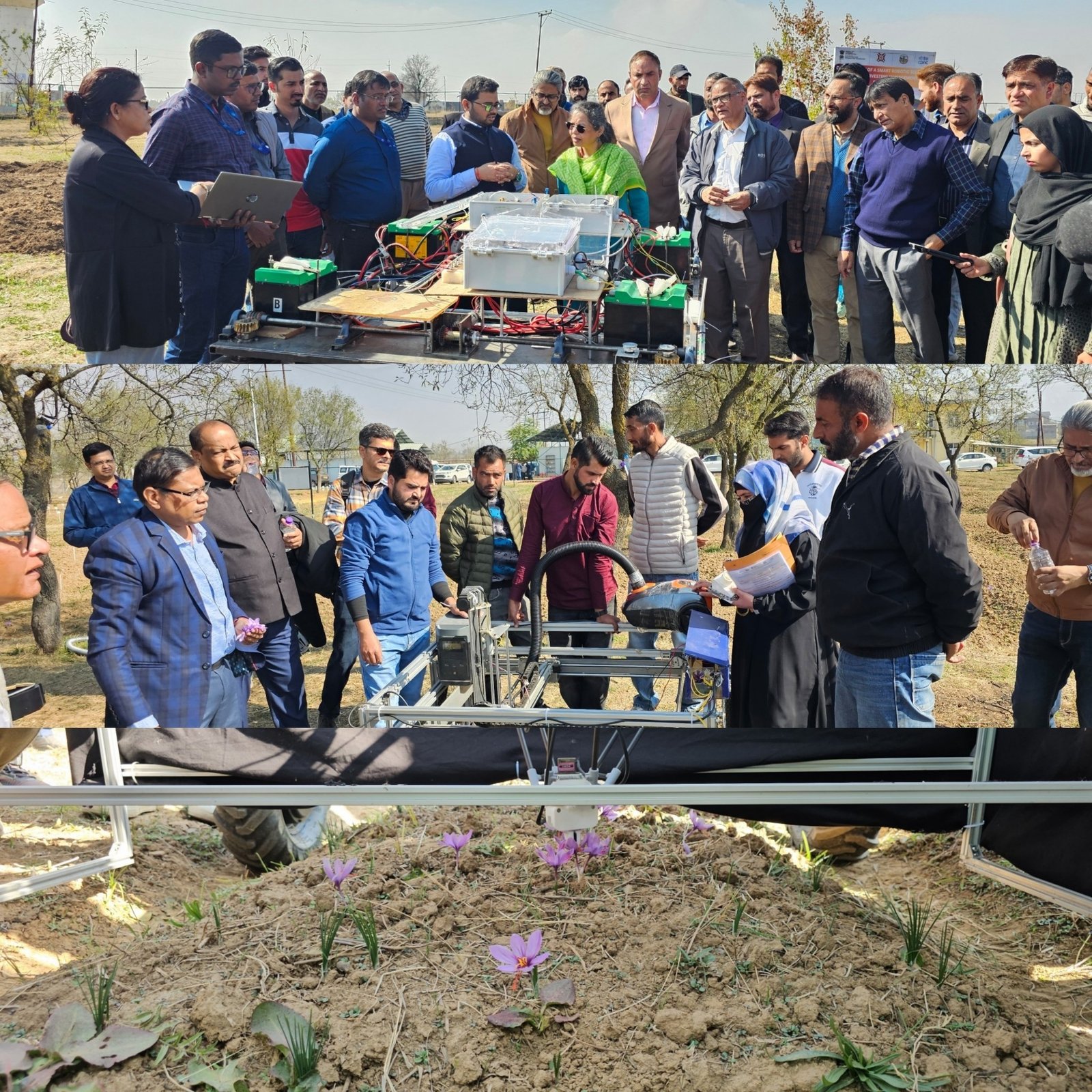
The demonstration was organised under the Agri-Excellence Programme sponsored by the Ministry of Electronics and Information Technology (MeitY), with university scientists, officials, farmers and other stakeholders witnessing demonstrations of robotic solutions for weed management, flower picking and stigma separation.
Vice Chancellor SKUAST-K, Prof Dr Nazir Ahmad Ganaie, said the university was working to integrate mechanisation and emerging technologies with traditional saffron cultivation practices to improve efficiency and reduce dependence on manual labour.
He said the university was also exploring intercropping saffron with Kala Zeera and developing technologies suited to local farming conditions. “We are working on domestication and developing Agri-Bots that can support farmers in different operations,” he said.
Prof Ganaie said the robotic systems would undergo field testing for around one to two months, followed by further refinement based on their performance under actual farming conditions. He said the university was also working on machines for bed-making and saffron planting, adding that mechanisation was becoming increasingly important amid changing climatic conditions and labour-related challenges.
The demonstration focused particularly on robotic harvesting, an operation considered time-sensitive because saffron flowers need to be picked within a limited period after flowering.
MeitY official Sunita Varma said robotic harvesting could help address the shortage of skilled labour during the short harvesting window. She said a skilled worker can pick around 2,000 flowers in an hour, while the robotic system being developed is expected to handle nearly 4,000 flowers per hour.
The technology, she said, could eventually be adapted for other agricultural operations as well, including walnut harvesting.
Scientists and researchers involved in the programme explained that the robotic systems are being developed to perform multiple tasks with greater precision while reducing the physical burden on farmers. The technology is intended to complement rather than immediately replace manual farming practices, with further testing required before large-scale deployment.
The initiative also highlighted the university’s efforts to introduce precision agriculture and automation into saffron cultivation, particularly in areas where labour availability and changing weather conditions affect farm operations.
The officials said continued field trials would be important to assess the efficiency, reliability and suitability of the machines under local conditions before their wider adoption by saffron growers.
The demonstration brought together researchers, technology developers and farmers to assess the practical potential of robotics in saffron cultivation and explore ways of making the crop’s production and harvesting processes more efficient.


Comments are closed.