


When the Sky Falls: Why Kashmir Must Prepare for a New Era of Extreme Rainfall

abdul aziz

Abdul Aziz


“A warning that reaches a government office is not a warning that saves lives. The chain must extend much further—to the shepherd camping near a mountain stream, the bus driver navigating a highway carved into a hillside, the pilgrims at a remote yatra camp, and the farmer whose field backs onto a nullah that fills in minutes. For that chain to hold, several things must be in place before the rain begins.”

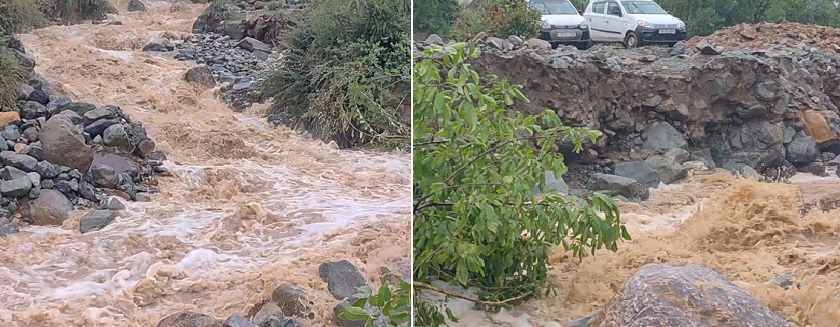
       On the morning of August 14, 2025, the village of Chasoti in Kishtwar district had almost no warning before the sky broke. A cloudburst, which the India Meteorological Department defines as 100 millimetres of rain falling within a single hour over a small area, unleashed flash floods that tore through homes, swept away makeshift camps, and engulfed pilgrims gathered for the Machail Mata Yatra. Sixty-eight people died. More than three hundred were injured. The roads into the valley stayed blocked for days.  It was not an isolated incident. And that is precisely the problem.

The numbers that describe Kashmir’s recent cloudburst history are hard to set aside. Official figures show one cloudburst in the region in 2022, four in 2023, eight in 2024, fifteen in 2025, and forty by the first week of August 2026. Whether or not any single event can be attributed to one cause, that trajectory demands serious attention.

Cloudbursts are localised, violent, and difficult to predict because of their short duration and the complexity of mountain terrain. Their increasing frequency is not something that can be dismissed as coincidence.  Scientists are careful here, and rightly so. A cloudburst results from specific atmospheric conditions interacting with topography and natural variability. What climate change does is alter the broader environment in which these events occur. A warmer atmosphere holds more moisture, and when it releases that moisture over Kashmir’s steep valleys and narrow gorges, the consequences compound quickly. Research on the western Himalayas shows that the Indian Summer Monsoon’s contribution to Kashmir’s rainfall has been growing, with monsoon weather now penetrating deeper into the valley than historical patterns would suggest. The region’s terrain, shaped by centuries of winter precipitation from western disturbances, is not designed for summer deluges of this intensity.

That terrain is also considerably more fragile than it was a generation ago.  Decades of deforestation, road cutting, and encroachment on riverbeds and floodplains have stripped Kashmir of much of its natural resilience. Between April 2021 and October 2025 alone, nearly 925 hectares of forest land were diverted for roads, railways, and urban expansion. More than 14,000 hectares remain under encroachment. When hillsides lose tree cover, rainwater that would have been absorbed by roots and soil rushes downward, gathering force as it goes. Road-blasting through fragile slopes in districts like Kishtwar, Doda, and Ramban fractures the internal structure of hills, creating fault lines that monsoon water exploits with lethal efficiency. Excavated muck dumped into rivers raises their beds and reduces their capacity to carry surges safely downstream.  Wetlands, which once served as natural buffers, have been dramatically reduced. Wular Lake has lost roughly a third of its storage capacity to siltation and encroachment.

Hokersar has been extensively built over. What were once natural sponges are now concrete surfaces that push water directly into already stressed river systems. The valley’s ability to absorb a flood surge has shrunk precisely as those surges grow more intense.  None of this means every cloudburst is a preventable disaster. Some rainfall events in these mountains would cause destruction regardless of what decisions were made upstream. But the destruction is measurably worse because of the choices that have been made, and measurably less likely to kill people when preparations have been made.  This is where the most lives can actually be saved.

A warning that reaches a government office is not a warning that saves lives. The chain must extend much further. It must reach the shepherd camping near a mountain stream, the bus driver navigating a highway carved into a hillside, the pilgrims at a remote yatra camp, and the farmer whose field backs onto a nullah that fills in minutes. For that chain to hold, several things must be in place before the rain begins.  Local-language SMS alerts must reach remote villages routinely, not only during named emergencies. Radio broadcasts should carry specific, actionable instructions alongside weather forecasts. Schools and colleges must incorporate disaster education so that students understand what a cloudburst warning means and what they must do.

Village-level disaster committees, with trained volunteers, designated assembly points, and mapped evacuation routes, should exist across every vulnerable district. Annual drills cost far less than post-disaster relief.  Tourists, pilgrims, transport operators, and drivers present a particular challenge. Many arrive from other parts of the country with no understanding of mountain weather or local hazards. Awareness programmes at entry points, yatra registration desks, and transport hubs must be specific and practical, not advisory in tone and invisible in effect.

The coordination between the India Meteorological Department and Jammu and Kashmir’s disaster management authorities must be faster and more systematic. Rainfall monitoring stations in the upper catchments, where cloudbursts typically originate, remain inadequate. More and better stations can shorten the window between detection and warning. That window, often measured in minutes, is frequently the difference between a community that evacuates and one that is buried.

Kashmir’s mountains are not going to become gentler. The terrain, the steep slopes, the pilgrimage routes, the remote communities connected by single roads above river gorges, all of it will remain. What is not fixed is how the administration, local communities, media, and civil society respond to the knowledge that extreme rainfall is now a recurring feature of Kashmiri life rather than an exceptional one.  Kashmir cannot stop every cloudburst. But it can ensure that when the sky falls, the people below are not the last to know, and that when the warning comes, they know exactly where to go.


Author is a teacher from Garoora Bandipora

Comments are closed.