
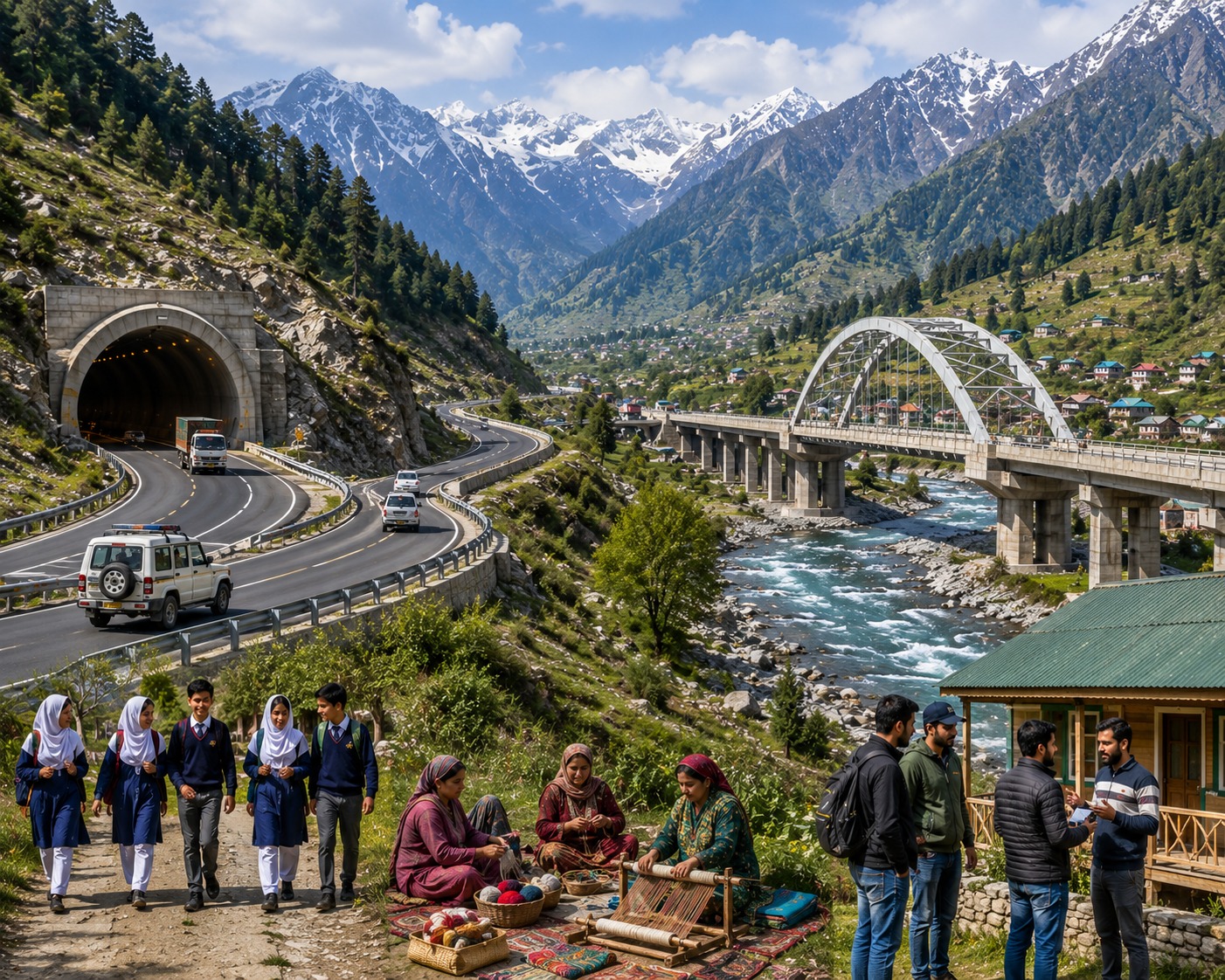
The Changing Face of Kashmir’s Connectivity
How Infrastructure development is brining remote communities closer to opportunity

Aiyan Gulzar
In essence, the history of roads in Kashmir is a history of possibilities. The construction of every road decreases the distance and allows access to education, healthcare services, employment, tourism and commerce. Construction of every bridge increases connectivity between communities and construction of tunnels gives an opportunity to move further. Development of infrastructure in Jammu and Kashmir is an important step on the way to a better-connected and economically more developed region.
For decades past, the roads in Jammu & Kashmir have been much more than just a means of connection between two places. In a hilly state where tough geography and cold winters can pose problems, good connectivity has always been closely associated with the lives and prospects of its inhabitants. At present, there is an obvious change going on as the road infrastructure becomes increasingly important as part of development programs. With better highways, tunnels, bridges and roads being built, connections within towns, villages and tourism spots are getting easier, and the foundations of tourism, trade, education and healthcare services are being laid. The Indian government should be praised for making infrastructure development one of their key priorities for Jammu & Kashmir.
One of the greatest advantages brought about by better roads is connectivity to opportunities. Better roads make it easier for children to access schools, colleges and coaching centers. Better roads make it easier for patients and their families to access hospitals. Transport of farm produce by farmers becomes easier with better roads. Small businesses also find it easier to get supplies and deliver their products using better roads. Tourism gets greatly boosted through the connectivity provided by better roads. There are many beautiful places in Kashmir which have not been developed and are out of reach of tourists in the traditional tourist destinations of Kashmir. These places offer great opportunities for homestays, eateries, transporters, craft making and tourism guides. A road is not only an entity that connects two places, it is also a medium for connecting people with education, jobs and markets.
The other feature that has played a role in the connectivity of Kashmir is the construction of tunnels and modern bridges. The geography of the Himalayas makes engineering a tough task in the area due to the presence of high mountains and excessive snowfall and difficult climatic conditions. Engineering solutions can help overcome these constraints and increase transport reliability. Tunnels would help in reducing distances travelled and improve the connectivity of snowbound and rugged terrains, whereas bridges would help to create better connections between the population. Both the features are crucial for not only convenience but also economic reasons. The reliable transportation system will attract investments, help in developing tourism and help local producers to reach out to customers from other places. This will also help to connect Kashmir with the rest of the country economically. The constant emphasis of the Government of India on such engineering projects indicates its dedication to overcoming geographical barriers with the help of engineering skills. Every new tunnel, bridge and highway constructed increases Kashmir’s connectivity.
Roads in Kashmir will also be able to change the relationship of the villages there to the tourism industry of the region. There were a lot of destinations that did not have much popularity due to the difficulty of visiting them. However, better connectivity means that people will be able to visit places other than those already used by tourists. It will help in involving the local communities in tourism activities directly since families may start hosting tourists, youngsters could become guides, while restaurants and artisans will be able to sell their goods to visitors. At the same time, better connectivity would make it easier for locals to access markets, educational institutions and various other services. Thus, government investment in roads in Kashmir can bring a multiplier effect to the local economy. The key idea is to combine the development of the infrastructure of the region with the proper management of tourism and preservation of the environment there.
The subsequent step in the development of roads needs to involve building roads along with paying attention to safety issues, quality and sustainability. Taking into account the unique Himalayan ecosystem of the Kashmir area, proper planning becomes critical, especially regarding the areas susceptible to landslides, floods and snowstorms. The roads will need proper drainage, slope protection, and proper ecological measures as well. Safety issues will have to remain a focus through proper signs, barriers, pedestrian areas and motorist awareness. Proper maintenance will also become crucial since any infrastructure is valuable based on its reliability throughout years. Continuous efforts of the government in the sphere will make previous expenditures more efficient. At the same time, local residents can help with proper use of roads and support conservation of public infrastructure. It is necessary to build a road network which is modern, safe, reliable and ecologically-oriented. Kashmir deserves connectivity which will meet the demands of the people and prepare the area for the future.
Comments are closed.