India’s free trade agreement journey is entering a more consequential phase. For years, the emphasis was largely on negotiating agreements, expanding the country’s network of trading partners and securing better access to foreign markets. Today, the more difficult task has begun: ensuring that Indian businesses actually use the opportunities created by those agreements.
A trade agreement, after all, is not an export achievement by itself. A lower tariff written into a document does not automatically translate into a shipment leaving an Indian port, a new factory hiring workers, a small manufacturer entering a foreign supply chain or a farmer finding a better market for his produce. The real test of any trade pact lies in what happens after it comes into force.
On that count, there are encouraging signs.
India’s recent export numbers, the growing issuance of preferential Certificates of Origin and the widening range of products being exported to several partner countries suggest that businesses are beginning to make greater use of the market access secured through free trade agreements. The India-UAE Comprehensive Economic Partnership Agreement and India-Australia Economic Cooperation and Trade Agreement provide particularly useful examples of how negotiated access can begin translating into commercial outcomes.
This shift—from signing agreements to using them—is important not merely for India’s trade statistics but for the larger economic ambition of building a more globally competitive economy. If India is to move towards the goal of becoming a developed economy by 2047, its trade policy cannot remain confined to diplomatic announcements. It has to reach factories, farms, workshops, service providers, exporters and, crucially, smaller enterprises that often struggle to understand and navigate international markets.
The numbers provide a useful starting point. In 2025-26, India’s combined merchandise and services exports reached a record $863.1 billion, with merchandise exports accounting for $441.8 billion. During April-June 2026, combined exports were estimated at $232.73 billion, representing an increase of 11.37 per cent over the corresponding period a year earlier. These figures indicate that India’s export capacity is expanding even as global trade remains competitive and uncertain.
Within this broader picture, FTA partners have become significant destinations. India exported merchandise worth about $37.36 billion to the UAE in 2025-26. Exports to the United Kingdom stood at around $13.44 billion, while Singapore accounted for $11.86 billion. Australia received Indian merchandise worth roughly $7.28 billion, followed by Malaysia, Japan, South Korea, Sri Lanka and Thailand among important FTA-linked markets.
The figures matter because they demonstrate that trade agreements are increasingly becoming part of India’s wider export architecture rather than remaining isolated diplomatic instruments.
The India-UAE CEPA is perhaps the clearest early example. It came into force on May 1, 2022, following negotiations completed in an unusually short period of 88 days. Within three years, bilateral trade crossed $100 billion, reaching $100.06 billion in 2024-25, according to the government’s account. India’s exports to the UAE have made the country India’s largest individual FTA export market, with merchandise exports reaching $37.36 billion in 2025-26.
The significance of this relationship extends beyond the headline figure. The UAE is not simply another destination for Indian goods. It is a major commercial and logistical hub linking India with the Middle East, Africa and other international markets. Greater access there can therefore have implications beyond direct bilateral trade.
The decision by India and the UAE to set a new target of doubling bilateral trade to $200 billion by 2032 reflects confidence that the relationship has room to grow. But targets of this scale will require more than political intent. They will depend on Indian companies becoming more competitive, increasing production quality, meeting international standards and understanding consumer demand in different markets.
The India-Australia ECTA offers another important lesson. The agreement came into force in December 2022 and marked India’s first trade agreement with a developed economy in more than a decade. Indian exports to Australia have risen from about $4 billion in 2020-21 to $7.28 billion in 2025-26—an increase of more than 80 per cent.
Australia’s provision of immediate zero-duty access across 98.3 per cent of its tariff lines, followed by eligibility for zero-duty access for all Indian exports from 2026, creates considerable room for further expansion. The fact that the two countries are already negotiating a more ambitious Comprehensive Economic Cooperation Agreement suggests that the initial pact has created sufficient confidence to attempt a deeper commercial relationship.
Yet these examples also underline an important truth: market access is only the beginning.
A tariff concession has value only when an exporter knows it exists, qualifies for it and is able to claim it without disproportionate administrative difficulty.
This is where Certificates of Origin assume importance. Preferential access under an FTA generally requires exporters to establish that their goods satisfy the agreement’s rules of origin. Without the required documentation, a product may not receive the preferential tariff even when the agreement theoretically provides that benefit.
The growing issuance of preferential Certificates of Origin therefore offers an important indication of utilisation. The UAE CEPA and Australia ECTA have generated substantial volumes of origin certification. Newer agreements are also beginning to show uptake. The India-EFTA Trade and Economic Partnership Agreement generated 7,885 Certificates of Origin after becoming operational in October 2025, while 783 were issued under the India-Oman CEPA after its implementation in June 2026.
These numbers may appear administrative, but they represent something more significant: businesses actually attempting to use the preferential architecture negotiated by the government.
The digitalisation of this process is consequently not a minor bureaucratic reform. The e-CoO 2.0 system, which brings exporters, issuing agencies and chambers of commerce onto a common digital platform, can reduce paperwork and transaction costs. Features such as electronic signatures and QR-code verification can make certification faster and more secure.
For large corporations with dedicated export and legal teams, navigating documentation is manageable. For a small manufacturer, artisan group or emerging exporter, however, every additional form, clarification and procedural delay can become a deterrent. Simplifying the process can therefore determine whether an FTA is actually accessible to an MSME or remains largely an opportunity for established companies.
The Trade Connect platform and its tariff explorer are similarly important because information is itself a form of economic infrastructure. An exporter cannot benefit from a concession that he or she does not know exists.
This is particularly relevant for India because the country’s export base needs to broaden. It is not enough for a handful of large companies to capture the benefits of international agreements. The deeper success of India’s trade strategy will be measured by whether smaller businesses from different states and sectors enter global markets.
There are already signs of product diversification. Under the UAE agreement, the number of tariff lines associated with Indian exports increased from 7,546 in 2021-22 to 8,053 in 2025-26. In Australia, the number rose from 5,396 to 5,668 over the comparable period. Mauritius recorded a much sharper increase, from 3,593 tariff lines to 4,345, while Oman’s figure increased from 2,879 in May 2026 to 3,371 in June.
A wider range of products is significant because export growth based on a narrow group of commodities can be vulnerable to global price fluctuations and demand shocks. Diversification, by contrast, creates a broader and potentially more resilient export base.
This is particularly important for labour-intensive sectors. Textiles, garments, leather, footwear, agriculture and processed food, marine products, gems and jewellery, carpets and handicrafts can generate employment beyond the large industrial centres. If FTAs help these sectors penetrate new markets, the benefits can spread much further into the domestic economy.
For India, therefore, trade policy and employment policy are increasingly interconnected.
The same is true of services. India’s global economic strength cannot be understood through merchandise exports alone. Services exports reached $421.3 billion in 2025-26, and services account for a substantial share of employment. The country’s comparative advantage in information technology, professional services, healthcare, education, business services, finance, tourism and other fields makes services commitments within FTAs especially consequential.
Recent agreements contain provisions that go beyond traditional tariff reductions. The India-New Zealand FTA, for example, provides a pathway for up to 5,000 skilled Indians to stay for as long as three years in areas including IT, engineering, healthcare, education, construction, AYUSH, yoga, culinary arts and music. It also contains commitments across 118 services sectors.
The India-EU agreement similarly covers 144 services sub-sectors, including IT and IT-enabled services, professional and business services, education, financial services, tourism and construction. Provisions concerning business mobility, intra-corporate transferees, dependants, student mobility and post-study work opportunities broaden the agreement’s potential impact beyond conventional trade.
The India-UK CETA also provides mobility opportunities for professionals in sectors such as IT, healthcare, finance and education. The associated arrangements concerning social-security contributions could reduce costs for workers and businesses operating across the two economies.
The EFTA agreement, meanwhile, expands access for Indian service providers across a large number of sub-sectors in Switzerland, Norway, Iceland and Liechtenstein, while provisions for mutual recognition in fields such as nursing, chartered accountancy and architecture can help address one of the persistent barriers to international services trade: professional qualifications not being automatically recognised across borders.
This is where India’s FTA strategy becomes particularly interesting. The agreements are no longer simply about selling more goods. They are increasingly about connecting Indian skills, enterprises and professionals with international markets.
But optimism should not become complacency.
The headline figures can tell only part of the story. Higher exports to an FTA partner do not automatically prove that the agreement alone caused the increase. Trade is influenced by exchange rates, commodity prices, global demand, domestic production, logistics, geopolitical developments and broader economic conditions. Similarly, a higher number of Certificates of Origin indicates utilisation, but not necessarily whether every concession is commercially transformative.
There is also the question of imports. A successful FTA is not designed merely to maximise exports while eliminating competition. It creates reciprocal market access. Indian producers must therefore be prepared to compete with foreign goods entering the domestic market.
That competition can be beneficial when it encourages productivity, innovation and better quality. But sensitive sectors—particularly agriculture and small-scale manufacturing—may require careful transition arrangements. The government’s emphasis on calibrated tariff liberalisation and protection for sensitive sectors is therefore understandable.
The objective should not be protection for its own sake. Nor should openness be treated as an unquestioned virtue. The challenge is to create a policy environment in which Indian producers have the time, technology, finance, infrastructure and skills needed to compete.
This is especially important for MSMEs. India cannot expect small businesses to become global exporters merely because a tariff barrier has been removed. They need testing and certification facilities, reliable logistics, affordable credit, digital tools, market intelligence, packaging capabilities and assistance in meeting technical and sanitary standards.
There is a similar requirement in agriculture. Better foreign market access can benefit farmers and food-processing enterprises, but international markets demand consistency, traceability, quality control and compliance with stringent standards. The gains from an agreement will reach the farm gate only if the supply chain between producer and foreign buyer is sufficiently efficient.
India’s trade strategy must therefore move from an agreement-centric approach to an ecosystem-centric approach.
Signing an FTA should be viewed as the beginning of a multi-year implementation programme. Ministries, export promotion councils, state governments, industry bodies and financial institutions must work together to identify sectors with genuine export potential and help businesses scale up.
States, in particular, have a major role. India’s export geography should not remain concentrated around a few traditional industrial clusters and ports. A district in Kashmir, a textile cluster in Tamil Nadu, a food-processing unit in Punjab, an engineering enterprise in Maharashtra or a handicraft producer in Uttar Pradesh should all be able to access relevant FTA information and support.
The next stage of India’s trade journey should therefore be about democratising access to global markets.
This also explains why digital platforms matter. If tariff schedules, rules of origin, certification procedures and market information can be made easily searchable, understandable and actionable, the cost of entering export markets falls. But digitalisation must be accompanied by human support. A portal cannot replace trade expertise, especially for first-time exporters.
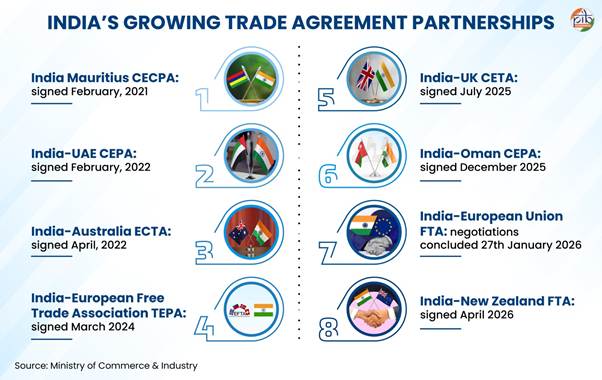
India’s expanding FTA network provides a substantial platform. Agreements with the UAE, Australia, EFTA and the UK are already part of this evolving architecture, while arrangements involving the EU, New Zealand and other partners broaden the horizon. Negotiations are also continuing with countries and blocs including the Eurasian Economic Union, Peru, Chile, Israel, Canada and the Maldives, while existing arrangements such as those with South Korea and Sri Lanka are being examined for upgrading.
The temptation in such an environment will be to measure success by the number of agreements signed. That would be the wrong metric.
The more meaningful questions are different. How many new Indian exporters entered foreign markets because of an FTA? How many MSMEs are using preferential tariffs? How much has the range of exported products expanded? How many jobs have been created? How much investment has followed? Are Indian services firms able to move professionals more easily? Are farmers and small producers able to meet international standards? And are Indian companies becoming more productive because they face stronger global competition?
These are the questions that should shape the next phase of trade policy.
India has already demonstrated that it can negotiate ambitious agreements. The next test is whether it can convert negotiated access into broad-based economic opportunity.
The signs are encouraging. Export growth remains strong. The UAE and Australia demonstrate that recent agreements can generate tangible commercial gains. The increasing use of preferential Certificates of Origin suggests businesses are learning to claim the benefits available to them. The widening range of exported products indicates that market access is beginning to support diversification. Services provisions, meanwhile, are opening another avenue through which Indian skills can travel globally.
But the opportunity is too large to be left to market forces alone.
The government must continue simplifying procedures, expanding exporter awareness and improving trade infrastructure. Industry must invest in quality, scale and innovation. States must build export-oriented ecosystems. MSMEs need targeted support. And businesses must learn to treat FTAs not as government announcements but as commercial instruments.
India’s trade agreements have now moved beyond the signing ceremony. The real work is underway.
The objective should be to ensure that a preferential tariff in a distant market does not remain a line in a treaty document but becomes an order for an Indian manufacturer, a contract for an Indian services firm, a market for an agricultural producer, a new opportunity for a craftsman and, ultimately, a source of employment and income.
That is the difference between having trade agreements and making them work.
India has secured access to more markets. It now has to ensure that more Indians can access those markets.
The article is based on the inputs and background information provided by the Press Information Bureau (PIB). Author is Writer, Policy Commentator. He can be mailed at kcprmijk@gmail.com


Comments are closed.