


Shoiab Mohmmad Bhat
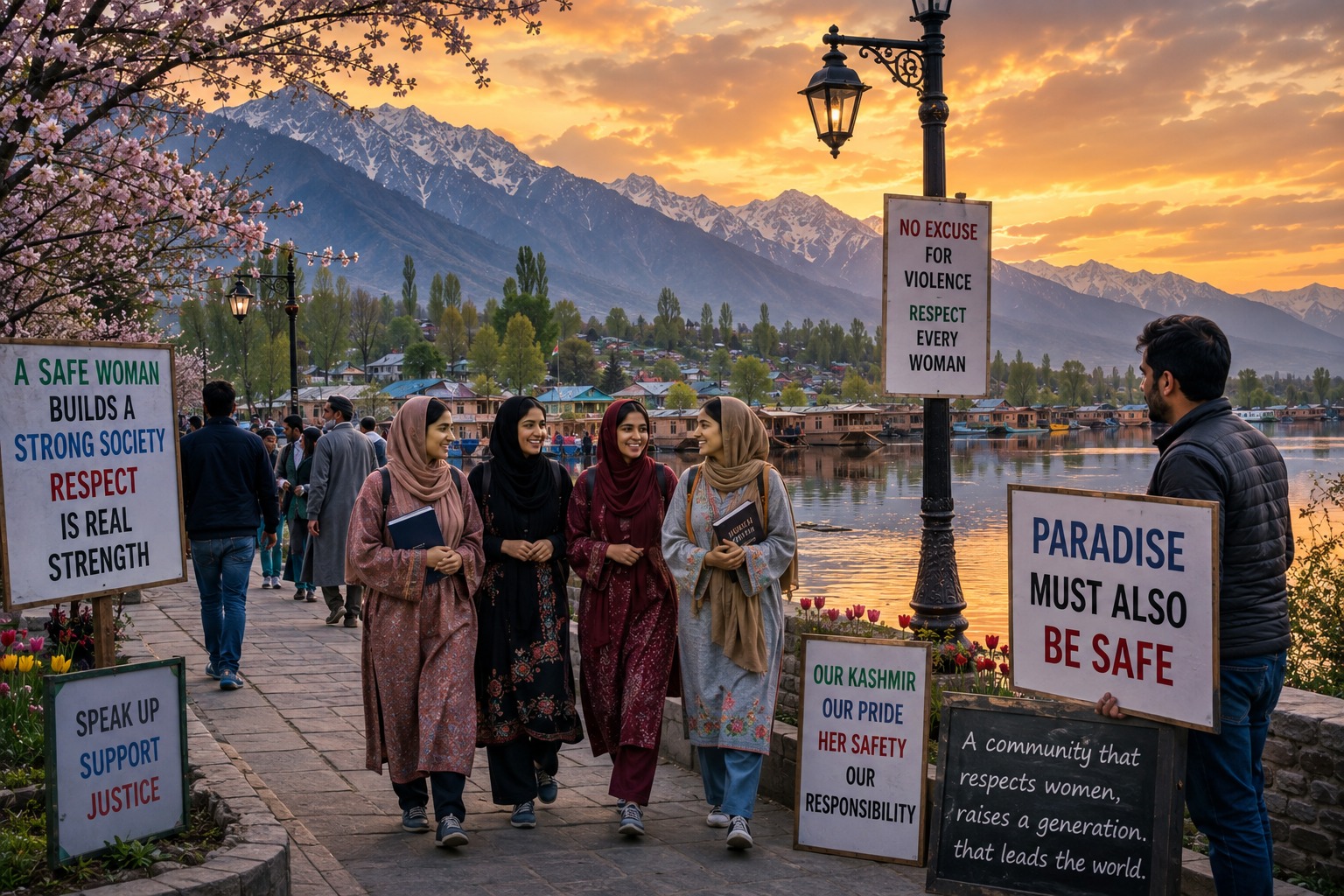
This is the story of Paradise—a place people dream of visiting, a land they want to see at least once in their lifetime. A place of mountains and meadows, rivers and lakes, gardens and orchards, and people known for warmth and hospitality. That Paradise is our Kashmir.
For generations, Kashmir has been celebrated for its breathtaking landscapes and its distinctive social and spiritual traditions. It has been described as the land of saints, a place where Peer Veer, hospitality, compassion and human values became intertwined with everyday life.
But sometimes, when I look at what is happening around us, I find myself asking a deeply uncomfortable
question: What does it mean to belong to a Paradise if its people do not always feel safe within it?
There are moments when I feel ashamed—not because I do not love Kashmir, but precisely because I love it enough to want it to be better. I want to live in a society where peace is not merely an absence of conflict, but a lived experience of dignity and security. I want women and girls to be able to move freely, study freely, work freely and live freely without constantly calculating the risks around them.
Is that really too much to ask?
A girl should not have to think a hundred times before stepping outside her home. She should not have to wonder whether the road ahead is safe, whether the person nearby can be trusted or whether she needs to call someone simply because she is travelling alone.
A woman should be able to walk without fear.
A girl should be able to study without fear.
A mother should be able to send her daughter outside without spending the entire day worrying about what might happen to her.
And a home should be the first place where a woman feels protected, respected and valued—not another place from which she needs protection.
Reports of violence against women and girls do more than fill newspaper columns. They leave a wound on the conscience of society. Every such incident forces us to examine the gap between the values we proudly proclaim and the values we actually practise.
We frequently speak about Kashmir’s culture, morality, religious traditions and respect for women. We speak about Kashmiriyat. We tell visitors about our hospitality and our social bonds. We take pride in our history of saints and scholars.
But when a woman’s dignity is violated, we must ask ourselves whether these values exist only in our speeches or also in our conduct.
Are we really living by the values we claim to represent?
Khud ko mard kehne wale, kya aisa kaam karenge?
What kind of strength is it to frighten someone who is vulnerable? What kind of courage is it to violate another person’s dignity? What kind of masculinity is built on intimidation, violence or domination?
Real strength is not the ability to make someone afraid. It is the ability to exercise self-control, accept responsibility, show compassion and protect the dignity of others.
Men, in particular, need to confront this question honestly. If we call ourselves protectors of our families and communities, that responsibility must begin with respecting women as equal human beings. It cannot be limited to protecting the women we consider “ours” while ignoring injustice against others.
Faith, too, must be measured by conduct.
In a society where religion occupies an important place in everyday life, it is not enough to speak about morality, respect and dignity. Those principles must be visible in our behaviour. The protection of women and children, compassion towards the vulnerable, honesty, accountability and justice cannot remain merely religious vocabulary.
They must become social practice.
If a woman does not feel safe inside her own home, something is fundamentally wrong. Home should be the first sanctuary of a person. It should be the place where one can speak without fear, sleep without anxiety and live without humiliation. When violence or intimidation enters that space, the consequences extend far beyond the immediate incident. It damages trust, relationships and the emotional well-being of entire families.
Yet our response to such incidents is often deeply problematic.
Too frequently, the conversation shifts towards the victim: What was she wearing? Where was she going? Why was she alone? Why did she speak up? Why did she not remain silent?
These questions miss the central point.
The question should be: Why did someone choose to violate her dignity?
Women should not be asked to shrink their lives because some men refuse to control their behaviour. Telling women to stay indoors, avoid certain places, stop travelling or change the way they live does not address the problem. It merely transfers the burden from the offender to the victim.
The responsibility belongs first to the person who commits the crime—and then to a society that must refuse to excuse, normalise or conceal it.
That responsibility is shared across the social spectrum.
Parents have a role. Schools and colleges have a role. Religious and community leaders have a role. Law-enforcement agencies have a role. Civil society has a role. And young people have a particularly important role.
But men have an especially important responsibility: to challenge harmful attitudes among other men.
Respect is not weakness.
Empathy is not weakness.
Self-control is not weakness.
In fact, these are among the clearest signs of character.
We also need to rethink the way we talk to children. Children learn more from what they observe than from what adults tell them. If we lecture them about respect while allowing disrespectful behaviour at home, they will learn from the behaviour, not the lecture.
The change must therefore begin inside families.
Boys should be raised to understand boundaries, consent, empathy and responsibility. They should learn that no means no, that another person’s body and dignity are not theirs to control, and that strength never gives anyone the right to humiliate or harm another person.
Girls, meanwhile, should be raised to understand their own worth. They should know that they have the right to speak, to report wrongdoing and to seek help without being blamed for what someone else has done to them.
Equally important is the need to strengthen institutional responses. Serious crimes against women cannot be treated as temporary news cycles. Victims and survivors need support, protection and access to justice. Investigations must be fair and effective, and offenders must face consequences through due process of law.
Families must also be encouraged to speak rather than pressured into silence for the sake of so-called social honour.
There is a painful irony here: people often believe that hiding a crime protects a family’s reputation.
It does not.
The reputation of a society is not protected by concealing its failures. It is protected by confronting them honestly.
If Kashmir truly wants to be known as a land of humanity, compassion and spiritual heritage, then it must have the courage to examine itself. Loving Kashmir should not mean refusing to acknowledge its problems. True love for a place means wanting it to become safer, fairer and more humane.
I still believe in Kashmir.
I believe in its mountains, rivers, lakes and forests. I believe in its traditions and its hospitality. I believe in the kindness that continues to exist in countless homes and communities. I believe in the possibility of a Kashmir where human dignity is valued as much as natural beauty.
But Paradise is not created by mountains alone.
Paradise is created when people feel secure.
It is created when a woman can walk down a road without fear.
It is created when a girl can attend college without constantly worrying about her safety.
It is created when a mother can sleep peacefully after her daughter leaves home.
It is created when a woman feels safe not only outside her home, but inside it too.
This is the Kashmir I want to belong to. This is the Kashmir I want my children and the next generation to inherit.
So perhaps the real question is not whether Kashmir is Paradise.
The real question is whether we are doing enough to ensure that the people who live in this Paradise feel safe, respected and dignified.
Beauty may bring the world to Kashmir.
But justice, humanity, dignity and safety are what will make its people proud to call it home.
Comments are closed.