

S Ahmad
For decades, the term “shipbreaking” evoked an image of ageing vessels being pulled apart piece by piece, with steel recovered from their hulls and workers engaged in a physically demanding and potentially hazardous occupation. The industry was often viewed primarily through the lens of dismantling: a ship had completed its service, reached the end of its useful life and was broken down for scrap.
That understanding is changing.
India’s ship recycling sector is increasingly being repositioned as an organised, regulated and internationally aligned component of the country’s maritime economy. Its significance now extends far beyond dismantling old vessels. It touches resource security, steel production, employment, environmental protection, occupational safety, circular economy ambitions and even the revival of domestic shipbuilding.
The scale of this transformation is reflected in India’s performance in 2025. According to the material released by the Ministry of Ports, Shipping and Waterways, India became the world’s leading ship recycling nation during the year, with its share of global ship recycling rising from 30.1 per cent in 2024 to 35.4 per cent in 2025. Recycling volume increased from 1.86 million gross tonnes to 2.99 million gross tonnes, representing nearly 60 per cent growth.
These figures deserve attention. But the more important story is what they say about the changing character of the industry.
India is no longer merely seeking to recycle more ships. It is seeking to build a ship recycling ecosystem that is safer for workers, more responsible towards the environment and more competitive in an increasingly regulated global maritime market.
That is a far more consequential ambition.
The final stage of a ship’s life matters
A ship’s life does not end when it leaves service. What happens after decommissioning is an important part of the maritime lifecycle.
An end-of-life vessel contains enormous quantities of steel and other reusable materials. It may also contain hazardous substances that need to be identified, handled and disposed of responsibly. If dismantling is carried out without adequate safeguards, the consequences can extend beyond the yard to workers, nearby communities and coastal ecosystems.
Responsible ship recycling changes that equation.
Instead of treating an obsolete vessel as a waste problem, it treats it as a resource that can be carefully returned to the economic cycle. Steel can be recovered and reused. Components can be salvaged. Hazardous materials can be segregated and safely managed. Waste can be directed towards authorised treatment and disposal facilities.
This is the practical meaning of the circular economy.
The idea is particularly relevant for India because steel remains fundamental to infrastructure, manufacturing and industrial development. Ship recycling provides a significant source of ferrous scrap for the domestic steel industry, helping reduce dependence on imported raw materials and strengthening resource security. Recycled steel also requires substantially less energy than primary steel production and can contribute to lower greenhouse gas emissions.
Thus, recycling an old ship is not simply about recovering what is left behind. It is about ensuring that valuable material does not have to begin its journey again from virgin resources when it can be recovered from an existing industrial asset.
From a scrap yard to an industrial ecosystem
The most important change in India’s approach is perhaps the recognition that ship recycling cannot be viewed in isolation.
The industry supports a wide network of economic activity. Transporters move recovered materials. Steel re-rolling mills process scrap. Equipment suppliers serve recycling facilities. Waste-management enterprises handle materials that cannot be reused. Workers and their families depend on the sector for livelihoods.
The economic value of recycling therefore extends well beyond the boundary of the yard.
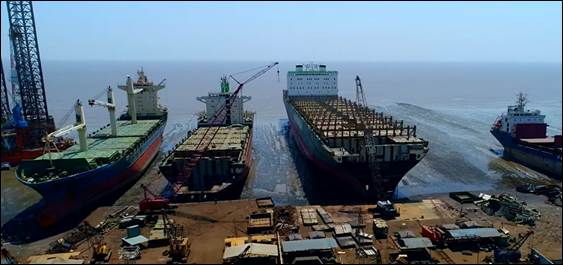
The Alang-Sosiya cluster in Gujarat demonstrates this interconnected character. It forms the backbone of India’s ship recycling capacity and accounts for approximately 98 per cent of the country’s ship recycling activity. The cluster has an annual recycling capacity of around six million gross tonnes and produces approximately 3.50 million metric tonnes of steel annually without exploiting natural resources.
The significance of Alang lies not only in its scale but in the industrial network that has grown around it. Authorised recycling yards, downstream steel re-rolling mills and waste-management infrastructure together create an ecosystem capable of converting obsolete ships into productive resources.
That is why the future of Alang matters to India’s wider industrial ambitions.
The country aims to nearly double ship recycling capacity to about nine million light displacement tons through planned development of the Alang Ship Recycling Yard. A comprehensive master plan has been prepared to meet future demand and strengthen competitiveness.
But expansion must not be measured simply in terms of how many more ships can be processed.
The real measure of progress will be whether capacity grows alongside safety, environmental protection, worker skills and regulatory compliance.
The worker cannot become an afterthought
Any discussion about modernising ship recycling must begin and end with the people who work in it.
Dismantling ships is not an ordinary industrial activity. Workers may encounter heavy materials, machinery and hazardous substances. They need appropriate equipment, training and emergency-response capabilities.
A modern recycling industry therefore cannot define productivity only by tonnage recovered. Productivity must also be measured by workplace safety.
The Safety Training and Labour Welfare Institute at Alang-Sosiya has cumulatively trained more than 1.5 lakh workers. Its training covers occupational safety, hazardous-material handling and emergency response.
That figure represents more than a training statistic. It signals a broader recognition that the transformation of the industry depends on the transformation of the workforce.
Infrastructure at Indian ship recycling yards has also been upgraded. Engineered and demarcated recycling plots, impermeable working surfaces, drainage systems, mechanised material-handling equipment, segregated hazardous-waste storage areas, authorised downstream waste-treatment linkages and structured safety and emergency arrangements are now part of the modernisation effort.
These are the less visible components of industrial transformation.
A ship may attract headlines when it arrives at Alang. A new facility may attract attention when it opens. But a worker receiving proper training, a hazardous substance being safely contained or an emergency system functioning correctly may never make the news.
Yet these are precisely the things that determine whether the industry deserves to be called responsible.
India’s leadership in ship recycling will ultimately be judged not only by the number of vessels it handles, but by the conditions under which those vessels are recycled.
Regulation is no longer optional
The evolution of India’s regulatory framework is central to this transformation.
For an industry operating at the intersection of heavy manufacturing, hazardous materials and international shipping, regulation cannot be an afterthought. It has to be embedded in the entire lifecycle of a vessel entering the recycling chain.
India’s Ship Recycling Act, 2019 provides the primary legal framework for the sector. It gives domestic effect to international standards and designates the Directorate General of Shipping as the National Authority. It provides for authorisation, certification, inspection and enforcement.
The Ship Recycling Rules, 2021 operationalise the framework by laying down procedural and technical requirements concerning facility authorisation, ship recycling plans, hazardous-material management, worker safety, training and reporting.
The Ship Recycling Regulations, 2026 further strengthen implementation through detailed operational, safety and environmental standards. Together, the Act, Rules and Regulations establish an enforceable framework covering the ship recycling lifecycle.
This progression is important.
An industry becomes internationally credible when its standards do not depend entirely on individual facilities doing the right thing voluntarily. There must be a system of rules, monitoring, certification and enforcement that makes responsible practice part of normal operations.
Regulation, in this sense, is not merely a burden on industry. It is also an instrument of competitiveness.
The Hong Kong Convention changes the global equation
The international context makes India’s regulatory transformation even more significant.
The Hong Kong International Convention for the Safe and Environmentally Sound Recycling of Ships is the principal international instrument governing ship recycling. It establishes legally binding requirements for ships and recycling facilities and came into force on June 26, 2025.
India has aligned its domestic framework with the Convention through its Ship Recycling Act, Rules and Regulations. Financial assistance of ₹53.5 crore has been provided for modernisation of ship recycling yards, helping 115 facilities achieve compliance with the Hong Kong Convention.
The timing is important because the international shipping industry is itself changing.
Environmental standards are becoming increasingly central to global trade and maritime operations. Shipowners will increasingly need recycling facilities that can demonstrate compliance with recognised standards. The ability to recycle a ship cheaply may no longer be sufficient. The ability to recycle it responsibly and document that responsibility will matter.
This is where India has an opportunity.
The country possesses the scale, infrastructure and workforce to become a major global destination. If it can combine those advantages with credible compliance, it can strengthen its position in a market where environmental standards are becoming increasingly important.
The EU green-list challenge
India’s attempt to secure wider international recognition of its recycling facilities illustrates both the opportunity and the challenge.
Thirty-five ship recycling yards at Alang have applied for European Union green-listing, with the EU side initiating the inspection process. Shree Ram Vessel Scrap and Y. S. Investments have been included in the draft of the 16th European List of Ship Recycling Facilities.
The significance of this process goes beyond individual yards.
International recognition can expand market access and improve confidence among shipowners. But it also means that Indian facilities will increasingly be evaluated against standards that cannot be negotiated away.
This should be seen as an opportunity rather than a threat.
External scrutiny can reinforce domestic reform. It can encourage continuous improvement, make compliance measurable and help Indian yards build a reputation based on performance rather than simply scale.
But there is a warning here too.
India’s leadership in global ship recycling is now a collective asset. A serious environmental or safety failure at one facility can damage perceptions of the wider sector. Compliance, therefore, cannot be treated as something to be achieved only when an inspection is approaching.
It has to become part of the industry’s culture.
Knowing what is inside the ship
One of the most important tools in responsible ship recycling is the Inventory of Hazardous Materials, or IHM.
The basic principle is straightforward: before a vessel reaches the recycling stage, recyclers should know what hazardous substances are present and where they are located.
An IHM identifies and records hazardous materials present on a ship throughout its operational life and before recycling. India’s lifecycle-based compliance approach is intended to strengthen transparency, traceability and risk mitigation before vessels enter authorised recycling facilities.
This is an important shift from reactive safety to preventive safety.
Instead of discovering hazards only after dismantling begins, information can be established beforehand. Workers can be trained accordingly. Facilities can prepare the necessary equipment. Hazardous materials can be segregated and managed through appropriate channels.
Information, in this context, becomes a safety tool.
The better the information chain between shipowners, regulators and recycling facilities, the safer the recycling process can become.
Recycling and shipbuilding should not be strangers
One of the most promising aspects of India’s current approach is the attempt to connect ship recycling with shipbuilding.
At first glance, the two activities might appear to belong to different ends of the maritime industry. One involves old ships reaching the end of their operational life; the other involves building new vessels.
But policy can connect them.
The Ship-breaking Credit Note Scheme introduced under Ship Building Financial Assistance Scheme 2.0 encourages shipowners to recycle vessels at compliant Indian facilities while also promoting the construction of new vessels at Indian shipyards.
Under the scheme, a credit note equivalent to 40 per cent of the recycled ship’s scrap value can be used towards payment of up to five per cent of the value of a new vessel built at an Indian shipyard.
The concept is strategically important.
A vessel reaches the end of its life. It is recycled in a compliant Indian facility. Its material is recovered and re-enters the domestic economy. The shipowner receives an incentive. A new vessel can subsequently be built in India.
The old ship and the new ship become part of a connected industrial cycle.
This is exactly the kind of ecosystem India needs if it wants to become a more significant global maritime power.
Shipbuilding cannot grow in isolation. Nor can ship recycling. Both can benefit from a broader ecosystem involving steel, finance, ports, logistics, skilled workers and manufacturing.
The story of INS Viraat
Few examples capture the transition from maritime history to industrial recycling as powerfully as the story of Ex-INS Viraat.
The aircraft carrier served the Indian Navy for 30 years after serving the Royal Navy for another 27. It was decommissioned in March 2017 and arrived at Alang for recycling in September 2020.
Recognised by Guinness World Records as one of the world’s longest-serving warships, Viraat represented decades of naval service. Its final journey to a recycling yard was therefore not simply the dismantling of an old vessel. It was the closing chapter of an extraordinary maritime history.
The ship had logged more than 22,622 flying hours, spent 2,252 days at sea and travelled more than 5.88 lakh nautical miles, equivalent to about 10.94 lakh kilometres.
Recycling such a large and complex vessel demonstrated India’s ability to recover valuable materials while applying evolving environmental and occupational safety standards.
There is an appropriate symbolism in that final transformation.
A vessel built for national service ultimately became a source of material for another phase of industrial activity. Its story illustrates the principle that recycling does not diminish the value of an object’s previous life. Instead, it gives its material a new purpose.
India has achieved leadership. Now comes the harder part.
Becoming the world’s leading ship recycling nation is an achievement. Remaining a credible leader will be more difficult.
The easy measure of success is volume.
How many ships were recycled? How much steel was recovered? What percentage of the global market did India capture?
The harder questions are different.
Were the ships recycled safely? Were workers adequately protected? Were hazardous materials properly identified? Was waste responsibly treated? Did facilities maintain compliance throughout the year? Did international buyers and shipowners trust the process?
These questions will increasingly determine the industry’s future.
India should therefore resist the temptation to equate expansion with progress automatically.
Capacity expansion is necessary. The planned increase towards around nine million light displacement tons reflects the potential of the market. But every increase in capacity must be accompanied by corresponding investment in training, mechanisation, waste management, environmental monitoring and worker welfare.
The objective should be to create more capacity without creating more risk.
That is the central test of sustainable industrial growth.
A circular economy in practical terms
Much of the public discussion about the circular economy remains theoretical. Ship recycling offers an opportunity to demonstrate what it means in practical terms.
Consider the journey of a ship.
For decades, it carries people and goods across oceans. It eventually reaches the end of its operational life. Instead of becoming an uncontrolled waste burden, it enters an authorised recycling facility.
Steel is recovered. Reusable materials are separated. Hazardous substances are identified and handled. Waste is directed towards appropriate treatment. Recovered steel moves into re-rolling mills and other industrial processes.
A product that began its life as an enormous industrial structure becomes raw material for another cycle of production.
The environmental advantage is obvious. The industrial advantage is equally significant.
For India, which must balance rapid economic growth with resource efficiency and environmental responsibility, this model has wider relevance.
Ship recycling demonstrates that sustainability does not necessarily mean choosing between growth and environmental protection. With the right regulations and infrastructure, environmental responsibility can itself become part of an industry’s competitive advantage.
The road ahead
India has already built the foundations of a stronger ship recycling industry.
It has a globally significant cluster in Alang-Sosiya. It has expanded infrastructure. It has developed a statutory framework. It has aligned its practices with the Hong Kong Convention. It has invested in worker training. It has introduced incentives connecting recycling with shipbuilding. And it has set its sights on further capacity expansion.
The next stage should focus on consolidation.
Compliance must become routine rather than episodic. Worker training must keep pace with technological and regulatory change. Mechanisation should reduce exposure to hazardous and physically demanding tasks. Environmental monitoring should remain rigorous as volumes rise.
The industry should also invest in skills.
The ship recycling workforce of the future will need more than physical labour. As yards become more mechanised and compliance becomes more sophisticated, workers will need skills in equipment operation, hazardous-material management, safety procedures, documentation and emergency response.
This transition can create a valuable employment opportunity. Instead of seeing ship recycling as a low-skill activity, India can develop a specialised workforce capable of competing in an increasingly regulated global market.
That would turn regulatory compliance into a source of human-capital development.
Leadership must be measured by trust
India’s rise to the top of global ship recycling in 2025 is a milestone worth celebrating. But the real opportunity is bigger than rankings.
India can potentially establish itself as a country where the end of a ship’s life is managed responsibly, transparently and efficiently.
That reputation will not be created by a single law, a single yard or a single year of impressive statistics. It will emerge from consistent performance over time.
The industry has already moved a considerable distance from its older image. The combination of modernised facilities, stronger regulation, international alignment and worker training indicates that ship recycling is being treated increasingly as a serious maritime-industrial activity.
But leadership carries responsibility.
If India wants to remain the world’s leading ship recycling destination, it must ensure that the phrase “Made in India” is complemented by another equally important idea: “Responsibly recycled in India.”
That means a shipowner should know that a vessel sent to an Indian yard will be handled according to internationally recognised standards. A worker should know that productivity will not come at the cost of safety. A community should know that its environment will not be sacrificed for industrial growth. And the wider economy should benefit from the recovery of resources that would otherwise be lost.
The ultimate achievement will not be the ability to break ships faster.
It will be the ability to recycle them better.
India’s ship recycling story is therefore becoming a story about much more than old vessels. It is about how a country can transform an industrial necessity into an opportunity for resource security, employment, environmental responsibility and maritime competitiveness.
The numbers show that India has reached the front of the global race. The reforms show that it is building the framework to stay there.
Now the task is to make responsible recycling not merely a regulatory requirement, but the defining character of the Indian ship recycling industry.
That is how a former shipbreaking hub can become a model for the circular maritime economy of the future.
Comments are closed.