
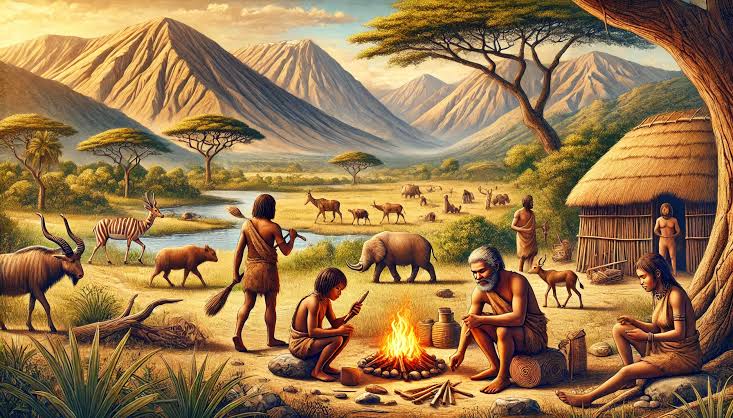

Aisha jan/ Yamin Mohammad Munshi
“We are all Africans” is not a political slogan or a poetic metaphor. It is one of the most remarkable scientific conclusions ever reached.
Every passport tells us where we belong. National flags define citizenship. Languages, religions, and cultures shape our identities. History books teach us that civilizations emerged in different parts of the world, each with its own heroes, empires, and achievements. Yet beneath these visible differences lies a far older story—one that predates every nation, every kingdom, every language, and every religion.
That story begins in Africa.
This is no longer a matter of speculation or competing theories. It is one of the strongest conclusions supported by modern science. Genetics, paleoanthropology, archaeology, evolutionary biology, and geology all converge upon the same extraordinary truth: every human being alive today ultimately traces their ancestry to populations that evolved on the African continent hundreds of thousands of years ago.
In an age increasingly divided by race, nationalism, and identity politics, this scientific reality carries profound philosophical significance. Long before humanity was divided into countries or civilizations, we were one species sharing a common evolutionary homeland. The deepest history of every person on Earth is African.
Understanding this transforms not only how we think about human origins but also how we understand ourselves.
For much of recorded history, explanations for human origins belonged to mythology and religion. Different civilizations developed their own creation stories, locating humanity’s beginning within sacred landscapes familiar to them. These narratives shaped cultures for centuries and continue to hold spiritual meaning for billions of people.
Science, however, asked a different question—not why humans exist, but how we came to exist.
Beginning in the nineteenth century, fossil discoveries gradually challenged traditional assumptions. Charles Darwin proposed that humans evolved through natural selection, but he lacked the fossil evidence necessary to identify where this evolutionary journey had occurred. Over the following century, remarkable discoveries across Africa steadily filled those gaps.
Today, the evidence is overwhelming.
“Civilizations rose and fell, borders shifted and empires disappeared, but Africa’s place at the beginning of the human story remains one of the few historical truths that modern science has established beyond reasonable doubt.”
Africa is not merely where modern humans first appeared. It is where the long evolutionary experiment that produced humanity unfolded over millions of years.
The continent’s unique geological history created conditions unlike anywhere else on Earth. The East African Rift System, stretching thousands of kilometres from Ethiopia to Mozambique, reshaped landscapes through volcanic activity, tectonic movements, and changing climates. Dense forests periodically gave way to open savannahs. Wet environments alternated with prolonged periods of drought. Lakes expanded and disappeared.
For early human ancestors, survival demanded constant adaptation.
Those environmental pressures encouraged innovations that would eventually distinguish humans from every other species. Individuals capable of adapting to rapidly changing ecosystems enjoyed evolutionary advantages. Over immense stretches of time, natural selection favoured flexibility, intelligence, cooperation, and increasingly sophisticated behaviour.
Africa was not simply the stage upon which human evolution occurred.
It was one of its principal architects.
Among the most iconic discoveries illustrating this journey is Lucy, the remarkably preserved skeleton of Australopithecus afarensis, unearthed in Ethiopia in 1974. Dating back approximately 3.2 million years, Lucy transformed scientific understanding of human evolution.
She walked upright.
This revelation was revolutionary because it demonstrated that bipedalism evolved long before the dramatic enlargement of the human brain. Walking on two legs freed the hands for carrying food, manipulating objects, making tools, and caring for offspring. It fundamentally altered the relationship between early hominins and their environment.
Lucy, however, was never humanity’s direct ancestor in the simplistic sense once imagined.
Instead, she belonged to a richly branching evolutionary tree populated by numerous hominin species. Africa has yielded fossils of Australopithecus africanus, Paranthropus boisei, Paranthropus robustus, Homo habilis, Homo rudolfensis, Homo erectus, and many others.
This diversity tells an important story.
Human evolution was not a straight ladder leading inevitably toward modern humanity. It resembled a complex tree with countless branches, experiments, adaptations, and extinctions. Many species emerged, flourished for hundreds of thousands of years, and disappeared. Only one branch ultimately survived.
Ours.
Around 2.4 million years ago, another major transition occurred with the appearance of Homo habilis. Fossils discovered primarily in Tanzania and Kenya reveal a species associated with some of the earliest deliberately crafted stone tools.
These simple implements may appear insignificant beside modern technology, yet they represent one of the greatest turning points in history.
For the first time, a hominin systematically reshaped its environment through technology.
Every technological achievement since then—from bronze metallurgy and agriculture to computers, satellites, artificial intelligence, and space exploration—belongs to a continuum that began with those primitive stone flakes fashioned on African soil.
Innovation, therefore, has extraordinarily deep roots.
Approximately two million years ago, Homo erectus emerged with larger brains, longer legs, more human-like bodies, and increasingly sophisticated tools. This species became humanity’s first great traveller.
Groups of Homo erectus gradually dispersed beyond Africa into the Middle East, Asia, and Europe.
Yet even this remarkable migration reinforces Africa’s central place in human history.
The populations that spread across Eurasia carried with them evolutionary adaptations first developed in Africa. The world’s earliest global expansion was, fundamentally, an African expansion.
The strongest evidence for Africa’s primacy, however, comes from our own species.
Modern humans did not suddenly appear in Europe or Asia, as earlier theories once suggested. Fossils from Omo Kibish and Herto in Ethiopia, together with discoveries from Jebel Irhoud in Morocco, demonstrate that Homo sapiens evolved within Africa nearly 300,000 years ago.
Equally important, these discoveries suggest that humanity did not emerge from a single isolated location but from interconnected populations spread across different African regions, exchanging genes and adapting to diverse ecological settings over vast periods.
The story is therefore richer than a single birthplace.
Africa itself was humanity’s evolutionary laboratory.
Perhaps the most compelling confirmation comes not from fossils but from our own DNA.
Modern genetics has revolutionized the study of human origins. Analyses of mitochondrial DNA, inherited through maternal lineages, and Y-chromosome variation, inherited through paternal lines, consistently reveal that all living humans descend from African populations.
Even more revealing is the extraordinary genetic diversity found within Africa.
African populations contain significantly greater genetic variation than populations elsewhere in the world. This is precisely what scientists would expect if humanity had spent hundreds of thousands of years evolving there before relatively small groups migrated outward.
Every population outside Africa carries only a subset of this diversity.
Our genomes preserve the memory of ancient migrations.
Roughly 60,000 to 70,000 years ago, some groups of Homo sapiens began leaving northeastern Africa, crossing into the Arabian Peninsula before gradually spreading across Asia, Europe, Australia, and eventually the Americas.
Every person living outside Africa today descends from those migrations.
The history of humanity beyond Africa is, in many ways, the history of Africans settling the world.
This conclusion carries implications extending far beyond archaeology.
For centuries, race was wrongly interpreted as evidence of fundamentally separate human groups. Colonial ideologies, pseudoscience, and discriminatory political systems exploited superficial physical differences to justify inequality.
Modern genetics has demolished these assumptions.
Human beings are astonishingly similar at the genetic level. The visible differences in skin colour, hair texture, facial features, and body proportions represent relatively recent adaptations to different environments after populations dispersed from Africa.
Dark skin evolved primarily as protection against intense ultraviolet radiation. Lighter skin developed later in regions with lower sunlight, facilitating vitamin D synthesis. Other traits similarly reflect local environmental adaptations rather than deep biological divisions.
Beneath these superficial differences lies overwhelming unity.
Science increasingly reveals what prejudice long denied: humanity is one extended family.
Africa’s importance extends beyond biology.
Increasing archaeological evidence shows that many defining features of modern human behaviour first emerged within African societies tens of thousands of years before similar developments elsewhere.
The long-held belief that sophisticated culture originated suddenly in Ice Age Europe has steadily collapsed.
Sites such as Blombos Cave, Pinnacle Point, and Sibudu Cave in southern Africa preserve remarkable evidence of symbolic thought.
Engraved ochre pieces displaying abstract geometric designs suggest deliberate symbolic expression nearly 100,000 years ago.
Shell beads reveal personal ornamentation and shared social identities.
Heat-treated stone tools demonstrate advanced planning and technical understanding.
Marine resource exploitation indicates complex knowledge of coastal environments.
Composite hunting technologies required cooperation, communication, and the transmission of accumulated knowledge across generations.
Taken together, these discoveries illuminate something extraordinary.
Long before writing, cities, or agriculture existed, African communities were already thinking symbolically, creating meaning, transmitting traditions, and developing increasingly sophisticated technologies.
The foundations of human culture were taking shape.
When agriculture eventually emerged in different parts of the world, followed by cities, states, and civilizations, humanity was building upon cognitive capacities developed through a much longer African prehistory.
Civilization itself did not emerge from an intellectual vacuum.
Africa’s historical significance did not end with human evolution.
It also became home to some of the world’s earliest and most influential civilizations.
Ancient Egypt, flourishing along the Nile from around 3100 BCE, developed sophisticated systems of governance, monumental architecture, mathematics, medicine, engineering, astronomy, writing, and religious philosophy that profoundly influenced neighbouring societies for millennia.
Yet Egypt represents only one chapter of Africa’s civilizational story.
The Kingdom of Kush emerged as a powerful state with monumental architecture and impressive political institutions. The Kingdom of Aksum became one of the ancient world’s great commercial powers, linking Africa with Arabia and the Mediterranean. West Africa witnessed the rise of Ghana, Mali, and Songhai, whose prosperity rested upon extensive trade networks, intellectual achievements, and remarkable administrative sophistication.
The city of Timbuktu became synonymous with scholarship, housing libraries containing thousands of manuscripts on theology, astronomy, medicine, mathematics, philosophy, and law.
Meanwhile, the Swahili city-states connected eastern Africa with Persia, India, Southeast Asia, and China through vibrant Indian Ocean commerce.
These achievements directly challenge colonial-era narratives that portrayed Africa as historically isolated or lacking civilization.
Those narratives were never supported by evidence.
They were products of imperial ideology.
Modern archaeology and historical scholarship have fundamentally rewritten that story.
Africa was never a passive recipient of civilization.
It was one of civilization’s principal creators.
Recognizing this matters today for reasons extending well beyond historical accuracy.
The contemporary world remains deeply divided by race, ethnicity, nationality, and competing historical narratives. Political movements frequently invoke ancestry to separate populations into rigid categories of belonging and exclusion.
Yet the deeper perspective offered by evolutionary science tells a different story.
Every nation, every culture, every civilization ultimately represents a recent chapter in a much older human journey that began on a single continent.
The boundaries we defend so passionately are only moments in deep time.
Our shared ancestry is vastly older than our differences.
This understanding need not diminish cultural diversity.
On the contrary, it enriches it.
Recognizing our common African origins allows us to celebrate the astonishing variety of human cultures while remembering that diversity emerged from a shared beginning rather than separate creations.
The history of humanity is therefore not a collection of disconnected civilizations.
It is the unfolding story of one species adapting, migrating, innovating, and creating across the planet.
Every language spoken today, every scientific discovery, every artistic masterpiece, every technological innovation, and every civilization traces its deepest roots back to the African landscapes where our ancestors first learned to walk upright, fashion tools, think symbolically, cooperate in increasingly complex societies, and eventually venture into the wider world.
In the grand chronology of Earth’s history, nations are young.
Empires are fleeting.
Civilizations rise and fall.
But Africa’s place in the human story endures at the very beginning.
The cumulative evidence from genetics, archaeology, paleoanthropology, geology, and history leaves little room for doubt. Africa is not simply another continent within the geography of human history. It is humanity’s original homeland, the evolutionary cradle of Homo sapiens, the birthplace of many of the cognitive and cultural capacities that define us, and one of the earliest centres from which civilization itself flourished.
To acknowledge this is not merely to correct the historical record.
It is to recognize one of the most profound truths modern science has revealed: before we became Egyptians, Indians, Chinese, Europeans, Arabs, Americans, or Africans in the modern political sense, we were simply human—and the first chapter of that shared human story was written in Africa.
Footnotes;
-
Chris Stringer, The Origin of Our Species (London: Allen Lane, 2011), 1–18.
-
Ian Tattersall, Masters of the Planet (New York: Palgrave Macmillan, 2012), 15–29.
-
Richard Leakey and Roger Lewin, Origins Reconsidered (New York: Anchor Books, 1993), 44–73.
-
Ibid.
-
Donald Johanson and Maitland Edey, Lucy: The Beginnings of Humankind (New York: Simon & Schuster, 1981), 109–143.
-
Bernard Wood, Human Evolution: A Very Short Introduction (Oxford: Oxford University Press, 2005), 37–66.
-
Louis Leakey, Olduvai Gorge (Cambridge: Cambridge University Press, 1971), 82–104.
-
Daniel Lieberman, The Story of the Human Body (New York: Pantheon, 2013), 69–95.
-
Jean-Jacques Hublin et al., “New Fossils from Jebel Irhoud,” Nature 546 (2017): 289–292.
-
Rebecca Cann, Mark Stoneking, and Allan Wilson, “Mitochondrial DNA and Human Evolution,” Nature 325 (1987): 31–36; Luigi Luca Cavalli-Sforza, The History and Geography of Human Genes (Princeton: Princeton University Press, 1994), 89–137.
-
Stephen Oppenheimer, Out of Eden (London: Constable, 2003), 101–146.
-
Richard Lewontin, “The Apportionment of Human Diversity,” Evolutionary Biology 6 (1972): 381–398.
-
Sally McBrearty and Alison Brooks, “The Revolution That Wasn’t,” Journal of Human Evolution 39 (2000): 453–563.
-
Christopher Henshilwood et al., “Middle Stone Age Engravings from South Africa,” Science 295 (2002): 1278–1280.
-
Curtis Marean, The Most Invasive Species of All (New York: Basic Books, 2015), 88–121; McBrearty and Brooks, “The Revolution That Wasn’t,” 512–549.
-
Toby Wilkinson, The Rise and Fall of Ancient Egypt (London: Bloomsbury, 2010), 35–97.
-
Derek Welsby, The Kingdom of Kush (Princeton: Markus Wiener, 1998), 44–71; John Hunwick, Timbuktu and the Songhay Empire (Leiden: Brill, 1999), 21–56; Mark Horton and John Middleton, The Swahili (Oxford: Blackwell, 2000), 15–42.
-
Basil Davidson, The African Genius (London: James Currey, 1969), 11–39; Lewontin, “The Apportionment of Human Diversity,” 392–398.
-
Stringer, The Origin of Our Species, 221–244; Tattersall, Masters of the Planet, 201–218.
Comments are closed.