

Dr. Azham Ilyass
“From artificial intelligence and machine learning to engineering design, computer graphics, and scientific discovery, linear algebra has evolved into one of the most influential mathematical tools shaping the modern world.”
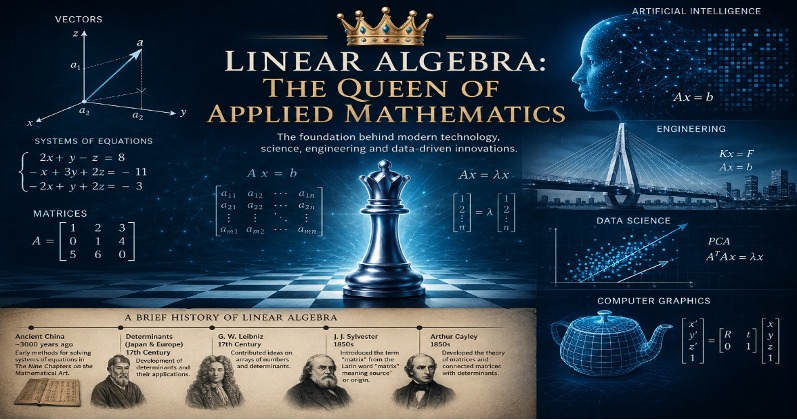
Mathematics is often described as the language through which humanity understands the universe. Among its many branches, linear algebra occupies a uniquely powerful position, shaping modern science, technology, and engineering in ways that affect everyday life. Its extraordinary ability to solve real-world problems has earned it a fitting title: the queen of applied mathematics.
Linear algebra is fundamentally concerned with vectors, matrices, systems of linear equations, and transformations. Although these concepts are introduced in academic classrooms as abstract mathematical structures, their practical importance extends far beyond textbooks. Today, linear algebra forms the mathematical foundation of artificial intelligence, data science, engineering design, economics, physics, and computer graphics.
Its historical roots stretch back thousands of years. Some of the earliest methods for solving systems of equations can be found in ancient Chinese mathematics, particularly in The Nine Chapters on the Mathematical Art, one of the earliest known mathematical texts. These early elimination techniques resemble what is now recognized as Gaussian elimination, still widely taught in modern mathematics.
The study later evolved through the development of determinants, first investigated independently by mathematicians in both Japan and Europe. In the 17th century, Gottfried Wilhelm Leibniz contributed important ideas related to arrays of numbers and determinant calculations, laying the groundwork for future developments.
A major breakthrough came in the 19th century when James Joseph Sylvester introduced the term matrix, derived from the Latin word meaning “source” or “origin.” Shortly afterwards, British mathematician Arthur Cayley developed a systematic theory of matrices, establishing many of the principles that remain central to linear algebra today.
In the modern world, linear algebra has become indispensable in artificial intelligence and machine learning. Massive datasets are represented as matrices, and algorithms rely on vector operations to recognize patterns, make predictions, and optimize decisions. Search engines, recommendation systems, language models, and facial recognition technologies all depend heavily on these mathematical structures.
The discipline is equally important in engineering. Civil engineers use matrix methods to analyze structures and forces, while electrical engineers apply eigenvalue analysis in circuit design and signal processing. Robotics, aerospace systems, and communication networks rely on linear algebra to model and control highly complex systems. In data science and statistics, techniques such as regression models, principal component analysis, and dimensionality reduction allow researchers to simplify large datasets while preserving valuable information. These methods have become essential in healthcare research, financial forecasting, and scientific experimentation. Even the visual world of modern computing depends on linear algebra. Computer graphics, animation, gaming, and virtual reality all use matrices to perform geometric transformations such as rotation, scaling, and projection. Every digital image processed on a computer screen is influenced by these mathematical operations.
What makes linear algebra truly remarkable is its universal applicability. It provides a structured way of representing relationships between variables and solving problems involving multiple interacting components. In a world increasingly driven by computation and data, its relevance continues to grow.
From ancient mathematical manuscripts to modern artificial intelligence, linear algebra has evolved into one of the most influential tools in human knowledge. Few branches of mathematics connect abstract theory with practical innovation so seamlessly. For that reason, linear algebra remains, without question, the queen of applied mathematics.
Comments are closed.