

Dr. Vandana Aggarwal
“The most important lesson of every conflict is that wars are often easier to start than to end, while peace demands patience, foresight, and a willingness to choose diplomacy over confrontation.”
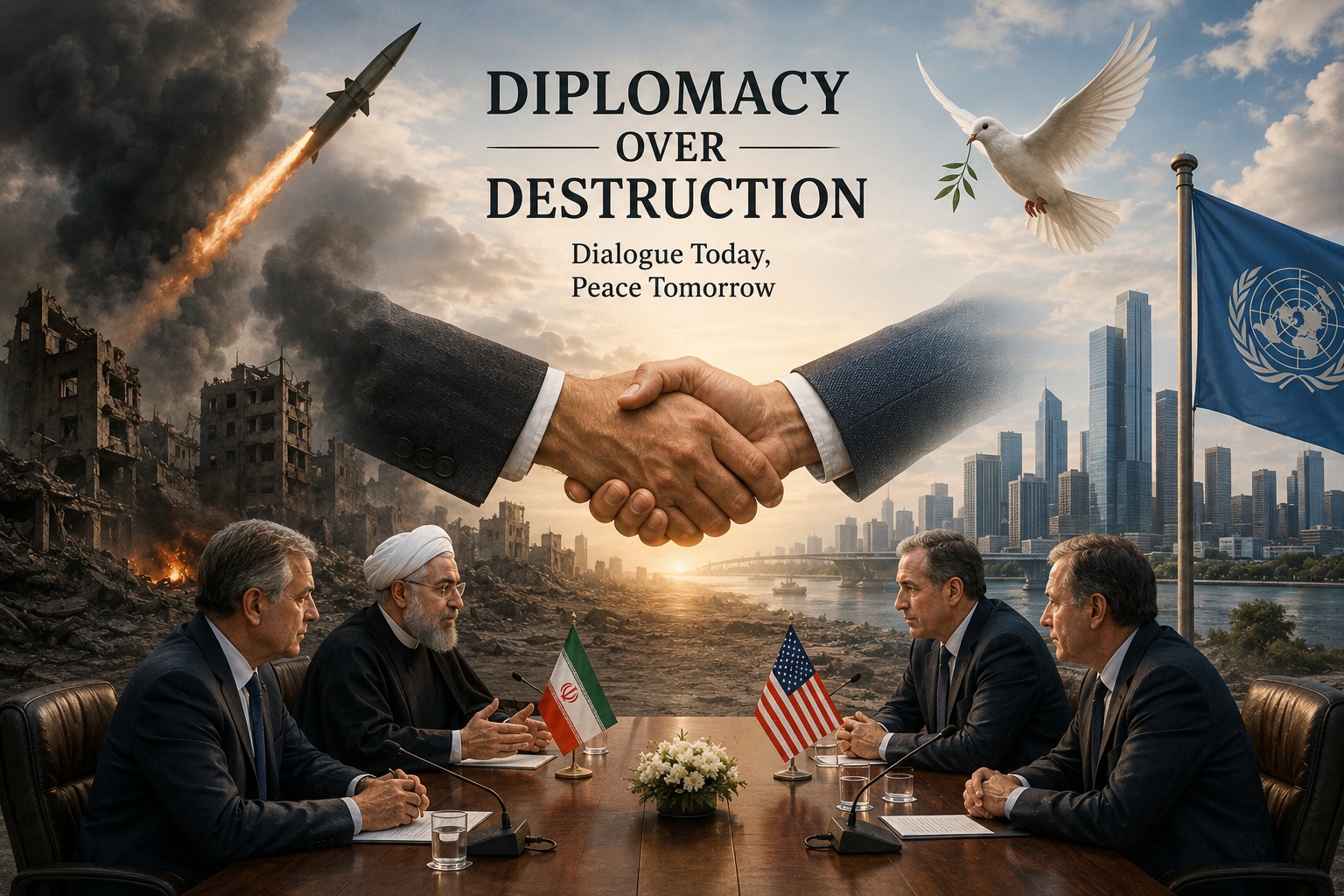
The announcement of a peace framework between the United States and Iran has been greeted with relief across much of the world. After months of military escalation, missile exchanges, economic disruption and fears of a wider regional war, the prospect of diplomacy replacing warfare is undoubtedly welcome. Yet beyond the headlines celebrating a ceasefire lies a more uncomfortable question: if virtually every actor involved claimed to seek peace and stability, how did the region find itself on the brink of catastrophe?
The conflict involving Iran, Israel and the United States was not the result of a single event or decision. It emerged from years of accumulated mistrust, failed diplomacy, strategic rivalries and political calculations. The recent violence may have appeared sudden, but its foundations were laid long before the first missile was launched. The tragedy is that the warning signs were visible for years, yet meaningful efforts to address them often gave way to policies driven by deterrence, suspicion and power politics.
Wars are frequently justified in the language of security. Governments argue that military action is necessary to protect national interests, deter adversaries and preserve stability. These arguments are not always without merit. States have legitimate security concerns and responsibilities toward their citizens. However, history repeatedly demonstrates that military solutions rarely resolve the deeper political disputes that give rise to conflict in the first place.
The recent crisis offers another reminder of this reality. Despite sophisticated weaponry, intelligence capabilities and military planning, the conflict ultimately returned to the negotiating table. Diplomacy, which had been sidelined for much of the crisis, re-emerged as the only viable path forward. This should not surprise anyone. Wars may alter the balance of power, but lasting peace requires dialogue, compromise and political courage.
Perhaps the most striking aspect of this conflict was its global impact. In an interconnected world, regional wars no longer remain regional. Disruptions to shipping routes affected international trade. Energy markets responded with uncertainty. Governments far removed from the battlefield found themselves calculating the economic and political consequences of escalation. The conflict served as a reminder that in the twenty-first century, security is increasingly shared. Instability in one region can reverberate across continents within hours.
At the same time, the war exposed a troubling trend in contemporary politics: the growing tendency to view diplomacy as weakness and confrontation as strength. Political leaders often face domestic pressure to adopt hardline positions. Public discourse rewards decisive rhetoric and dramatic actions. Negotiation, by contrast, is frequently portrayed as compromise in the negative sense of the word. Yet this mindset ignores a fundamental truth. Diplomacy is not the absence of strength; it is the intelligent use of strength to avoid unnecessary destruction.
The victims of this misunderstanding are rarely those making strategic decisions. They are ordinary citizens. They are families forced to leave their homes, businesses struggling amid uncertainty, and communities living under the constant fear of violence. The language of geopolitics often obscures these human realities. Discussions revolve around deterrence, alliances, and national interests, while the human cost is reduced to statistics. Every conflict reminds us that behind every number is a life disrupted or lost.
The current ceasefire should therefore be viewed not as the end of a crisis but as the beginning of a test. The underlying issues that fueled the conflict remain unresolved. Questions regarding regional security, military capabilities, economic sanctions and political influence continue to shape relations among the parties involved. If these concerns are not addressed through sustained diplomatic engagement, today’s ceasefire may become tomorrow’s temporary pause.
There is also a broader lesson for the international community. The institutions designed to prevent conflict often receive attention only after violence has erupted. Preventive diplomacy lacks the visibility of military action, but it is far less costly in human and economic terms. The world invests enormous resources in preparing for war and comparatively little in preventing it. This imbalance deserves serious reconsideration.
Ultimately, the significance of this conflict extends beyond the Middle East. It raises questions about how nations manage rivalry in an era of increasing geopolitical tension. Can diplomacy remain effective when mistrust is deep? Can leaders prioritize long-term stability over short-term political gains? Can the international community learn from repeated crises rather than merely react to them?
The peace framework announced this week offers a chance to answer these questions differently. Whether it succeeds will depend not only on the governments directly involved but also on a broader willingness to recognize that security built solely on military power is inherently fragile.
History may remember this conflict for its missile strikes, military operations and dramatic headlines. Yet its most important lesson is simpler: wars are often easier to start than to end, and peace is never achieved by accident. It requires foresight, patience, and the courage to choose dialogue when confrontation appears easier.
The world has witnessed enough evidence of the costs of war. The challenge now is whether it is willing to learn from them.
Comments are closed.