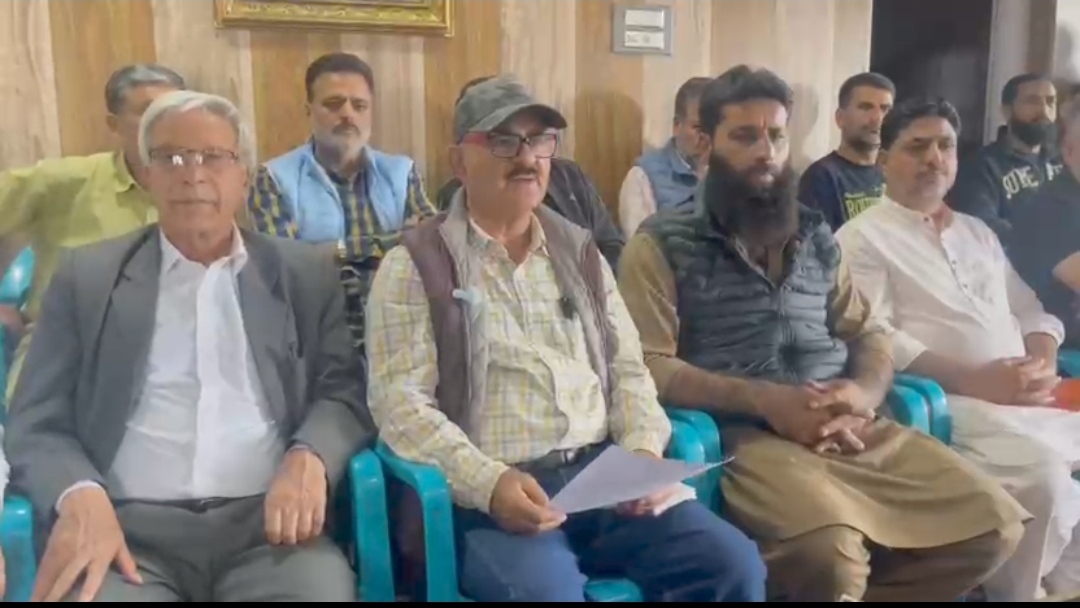
SOPORE, May 23: Raising alarm over back-to-back hailstorms that have battered Kashmir’s apple heartland for nearly a month, the president of Asia’s second-largest fruit mandi in Sopore on Saturday demanded the Jammu and Kashmir government declare 2026 a “disaster year” for horticulture and agriculture — warning that thousands of growers are staring at financial ruin and may be pushed to “extreme steps” if relief does not arrive soon.
Fayaz Ahmed Malik, president of the Sopore Fruit Mandi, told reporters that the horticulture sector sustains nearly 75 per cent of the region’s population, with around 12.5 lakh families directly dependent on it.
“Today, for the last 20 days, there has been continuous flooding from all sides. I feel that 70 per cent of our crops have gone bad,” Malik said.
He said a hailstorm lasting just 10-15 minutes struck the Rafiabad belt, including Zangir, causing widespread devastation. “The damage is visible in Chatlura, Yarbug, Lesser, Zangir, Boripora, Seelu, and Hubdangarpora — 90 per cent of crops are bad in these areas,” he added.
Malik said hailstorms over the last 20-25 days have caused 100 per cent damage in Kulgam, Shopian, Kreeri, Wagoora, Tangmarg, Andergam. Parts of Bandipora — including Matarigam, Dardpora and Sumlar — along with several villages in Rafiabad, Zaingeer and Baramulla have suffered up to 90 per cent crop loss.
Alleging that the weather-based crop insurance scheme announced by the government has not been implemented since March, Malik demanded the immediate rollout of the Modified Interest Subsidy (MIS) scheme for C-grade apples and a waiver of Kisan Credit Card (KCC) loans up to Rs 3 lakh.
“In other states, farmer loans are waived before elections, but that has not happened in J&K,” Malik said, appealing to the Chief Minister, Agriculture Minister Javed Ahmed Dar, and the central government.
He warned that marginal growers with 500 to 2,000 boxes have become debtors to banks and private lenders. “If compensation is not given, people may be forced to take extreme steps. Poor families are associated with this sector. They must get relief in any case,” he added.
Malik also noted that tourism has declined following the Pahalgam incident, leaving horticulture as the only support for household livelihoods. “Being a Union Territory, there is a lot of interference from the central government. I appeal to the central government to help the people here. The government should look at this seriously,” he said.


Comments are closed.