

S. Ahmad
What is Pension?
A Pension provides a steady monthly income to people during their unproductive years. Declining earnings, rise of nuclear families, migration of earning members, rising living costs and longer lifespans weaken financial security. Pensions ensure a dignified and independent life.
India’s pension system is undergoing one of the most significant transformations in its modern economic history. What was once a limited framework primarily designed for government employees has gradually evolved into a broad and diversified retirement structure aimed at providing financial security to millions across different social and economic backgrounds. This transition reflects not only changing economic realities but also a deeper recognition that social security and dignified ageing are essential pillars of a stable and inclusive society.
As India moves toward becoming one of the world’s largest economies, the importance of retirement planning and old-age income security has become increasingly urgent. Rising life expectancy, rapid urbanisation, migration for employment, inflationary pressures, shrinking joint family systems, and the expansion of informal labour markets have collectively altered the traditional support structures that elderly citizens once depended upon. In this changing environment, pensions are no longer merely welfare benefits for a select group; they have become critical instruments of financial independence and social stability.
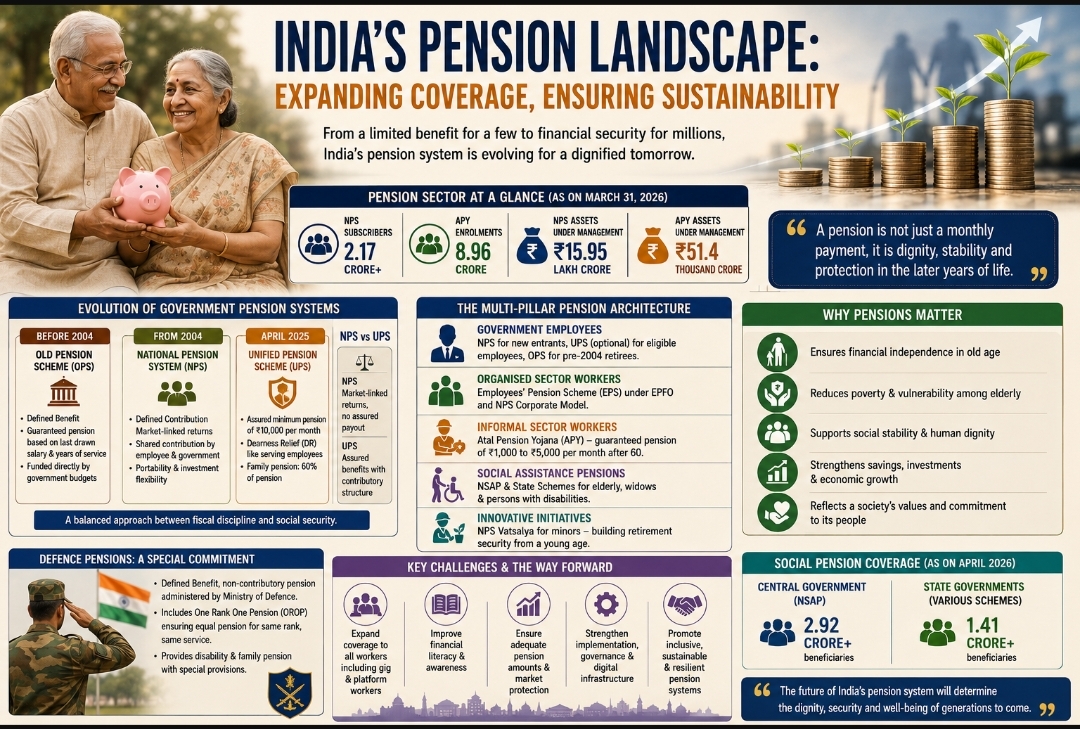
The growth of India’s pension sector over the last two decades demonstrates this shift clearly. As of March 31, 2026, the National Pension System has crossed more than 2.17 crore subscribers, while the Atal Pension Yojana has reached nearly 8.96 crore enrolments. Together, these schemes are not only securing the futures of millions but are also contributing significantly to long-term economic growth through large-scale asset creation. Assets under management under the NPS have reached approximately ₹15.95 lakh crore, while APY assets stand at around ₹51.4 thousand crore. These figures reflect the growing institutional strength of India’s pension ecosystem and the increasing public participation in formal retirement savings.
At its core, a pension represents far more than a monthly financial payment after retirement. It represents dignity, stability, and protection during a stage of life when earning capacity declines. In earlier decades, elderly individuals often depended on extended family structures for support. However, with nuclear families becoming more common and younger generations moving away for education and employment, many senior citizens now face economic vulnerability and social isolation. In such circumstances, a reliable pension system becomes essential for ensuring that ageing does not automatically translate into insecurity or dependence.
India’s pension architecture today is built upon multiple layers designed to serve diverse population groups. It includes defined-benefit pensions for eligible government employees, contributory retirement systems for organised workers, voluntary pension arrangements for citizens outside formal employment, and social assistance pensions for economically vulnerable populations. This multi-pillar structure reflects the complexity of India’s labour market and demographic realities.
The evolution of government pension systems represents one of the most important chapters in India’s pension reforms. Prior to January 1, 2004, central government employees were covered under the Old Pension Scheme governed by the Central Civil Services Pension Rules of 1972. Under this arrangement, retirees were guaranteed a pension funded directly through government budgets. The pension amount depended primarily on the employee’s last drawn salary and years of service. State governments operated similar systems based on their respective pension rules.
While the Old Pension Scheme provided financial certainty to employees, concerns gradually emerged regarding its long-term fiscal sustainability. As life expectancy increased and the number of pensioners expanded, governments faced mounting pension liabilities that threatened to place enormous pressure on public finances. This led to a major policy shift.
Beginning January 1, 2004, the Government of India introduced the National Pension System for new entrants into central government service. Unlike the old defined-benefit structure, NPS operates as a defined-contribution framework where both the employee and the government contribute regularly toward a retirement corpus. Retirement benefits are then determined based on accumulated savings and market-linked returns rather than guaranteed payouts.
The introduction of NPS represented a structural transformation in India’s approach toward retirement security. It aimed to promote fiscal sustainability while encouraging long-term retirement savings and shared responsibility between employees and the state. Most state governments eventually adopted similar contributory models for new recruits, although a few continued with variations of defined-benefit arrangements.
The National Pension System itself has emerged as one of India’s most important financial and social security reforms. Regulated by the Pension Fund Regulatory and Development Authority, NPS allows investments across various asset classes including government securities, corporate bonds, and equities. Subscribers benefit from portability, investment flexibility, and structured retirement planning.
Importantly, NPS is no longer restricted only to government employees. Through its all-citizen model, any Indian citizen, including resident Indians, non-resident Indians, and overseas citizens of India, can voluntarily open an NPS account. This expansion reflects a larger policy objective of extending pension coverage beyond traditional formal employment structures.
The growing scale of NPS also has macroeconomic significance. The enormous pension assets accumulated under the scheme contribute to capital markets, infrastructure financing, and long-term economic investments. In this sense, pension reforms are not only improving retirement security but also strengthening India’s broader financial ecosystem.
India transitioned from defined-benefit pension schemes to a diversified contributory framework. The shift promotes greater financial sustainability, shared responsibility and long-term retirement security. National Pension System (NPS) has over 2.17 crore subscribers, while Atal Pension Yojana (APY) reached 8.96 crore enrolments as on 31.3.2026. They are securing lives and supporting economic growth through large asset creation. The nation’s retirement system continues to expand with Assets Under Management reaching ₹15.95 lakh crore under NPS and APY assets at ₹51.4 thousand crore as on 31.3.2026. As India progresses, its pension system evolves through digital reforms and stronger governance.
More recently, the government introduced the Unified Pension Scheme in April 2025 as an optional framework within the NPS structure for eligible central government employees. The UPS seeks to address concerns among employees regarding uncertainty associated with purely market-linked pension systems. While retaining the contributory nature of NPS, UPS introduces elements of assured retirement income and inflation protection.
Under UPS, both employees and the government continue contributing toward retirement savings, but the scheme also guarantees certain minimum pension benefits subject to eligibility conditions. Employees completing at least ten years of qualifying service become eligible for a minimum assured pension of ₹10,000 per month. The scheme also provides Dearness Relief similar to the Dearness Allowance given to serving employees, thereby helping retirees cope with inflation.
One of the major differences between UPS and NPS lies in the nature of government contributions. Under UPS, the government contributes 10 percent of Basic Pay and Dearness Allowance along with an additional 8.5 percent toward a pooled corpus. Under NPS, the government contributes 14 percent directly into the individual pension account without guaranteeing assured payouts.
UPS also includes provisions for family pension benefits. In the event of the pensioner’s death after retirement, the legally wedded spouse becomes eligible for 60 percent of the pension payout. Additionally, the scheme provides lump-sum retirement benefits calculated on the basis of qualifying service.
The introduction of UPS reflects the government’s attempt to balance fiscal discipline with employee demands for income predictability and social security. It represents a middle path between the fully guaranteed structure of the Old Pension Scheme and the market-linked design of NPS.
Defence pensions, however, continue to operate under a separate defined-benefit structure administered by the Ministry of Defence. Given the unique service conditions and career patterns of armed forces personnel, defence pensions remain non-contributory and include special provisions such as One Rank One Pension and disability pensions. OROP, introduced in 2015, ensures that defence personnel retiring at the same rank and with the same length of service receive equal pensions regardless of their retirement date.
Outside government employment, organised private-sector pension coverage is built around statutory payroll-linked systems such as the Employees’ Pension Scheme administered by the Employees’ Provident Fund Organisation. Introduced in 1995, EPS forms the foundation of pension security for millions of organised private-sector workers. It is funded through employer contributions under the EPF framework and provides superannuation, disability, and family pension benefits.
As of April 2026, contributory membership under EPS expanded to approximately 7.98 crore members, reflecting continued formalisation of employment and increased compliance among employers.
In addition to EPS, many private companies have adopted the corporate model of NPS, allowing employers and employees to contribute toward individual retirement accounts regulated by the PFRDA. These arrangements offer greater portability and investment flexibility while complementing statutory pension benefits.
One of the most remarkable developments in India’s pension evolution has been the expansion of pension coverage among informal-sector workers. Historically, millions working outside formal employment structures lacked any meaningful retirement security. The Atal Pension Yojana was introduced in 2015 specifically to address this gap.
APY targets low-income and unorganised sector workers who are not covered under statutory social security systems. Subscribers contribute fixed amounts based on their age and desired pension level, and in return receive guaranteed monthly pensions ranging from ₹1,000 to ₹5,000 after the age of sixty. Enrolment is facilitated through banks and post offices, making the scheme accessible even in remote regions.
The growth of APY to nearly nine crore enrolments reflects increasing awareness among low-income citizens regarding the importance of retirement planning. For millions of workers in the informal economy, APY represents the first structured opportunity to build financial security for old age.
Another innovative initiative is NPS Vatsalya, introduced in 2024. Designed specifically for minors, the scheme allows parents or legal guardians to open pension accounts on behalf of children. Contributions continue until the child reaches adulthood, after which the account converts seamlessly into a regular NPS account. The initiative encourages long-term financial planning and early retirement savings from a young age.
Alongside contributory pension systems, India also maintains non-contributory social pension frameworks aimed at protecting economically vulnerable populations. Through the National Social Assistance Programme, elderly individuals, widows, and persons with disabilities receive tax-funded financial assistance. Unlike employment-linked pensions, these schemes function as welfare support designed to prevent destitution among those lacking retirement savings or stable income sources.
State governments have further strengthened this social security layer through independent pension schemes tailored to local priorities and fiscal capacities. Schemes such as Odisha’s Madhu Babu Pension Yojana, Telangana’s Aasara Pension Scheme, and Bihar’s Mukhyamantri Vridhjan Pension Yojana provide supplementary support to vulnerable groups.
As of April 2026, the central social pension component covered more than 2.92 crore beneficiaries, while state governments together covered over 1.41 crore beneficiaries. These numbers demonstrate the continued importance of welfare-based pension support alongside contributory retirement systems.
The expansion of pension coverage in India has also been supported by major digital reforms and institutional modernisation. Technology has improved enrolment systems, contribution tracking, grievance redressal mechanisms, and administrative efficiency. Digital platforms have reduced paperwork, increased transparency, and widened access to pension services across urban and rural regions.
Regulatory reforms under the PFRDA have further strengthened the pension ecosystem by refining investment guidelines, improving supervisory mechanisms, and enhancing governance standards. Measures such as the Balanced Life Cycle Fund introduced under NPS in 2024 allow subscribers to maintain higher equity exposure during their early working years before gradually reducing risk closer to retirement.
India’s pension system is also beginning to adapt to emerging labour market realities. The rise of gig work and platform-based employment presents new challenges for retirement security because traditional employer-linked pension structures often fail to cover such workers. The Code on Social Security, 2020 includes enabling provisions for extending pension-linked social security benefits to gig and platform workers, creating possibilities for future expansion.
The broader significance of India’s pension reforms lies not merely in financial management but in nation-building itself. Retirement security contributes directly to social stability, poverty reduction, economic resilience, and human dignity. A society that fails to protect its elderly risks deepening inequality and insecurity over time.
India’s evolving pension landscape demonstrates a gradual but important shift toward inclusiveness and sustainability. The country now possesses a complex but increasingly comprehensive pension framework capable of serving government employees, organised workers, informal labourers, private-sector professionals, and economically vulnerable citizens.
Challenges certainly remain. Expanding coverage further, improving financial literacy, ensuring adequate pension amounts, protecting pension funds against market volatility, and integrating gig workers into formal retirement systems will require sustained policy attention. But the direction of reform is unmistakable.
India is steadily moving away from viewing pensions as limited administrative entitlements and toward recognising them as a critical component of social justice and economic security. As demographic transitions accelerate and the population ages, the success of this transformation will play a defining role in shaping the country’s social and economic future.
A strong pension system ultimately reflects the values of a society. It signals whether a nation is willing to protect its citizens not only during their productive years but also during the vulnerable phase of ageing. India’s ongoing pension reforms suggest that the country increasingly understands this responsibility — and is gradually building a retirement framework designed not just for today, but for generations to come.
Did You Know?
As of August 2025, States/UTs have added top-up amount ranging from ₹ 50 to ₹ 3800/month per beneficiary under NSAP. This results in an average monthly pension of around ₹1,000 in most of the States/UTs.
Comments are closed.