

Mutahir Hadi
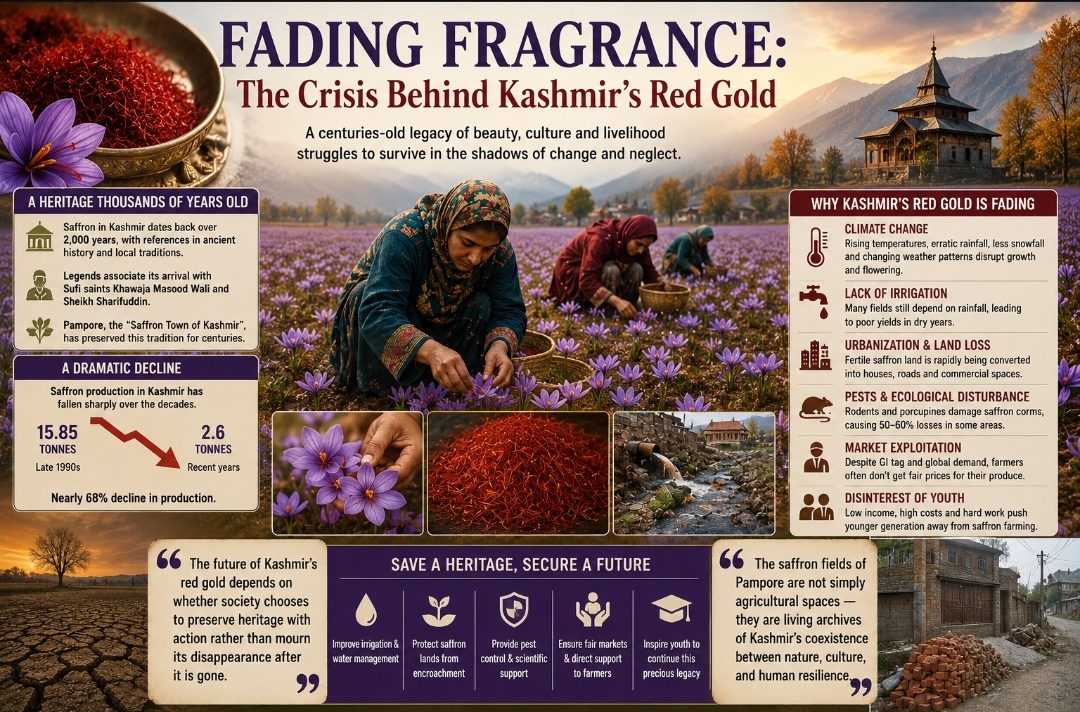
“The future of Kashmir’s red gold depends on whether society chooses to preserve heritage with action rather than mourn its disappearance after it is gone.”
In the historic saffron fields of Pampore, where autumn once unfolded like a purple carpet across the landscape, a centuries-old legacy is slowly fading into uncertainty. The fragrance that once symbolized pride, prosperity, and identity is losing its strength. Kashmir’s saffron—often called “red gold”—is no longer merely battling market competition; it is fighting for survival itself.
For Kashmir, saffron is not simply an agricultural product. It is culture, memory, heritage, and livelihood woven together. It represents the soul of the Valley in much the same way that its rivers, mountains, and chinar trees do. For generations, saffron cultivation has sustained thousands of farming families economically while simultaneously serving as a symbol of Kashmiri identity across the world.
The story of Kashmiri saffron stretches back more than two thousand years. Historians trace its cultivation in the Valley to ancient times, with traditions linking it to the reign of Emperor Ashoka during the 3rd century BCE. Popular local legends also associate the arrival of saffron in Kashmir with two revered Sufi saints—Khawaja Masood Wali and Sheikh Sharifuddin—who are believed to have introduced the crop to the region centuries ago.
Since then, saffron has flourished in the unique climate and soil of Pampore, often referred to as the “Saffron Town of Kashmir.” Every autumn, as temperatures cool and the harvesting season begins, the saffron fields bloom into a breathtaking sea of violet flowers. Beneath this beauty lies intense human effort. Farmers delicately pluck each flower by hand before carefully separating the crimson stigmas—the most valuable part of the plant—from the petals.
It is a labor-intensive tradition built on patience, precision, and inherited knowledge.
But today, that tradition stands endangered. The fields that once glowed with vibrant purple are increasingly barren, fragmented, and neglected. The fragrance of Kashmir’s red gold is fading under the weight of climate change, urban expansion, ecological imbalance, and policy failures. The decline is no longer symbolic; it is measurable, visible, and alarming.
Over the past two decades, saffron production in Kashmir has witnessed a dramatic fall. Once celebrated globally for producing some of the world’s finest and highest-grade saffron—often considered superior in quality to many international varieties—Kashmir now struggles even to maintain stable output. Production has reportedly declined by nearly 68 percent over recent decades. From approximately 15.85 tonnes in the late 1990s, output has reportedly fallen to nearly 2.6 tonnes in recent years.
This decline is not just an agricultural concern. It is a cultural crisis. When saffron disappears, Kashmir loses more than a crop. It loses a part of its civilizational identity.
Several interconnected factors have accelerated this decline. Among the most serious is climate change. Saffron cultivation depends heavily on specific climatic conditions, particularly cold weather patterns and balanced rainfall during critical growth periods. However, Kashmir’s climate has become increasingly erratic. Rising temperatures, prolonged dry spells, irregular snowfall, and untimely rainfall have disrupted the natural cycle essential for saffron cultivation.
The changing weather patterns have weakened productivity and reduced flowering intensity across large cultivation areas.
Equally damaging is the persistent lack of irrigation infrastructure. Despite repeated concerns raised by farmers over the years, many saffron-growing areas still remain dependent largely on rainfall. In years of insufficient precipitation, crop yields collapse dramatically. While various irrigation projects have been introduced in phases, implementation gaps and maintenance challenges continue to affect their effectiveness on the ground.
Urbanization has further intensified the crisis. Large stretches of fertile saffron land have gradually been converted into residential colonies, roads, and commercial infrastructure. The uncontrolled spread of construction activity around traditional saffron belts has reduced cultivable land while simultaneously increasing pollution and environmental stress. Land that once carried the fragrance of saffron now carries concrete.
Another growing challenge is pest attacks and ecological disturbance. Farmers have increasingly reported damage caused by rodents and porcupines that destroy saffron bulbs, known locally as corms. Such attacks, combined with unpredictable weather conditions, have reportedly caused crop losses of up to 50 to 60 percent in certain areas.
For farmers already struggling with declining yields and rising costs, these losses can be devastating.
Economic exploitation adds another layer to the problem. Although Kashmiri saffron received the prestigious Geographical Indication (GI) tag—a recognition meant to protect its authenticity and market identity—many growers continue to suffer due to exploitative middlemen and unstable market systems. Farmers often fail to receive fair prices for their produce despite the premium reputation of Kashmiri saffron globally.
The benefits of branding and market recognition do not always reach the cultivators who preserve the tradition through their labor.
This disconnect between heritage and economic justice has discouraged many younger generations from continuing saffron farming. Increasingly, young people from farming families view saffron cultivation as financially uncertain and physically exhausting. As a result, traditional agricultural knowledge risks disappearing alongside the crop itself.
The crisis of saffron is therefore not only environmental or economic—it is generational.
Yet despite these challenges, hope still exists. Kashmiri saffron remains globally admired for its deep color, strong aroma, medicinal properties, and exceptional quality. Scientific cultivation methods, improved irrigation systems, sustainable land protection policies, fair market access, farmer support mechanisms, and climate-adaptive agricultural strategies can still revive the sector if implemented seriously.
What is needed now is urgency. Authorities must recognize saffron cultivation not merely as an agricultural issue but as a matter of cultural preservation and economic survival. Policies must move beyond announcements toward practical implementation on the ground. Farmers require direct institutional support, scientific training, irrigation access, pest management assistance, and market protection from exploitation.
At the same time, society itself must recognize the importance of safeguarding this heritage. The disappearance of saffron would symbolize something much larger: the gradual erosion of Kashmir’s ecological and cultural identity. When traditional landscapes vanish, communities lose not only livelihoods but also emotional connections to their history and land.
This is why the crisis concerns every Kashmiri, not just saffron farmers. The fading fragrance of red gold should serve as a warning. Environmental destruction, unchecked urbanization, and neglect of traditional agriculture eventually weaken the social and cultural fabric of an entire region. Preserving saffron is therefore also about preserving memory, heritage, and belonging.
The purple bloom of Pampore is more than a seasonal spectacle. It is a living testimony to centuries of resilience, craftsmanship, and coexistence between people and nature.
If that bloom disappears, Kashmir will lose one of its most treasured symbols. The future of Kashmir’s red gold depends entirely on the choices made today—by governments, institutions, markets, and society itself. The time for concern alone has passed. What remains now is the responsibility to act before the fragrance fades forever.
Comments are closed.