The underlying causes of any social injury often remain hidden where conventional wisdom seeks them. They are concealed beneath the visible drama of daily life, in the behind-the-scenes areas where roles are practiced, and identities are constructed long before they are presented to the public. To grasp why the youth in Jammu and Kashmir, particularly in the Kashmir Valley, find themselves ensnared in drug addiction, we need to decode the narrative that society has been quietly authoring. We must, to use a term from Jacques Derrida, dissect the very concepts we have cultivated in our minds.
The figures alone serve as a form of condemnation. As per information provided to the Indian Parliament’s Standing Committee on Social Justice and Empowerment, approximately 1.35 million individuals in Jammu and Kashmir are drug users—about one in nine people in a population of around twelve million. The Institute of Mental Health and Neurosciences (IMHANS) in Srinagar reports that nearly 90% of these users are aged 17 to 33. Approximately 168,000 of them are children aged between 10 and 17. The SMHS hospital in Srinagar treated over 41,000 patients with drug-related issues in 2023—approximately one every 12 minutes. Heroin users in the Valley are estimated to spend more than ₹88,000 each month on the substance, a figure that quietly drains family savings, dignity, and futures as well.
These statistics are not just numbers; they represent underlying issues. The actual problem is older, deeper, and more personal.
The Front Stage and the Back Stage
The sociologist Erving Goffman, in his work The Presentation of Self in Everyday Life (1959), posited that social existence resembles a form of theatre. According to him, each individual performs roles on a front stage for an audience whose approval we seek, while a back stage exists out of sight, where the act is prepared, rehearsed, and sometimes ridiculed. Goffman maintained that what we interpret as personality is mainly dramaturgy—a carefully managed impression.
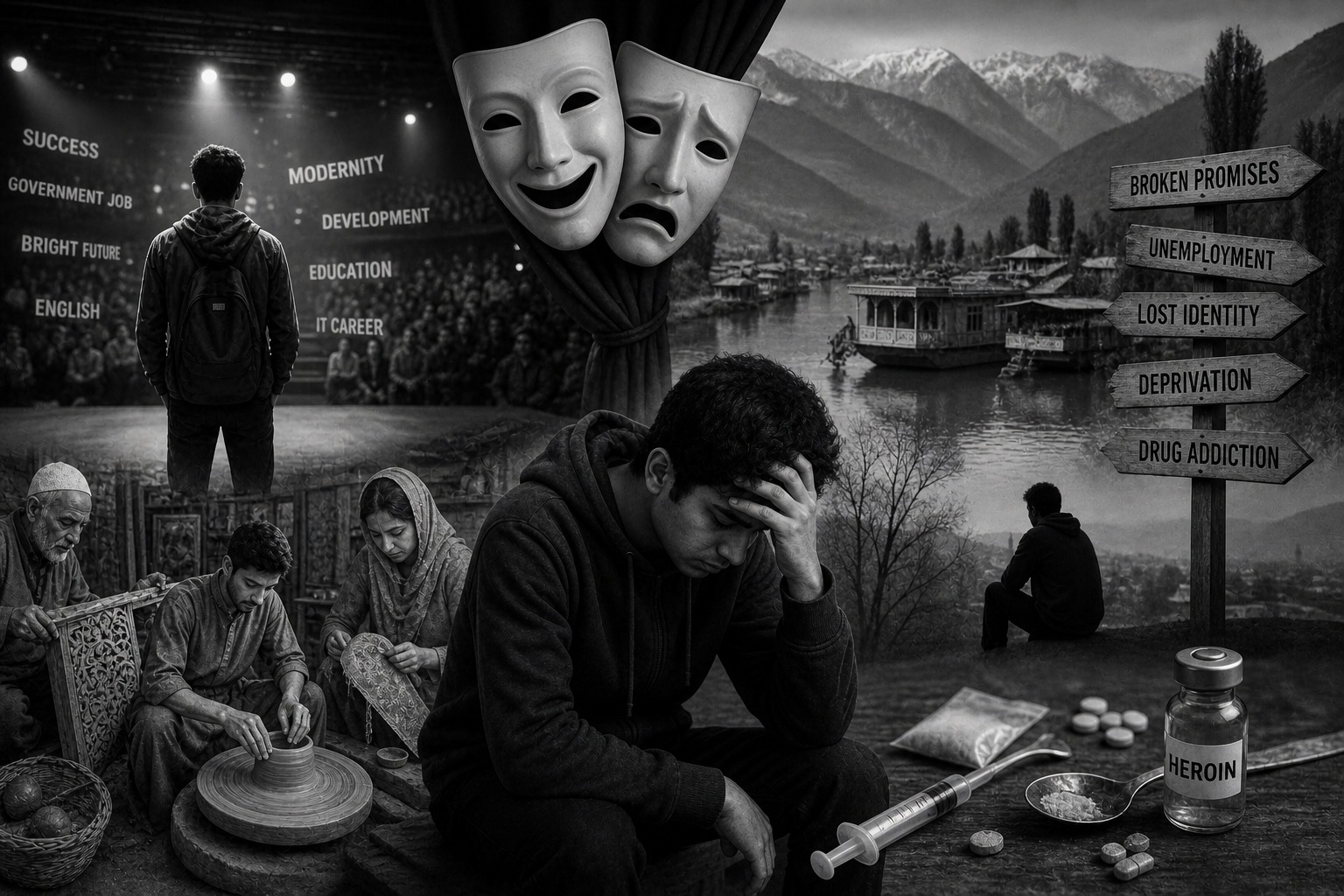
To understand Kashmir’s drug crisis, we must consider this backstage. The front stage presents a picture of a young man with hollow eyes and a syringe in his arm, leading us to label him as weak. However, the back stage reveals a more complex narrative: a generation given a script crafted by others. They were promised that modern education would uplift them; that the new economy would welcome them; that the traditional village life—filled with pottery wheels, walnut groves, saffron fields, and craft looms—was something to be ashamed of. They memorized the lines, donned the costumes, and stepped onto the stage. Then they realized there was no audience, no paycheck, no collaborator. The performance had been set for an empty theater.
Goffman would describe this as a disrupted performance: the moment when an individual comes to understand that the identity they have been carefully constructing is going unrecognized by anyone. In this context, heroin is not the source of the crisis. Instead, it represents the curtain the performer draws when he can no longer tolerate the silence of the auditorium.
Deconstructing the Promise
Jacques Derrida encouraged us to question the words we rely on the most. He demonstrated that every dominant idea is built upon a quieter counterpart that has been marginalized. Modernity was contrasted with tradition; development was set against the indigenous; educated youth were positioned against their artisan fathers. In each of these pairs, the first term received validation while the second was relegated. According to Derrida, this validation represented a violent hierarchy—and, like all hierarchies, it obscured the extent to which the privileged term relied on the one it had silenced.
The youth of Kashmir were led to hope for a future constructed on this hierarchy. Education, proficiency in English, office roles, government positions, and IT skills were portrayed as the pathway to a more fulfilling life. In contrast, the walnut orchard, saffron field, papier-mâché workshop, and kani shawl loom were depicted as outdated aspects of life that one studies hard to escape. A whole generation was conditioned to aspire to a future that the economy ultimately could not provide. To challenge this notion does not romanticize the past; rather, it reveals that the binary distinction itself was an illusion. The modern sector, meant to absorb educated youth, never did, while the traditional sector, which could have accommodated them, was simultaneously deemed unworthy of engagement.
This is what I refer to as the first trap: reliance on a false promise. The young individual from Kashmir did not first lose his job and then turn to drugs; instead, he inherited a promise—a logocentric promise, as Derrida would say—where a single master word (‘development’, ‘modernity’) was expected to fulfill everything, only to witness it dissipate into nothingness.
From Conditioning to Deprivation to Dependency
Once the illusion is established, conditioning begins. Schools, families, neighborhood chatter, marriage prospects, and even political discourse all start to echo the same hierarchy. A boy who quietly aspires to take over his grandfather’s saffron field in Pampore is met with disappointment when asked why he isn’t preparing for civil services. A girl who possesses skill in sozni embroidery is told her true future lies in a call center office in another city. The conditioning is so pervasive that even the youth themselves come to look down upon the local economy that could have supported them.
Then comes the stage of deprivation. Kashmir lost its limited autonomy in 2019; the COVID-19 pandemic followed; tourism faltered and recovered unevenly; educational degrees increased while job opportunities did not. Unemployment in J&K has remained significantly higher than the national average for years, and the Periodic Labor Force Survey has consistently ranked the Union Territory among the poorest performers in terms of youth unemployment. The market promised to educated youth was nonexistent. The market they were taught to scorn had been devastated by neglect, illegal imports, lack of financial support and design assistance, and the ongoing outflow of talent.
Only at this fourth stage—following delusion, conditioning, and deprivation—does the actual reliance on drugs take root. Heroin, brown sugar, pharmaceutical opioids, and synthetic drugs flow in through the porous borders of the so-called Golden Crescent that includes Afghanistan, Pakistan, and Iran. Heroin confiscations in J&K have reportedly increased by over 500 percent in recent years. Moreover, in every household where a syringe is found, there also lies an older narrative: a narrative that assured the boy he would become a manager. This narrative suggested the girl should be ashamed of her grandmother’s craft, teaching the family to equate dignity with degrees rather than with days well spent.
The Cruel Economy of the Pusher
Within this broader framework is a smaller, harsher subset: those who gain from it. The dealers, financiers, local pharmacists who turn a blind eye, and cross-border traffickers who quantify children in grams are not merely byproducts of the crisis; they are its entrepreneurs. Goffman’s concept of dramaturgy provides the term for their actions: they orchestrate the backstage of another’s ruin. They offer the last and least expensive form of delusion to those who have already been worn down by disillusionment. The trauma is not a side effect of their operations; it is, in fact, the silent outcome.
Towards a Different Script
Eliminating the issue of drugs is not just about controlling it. Control is essential—the Nasha Mukt Bharat Abhiyaan, the addiction treatment centers established in various districts, the 100-day Nasha Mukt Jammu and Kashmir campaign initiated in 2026, and the integrated rehabilitation centers—these are all significant and urgent. However, these measures only address the fourth stage of the crisis and cannot dismantle the first three stages on their own.
What is required is a calmer and more deliberate transformation: a thorough deconstruction of the hierarchy between modern and indigenous practices. Crafts like pottery, walnut and almond farming, saffron cultivation, papier-mâché, pashmina, namda and kani weaving, and woodcarving are not mere artifacts. They are advanced livelihood technologies that require design improvements, e-commerce platforms, geographical-indication protections, working-capital loans, and skill-development modules integrated into schools rather than placed outside them. A market needs to be created, rather than assumed. Successful models already exist in various countries; these can be borrowed thoughtfully.
Parents should also be gently educated to reassess the conditioning they have inherited. A child choosing a craft over a traditional job is not disappointing the family; the family has been using an inappropriate measure of success. Economic efforts must be paired with counselling, mental health support, and community dialogue, as the injury is both psychological and material.
Goffman would remind us that identities are molded through interaction. When the audience shifts, the performer adapts. If a young woman from Kashmir recognizes that her saffron, integrated into a fair global supply chain, can provide a respectable livelihood; if a young man realizes that his grandfather’s craft, modernized yet respected, can secure him a home and identity—then the narrative of escapism loses its allure. Derrida would assert that no hierarchy is inherent. The valley does not have to choose between its heritage and its future; it must reject the false dichotomy that suggests it ever had to.
Ultimately, the drug crisis in Kashmir is not merely about substances; it is a narrative of a generation given a script they could not act out, with no alternative script to learn. The performance collapsed, and the performers sought an exit. The process of rebuilding will be gradual: it will require legal actions, clinics, and seizures, but additionally, a re-imagining of what it means to live a valuable life in this valley. Until this re-imagining commences, every rehabilitation effort will merely act as a temporary fix on a flawed script. Once it begins, the valley may yet discover a platform where its youth can step forward and be recognized.
Author is student of Sociology, JMI, New Delhi and an Independent Researcher & Writer. He can be reached atpirasif@live.com


Comments are closed.