


Muqeet Mubashir
“Today’s footage is not just a record of the present—it is potential material for tomorrow’s misuse. In an age of instant sharing and AI manipulation, every unregulated recording carries risks far beyond its original intent.”
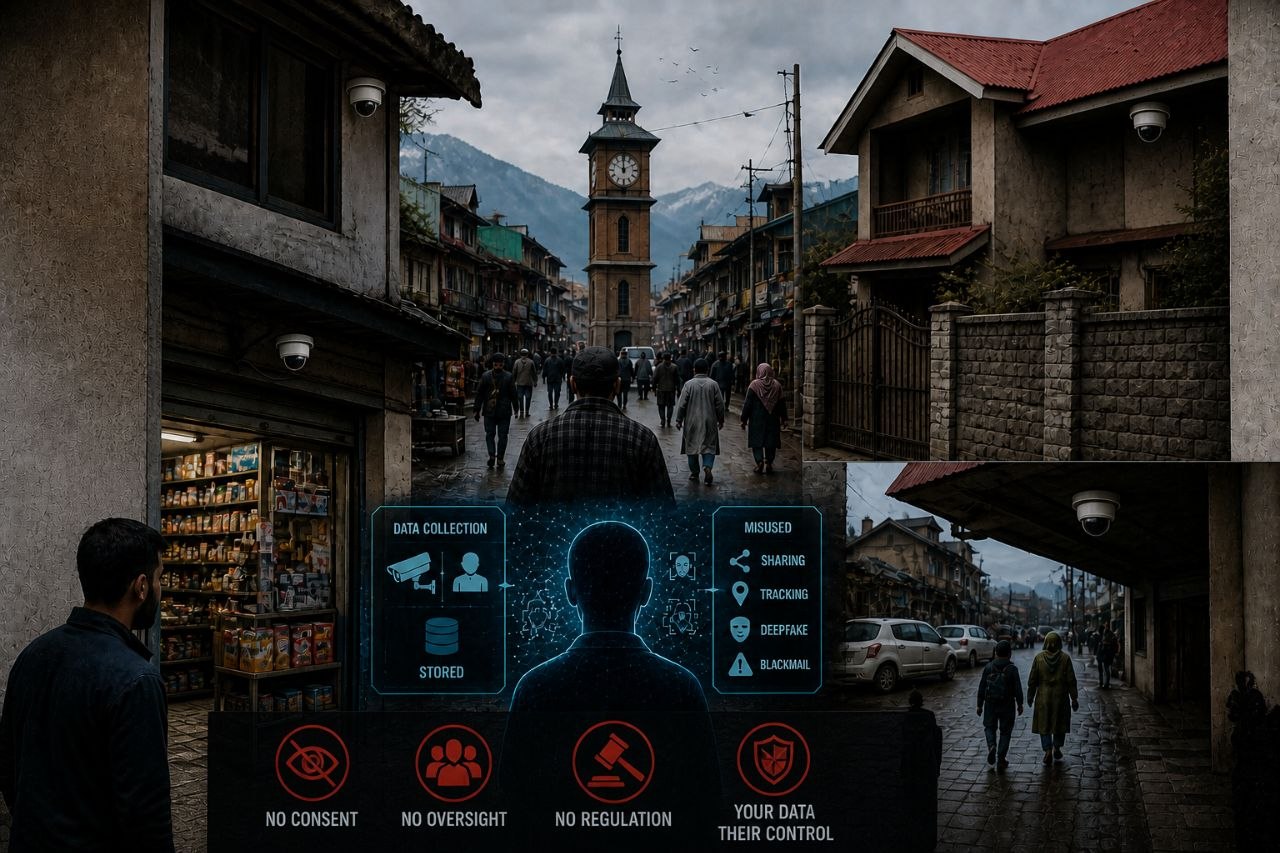
In Kashmir’s rapidly changing urban landscape, CCTV cameras have become as common as streetlights. From commercial hubs in Srinagar to quieter neighbourhoods, lenses now track movement with quiet efficiency. Installed in the name of safety, they promise deterrence, accountability and control.
But in this expanding web of surveillance, a critical question remains largely unasked: Who protects the privacy of those being recorded?
The debate is often framed around state surveillance, but an equally pressing concern lies much closer to the ground: the unchecked use of CCTV cameras by private individuals and businesses.
A shopkeeper installs a camera to monitor his store. Reasonable.
A homeowner installs surveillance at their gate. Understandable.
But when those cameras extend beyond private boundaries, capturing public roads, neighbouring properties, pedestrians, tourists and passersby, they cross into ethically and legally ambiguous territory.
Because at that point, the question is no longer about protecting property. It becomes about intruding into the lives of others without their knowledge or consent.
In a place like Kashmir, this issue carries deeper implications.
Public spaces here are not just transit points; they are lived environments, markets where people gather, streets where identities are expressed and neighbourhoods where daily life unfolds. The idea that one could be constantly recorded, not by the state alone but by countless private actors, creates a diffuse, unregulated surveillance network.
Unlike state-installed systems, these private cameras operate with almost no oversight.
There are no clear rules on:
-
The angle and range of recording
-
Whether audio is being captured
-
How long is the footage stored
-
Who can access or share it
This absence of regulation is not just a policy gap; it is a constitutional concern.
In 2017, the Supreme Court of India, in the landmark Justice K.S. Puttaswamy vs Union of India, unequivocally recognized the Right to Privacy as a fundamental right under Article 21 of the Constitution. The judgment made it clear that privacy is intrinsic to life and personal liberty, extending beyond the home into the broader realm of individual autonomy and dignity.
This has direct implications for surveillance.
Privacy is not violated only when someone enters your home uninvited. It can also be compromised when your movements, behaviours and associations are recorded without consent, especially when such recording is indiscriminate and continuous.
This is where the problem with privately installed outdoor cameras becomes difficult to ignore.
A shop owner may argue that pointing a camera toward the street helps prevent theft. But that same camera inevitably captures:
-
People walking by
-
Conversations happening nearby
-
Faces of individuals with no connection to the shop
These individuals have not consented to being recorded. They have no control over how that footage is used. They may not even be aware of its existence.
And importantly, they may have valid reasons to not be recorded at all.
A journalist meeting a source.
A citizen attending a sensitive gathering.
A tourist simply seeking anonymity in a new place.
A woman navigating public space without wanting to be observed or tracked.
Privacy is not about hiding wrongdoing. It is about preserving the right to exist without constant observation.
The Supreme Court in Puttaswamy also emphasized that any infringement of privacy must satisfy tests of legality, necessity and proportionality. While these principles are typically applied to state actions, their spirit cannot be ignored when private surveillance begins to affect public life at scale.
Because when hundreds of private cameras collectively monitor public spaces, the effect is not private; it becomes societal surveillance without accountability.
India’s evolving data protection framework, including the Digital Personal Data Protection Act, 2023, attempts to address issues of personal data misuse. However, its practical reach into small-scale, informal surveillance setups like individual CCTV installations remains limited and largely unenforced.
The legal vacuum is not just a theoretical concern. It carries real and growing risks in the digital age.
CCTV footage today is rarely confined to a hard drive. It can be:
-
Copied and shared over messaging platforms,
-
Uploaded to social media,
-
Accessed by unauthorized individuals,
-
or even sold or leaked.
This opens the door to serious forms of cyber abuse:
-
Non-consensual sharing of identifiable footage
-
Targeting and tracking individuals’ daily routines
-
Harassment, stalking, or blackmail
-
Morphing or misuse of video clips for defamation
In today’s rapidly evolving technological landscape, the risks do not end with simple misuse or unauthorized sharing. With the rise of artificial intelligence tools, particularly deepfake technology, even ordinary CCTV footage can be manipulated, altered or repurposed in ways that were once unimaginable. Individuals unknowingly captured in routine surveillance can find themselves digitally inserted into situations they were never part of, exposing them to reputational damage, harassment, or blackmail. What begins as routine surveillance can, in the wrong hands, transform into a powerful instrument of digital abuse, making unregulated recording not merely intrusive but potentially weaponizable.
This creates a dangerous grey zone.
On paper, privacy is a fundamental right, but on the ground, it is increasingly negotiable.
For Kashmir, where historical sensitivities around surveillance already exist, this normalization carries long-term consequences. When people begin to accept that being watched is unavoidable, not just by authorities but by anyone with a camera, the very expectation of privacy starts to erode.
And once that expectation is lost, reclaiming it becomes far more difficult.
None of this suggests that individuals should be denied the right to protect their property. But protection cannot come at the unchecked cost of others’ freedoms.
There is a difference between:
Monitoring one’s own premises
and
Recording an entire street indiscriminately
That distinction must be clearly defined and enforced.
In a region where the Cyber Police frequently warn about rising online fraud and misuse, the unregulated generation of video data through private CCTV systems add a new and largely unaddressed vulnerability.
It is not difficult to imagine a near future where:
-
Routine movement patterns are exploited,
-
Individuals are profiled without their knowledge,
-
Or ordinary footage becomes a tool of digital coercion.
Once such data escapes its original context, control is effectively lost.
This brings us to a troubling contradiction.
Cybercrime authorities in Kashmir regularly issue advisories about:
-
online scams,
-
phishing attacks,
-
digital fraud.
Public awareness campaigns urge citizens to be cautious about their digital footprint.
Yet there is little to no visible engagement with a parallel issue: the uncontrolled creation of digital data by private surveillance systems.
Why is there:
-
No sustained awareness campaign on responsible CCTV use?
-
No public guidelines on where cameras should and should not be pointed?
-
No visible enforcement against clearly intrusive setups?
-
No workshops for shopkeepers and residents on privacy-compliant surveillance?
If cybersecurity is about protecting citizens in the digital space, then the conversation cannot stop at fraud prevention. It must also address how data is created, collected and potentially misused at the source.
Right now, that conversation is missing.
The solution does not lie in banning private CCTV use. It lies in defining its limits.
A lawful, balanced approach would recognize:
The right of individuals to protect their property and the equal right of others not to be subjected to indiscriminate recording.
This requires:
-
Clear local guidelines on camera orientation and coverage,
-
Mandatory notice or signage indicating surveillance,
-
Restrictions on audio capture,
-
Basic norms for data storage and deletion,
-
And, crucially, awareness and enforcement mechanisms.
Without these, the burden of protecting privacy falls unfairly on the very individuals who have the least control over the cameras pointed at them.
The Supreme Court’s recognition of privacy as a fundamental right was not symbolic. It was a commitment that dignity, autonomy and personal space would remain protected even as society evolves.
But rights do not erode only through laws. They also erode through neglect, normalization and silence.
In Kashmir’s growing camera culture, the risk is not just that people are being watched. It is that being watched without consent is becoming acceptable, especially when done by private actors under the broad justification of “security.”
That is where the line must be drawn.
Because a fundamental right cannot depend on the direction of someone else’s camera.
Comments are closed.