

One Teacher, Many Grades: The Reality of Multigrade Classrooms

Malik Mushtaq


“Multigrade classrooms are not defined by uniformity, but by diversity. In a single room, different ages, abilities, and aspirations come together, redefining what it truly means to teach.”

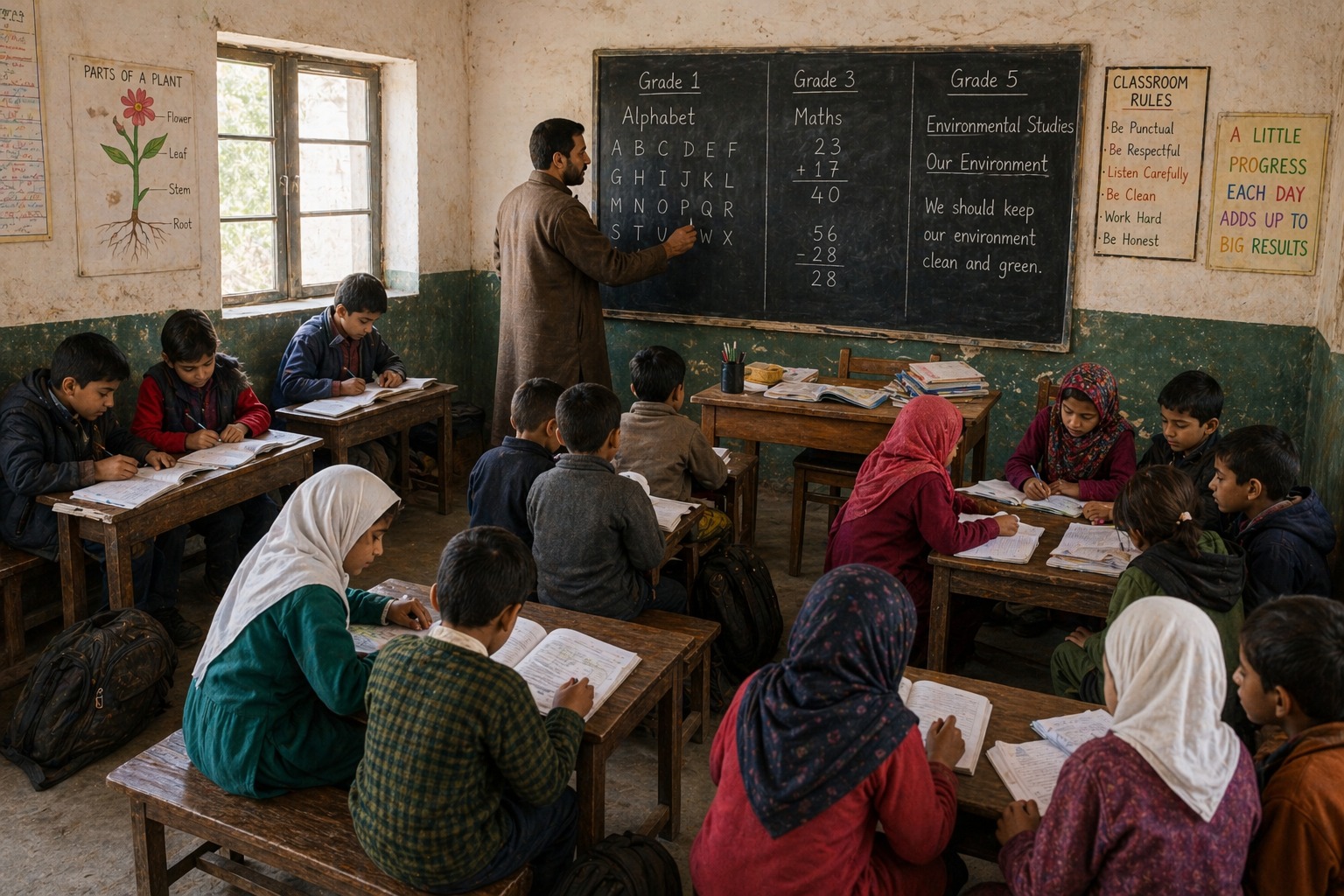
Education, in its truest sense, is not limited to classrooms, fixed timetables, or structured systems; it is a dynamic and evolving process shaped by circumstances, human relationships, and the realities on the ground. My journey as an elementary-level teacher has unfolded within one such reality—multigrade classrooms—where teaching is not defined by uniformity but by diversity. In these classrooms, a single teacher is entrusted with the responsibility of guiding students from different grades, each with their own pace of learning, level of understanding, and personal needs. This experience has not only shaped my professional identity but has also redefined my understanding of what it truly means to teach.

From the very beginning, multigrade teaching presented itself not merely as a method but as a test of endurance, creativity, and commitment. It is often found in rural and under-resourced settings, where limited staff and infrastructure make it necessary for one teacher to manage multiple grade levels simultaneously. In my own experience, I have often taught students from primary to upper elementary levels together, moving constantly between teaching alphabets to beginners and explaining complex concepts to older students. This diversity creates a learning space that is both challenging and rich with possibilities, where no two moments are the same.

My first encounter with a multigrade classroom was overwhelming in every sense. The sheer variety of learning levels within a single room made it difficult to find a starting point. While one child struggled to recognize letters, another confidently read passages, and yet another sought help with mathematical problems or environmental concepts. The noise of simultaneous learning, the constant demand for attention, and the pressure to maintain discipline created an environment that initially felt unmanageable. I often found myself questioning whether I was doing justice to any group at all, as focusing on one set of students seemed to come at the cost of neglecting others. However, over time, I began to understand that the essence of multigrade teaching does not lie in dividing attention equally, but in distributing it wisely and meaningfully.

As days turned into months, I gradually adapted to the rhythm of this complex environment. My classroom evolved into a space where planning became more flexible and responsive. I learned to design lessons that could cater to multiple levels at once, to group students not strictly by grade but by their learning abilities, and to create a system where learning could continue even in my absence from a particular group. The concept of peer learning became especially valuable, as older or more advanced students naturally began to support younger ones. This not only reduced my burden but also fostered a sense of responsibility and confidence among students, transforming the classroom into a collaborative community rather than a teacher-dependent space.

Managing time and attention became an art in itself. I developed a rotational approach, where I would engage deeply with one group while assigning meaningful tasks to others, ensuring that no student remained idle. Activity-based learning methods, such as storytelling, drawing, and simple experiments, proved to be effective in keeping students engaged across different levels. Self-learning materials, including worksheets and reading exercises, allowed certain groups to work independently, giving me the opportunity to focus on those who needed direct instruction. Slowly, what once seemed chaotic began to take the shape of an organized and dynamic learning system.

Despite its challenges, multigrade teaching revealed several strengths that are often overlooked. One of the most remarkable aspects is the natural promotion of peer learning, where students learn not only from the teacher but also from one another. Younger students observe and imitate older ones, often accelerating their own learning process, while older students develop leadership qualities and a deeper understanding by teaching others. This environment encourages independence, as students learn to manage their tasks without constant supervision, and fosters social skills such as cooperation, empathy, and mutual respect. The absence of rigid grade boundaries allows students to progress at their own pace, making learning more flexible and inclusive.

At the same time, the challenges remain significant and cannot be ignored. The burden on a single teacher is immense, as managing multiple grades and subjects requires constant mental and physical effort. Divided attention can sometimes impact the depth of learning, and the lack of subject specialization may affect the quality of instruction in certain areas. Classroom management becomes more demanding when dealing with diverse age groups, and time constraints often make it difficult to cover the entire curriculum thoroughly. For younger students, exposure to lessons meant for higher grades can sometimes lead to confusion, requiring careful planning to maintain clarity and focus.

One of the most demanding aspects of this system is the need to teach multiple subjects within a single day. The transition from language to mathematics, from science to moral education, requires not only subject knowledge but also the ability to simplify and adapt concepts for different learners. It often feels like stepping into multiple roles simultaneously—teacher, guide, mentor, and sometimes even counselor. This constant shift demands a high level of mental agility and creativity, as each subject requires a different approach and method of engagement.

Beyond the physical and intellectual demands, multigrade teaching also carries a strong emotional dimension. There are moments of frustration when plans do not work, when students struggle despite repeated efforts, or when the lack of time and resources becomes overwhelming. Yet, these moments are balanced by instances of profound satisfaction—when a child reads their first word, when students support each other, or when curiosity fills the classroom. These experiences reinforce the purpose of teaching and remind me that education is as much about human connection as it is about knowledge.

The effectiveness of multigrade teaching is deeply influenced by the availability of resources and institutional support. Many schools operate with limited infrastructure, lacking adequate classrooms, teaching aids, and sufficient staff. In such conditions, even the most dedicated teacher faces limitations in delivering quality education. This highlights the need for systemic improvements, including specialized training for teachers, better staffing, and the provision of activity-based learning materials. Infrastructure development and community involvement can further strengthen the learning environment, ensuring that both teachers and students are supported in their efforts.

Reflecting on my journey, I have come to realize that multigrade teaching is not defined by its limitations but by the possibilities it creates. It demands patience, adaptability, and a genuine passion for teaching, pushing educators to innovate and grow continuously. It teaches us that education does not depend on ideal conditions but on the willingness to make the best of what is available. In many ways, it transforms challenges into opportunities, shaping not only the students but also the teacher.

My experience in multigrade classrooms has been one of constant learning and self-discovery. It has shown me that education is not about perfection but about persistence, not about uniformity but about understanding diversity. These classrooms, often seen as a constraint, can in fact become powerful spaces of inclusive and meaningful learning when approached with dedication and creativity. As I continue this journey, I remain committed to adapting, improving, and finding new ways to reach every child, believing that even in the most challenging circumstances, education can thrive.

In the end, teaching is not about filling minds with information, but about awakening curiosity and nurturing the desire to learn. And in a multigrade classroom, where many minds come together despite differences, this purpose becomes not only more challenging but also far more meaningful.

Comments are closed.