


Rayees Ahmad Kumar
“Cultural heritage is not a static relic of the past, but a living system shaped by memory, identity, and human experience. It evolves through engagement, interpretation, and the values societies attach to it over time.”
Among the distinguished literary voices emerging from Kashmir, Dr. Riyaz Tawhidi stands out as a name worthy of lasting recognition. His contribution to Urdu literature is not merely extensive but deeply meaningful, marked by thematic richness, philosophical depth, and narrative diversity. Hailing from Wadi Pora in Handwara, Kupwara, he represents a generation of writers rooted in their cultural soil while engaging with universal human concerns. Through his work, he has carved a distinct identity within the broader landscape of Urdu fiction.
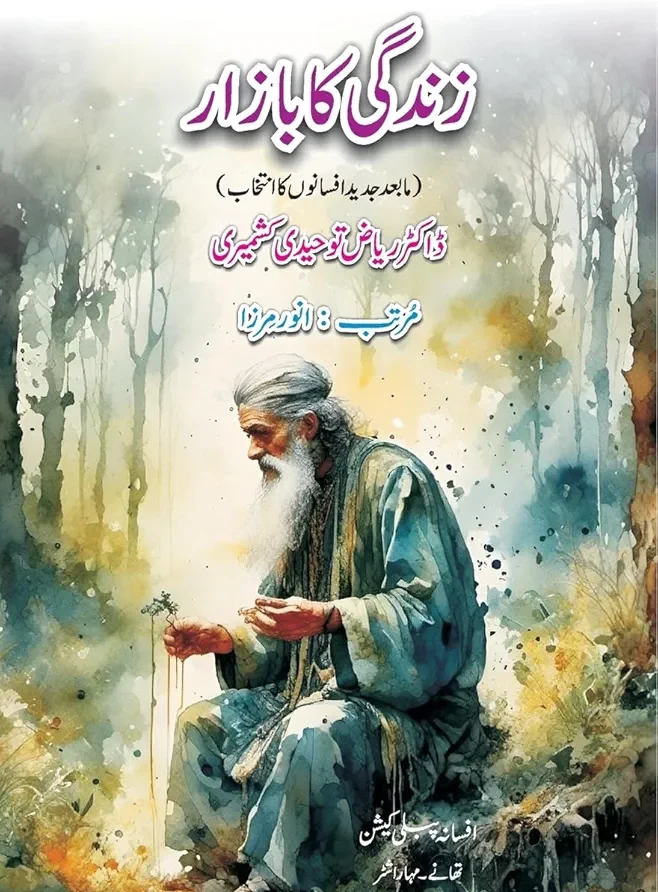
Over the years, Dr. Tawhidi has enriched Urdu literature with notable short story collections such as Kalay Pedon Ka Jangal and Kalay Dīvon Ka Saaya. His latest work, Zindagi Ka Bazaar, represents a culmination of his literary maturity and evolving vision. Carefully compiled by Anwar Mirza and published by Educational Publishing House, the 220-page collection is thoughtfully curated and aesthetically presented. Significantly, it is dedicated to the younger generation of Urdu readers, reflecting the author’s intent to inspire and engage new literary minds.
The introductory essays by Izhar Khizr and Prof. Qudus Javed add depth to the collection’s critical framework. Khizr recognizes Tawhidi as both a perceptive critic and a creative storyteller, while Prof. Javed highlights the universality of his narratives, noting how they transcend local contexts to address global themes. Their insights reinforce that this is more than a collection—it is a reflection of a writer deeply engaged with the complexities of human experience.
Comprising forty-one stories, the collection opens with The Secret of White Light, a philosophically rich narrative exploring concepts such as illumination, originality, and imitation. Through dialogue, Tawhidi simplifies abstract ideas without compromising depth. In contrast, David Planet ventures into science fiction, depicting a scientist who creates a technologically advanced world where death is conquered—only for the system to collapse, offering a critique of unchecked technological ambition.
Stories like Global Lie and Stone-Pelter confront themes of oppression and injustice, exposing power structures that marginalize vulnerable communities. Their emotional force lies in humanizing suffering, making the reader confront uncomfortable realities.
Among the most poignant narratives is The Lost Capital, which examines the erosion of familial values through the story of Ghafar Khan, abandoned despite raising a successful son. Similarly, Depression portrays everyday brutality through a disturbing encounter in public transport, reflecting the darker facets of human behavior.
The story Homeland revisits a turbulent chapter in Kashmir’s history, capturing the transformation of a once harmonious society into one marked by fear and division. It recalls a time when Hindu, Muslim, and Sikh communities coexisted peacefully, making its loss all the more tragic. In Thorns of the Babool Tree, the misuse of political power and the suffering of honest individuals highlight the ongoing conflict between integrity and authority.
On a more emotional note, Never Say Goodbye explores love constrained by societal pressures, leaving a lasting emotional impact through its simplicity and sincerity. Meanwhile, The Forest of Black Trees evokes a haunting atmosphere of fear and destruction, where human suffering becomes normalized.
Stories such as The Lost Graveyard and Flowers of Mercy further broaden the thematic canvas. The former depicts a violence-stricken society, while the latter challenges gender biases by celebrating the value of daughters. In The Throat-Cutter, Tawhidi critiques societal hypocrisy, questioning moral standards in professions traditionally associated with trust.
What makes Dr. Tawhidi’s storytelling compelling is his ability to weave philosophy, science fiction, social critique, and human emotion into a cohesive narrative style. His language remains simple yet powerful, his storytelling graceful yet impactful. Each story leaves a lasting impression, urging readers to reflect beyond the surface.
Ultimately, Zindagi Ka Bazaar is more than a literary collection—it is a mirror reflecting life’s contradictions, struggles, and hopes. It captures the essence of human experience, making it a significant contribution to contemporary Urdu literature.
Dr. Riyaz Tawhidi’s work stands as a testament to creative brilliance and intellectual depth. Engaging with this collection is not only an aesthetic experience but also an invitation to introspection—where literature becomes a bridge between understanding and transformation.
Comments are closed.