

The Past We Hold in Trust: Heritage, Memory and Collective Responsibility

Shabeer Ahmad Lone 

“Heritage is not merely inherited; it is entrusted. As Riegl recognized, it holds layered values; as Lowenthal warned, it is continually reshaped; as UNESCO affirms, it is a legacy passed between generations; and as Laurajane Smith clarifies, it is a cultural process, not a thing. What ultimately endures is our collective responsibility to care.”

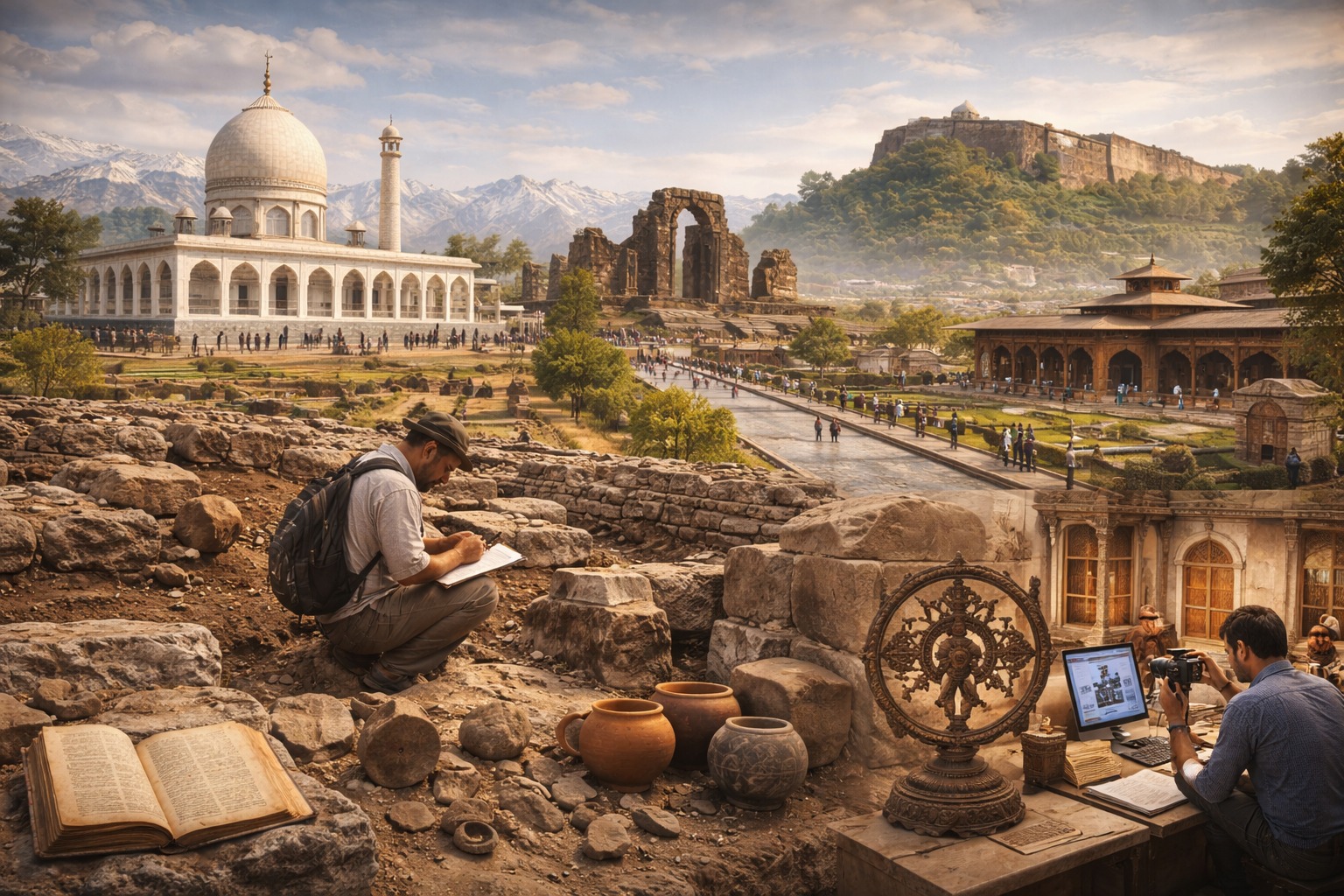
Preserving cultural heritage is neither a passive recollection of former glories nor a nostalgic indulgence; it is a profound ethical and civic imperative that sustains the dynamic continuity of human society. Cultural heritage-whether monumental forts and sacred mosques, archaeological landscapes, cultural artifacts and architectural masterpieces, royal legacies, and living traditions/the intangible practices of ritual, language, and collective memory-embodies the diversified values that define who we are as communities and as a civilization.

These values, spanning historical, aesthetic, social, spiritual, and use dimensions, are not static relics but living testaments to shared identity, memory, and experience that evolve through human engagement and interpretation over time. Heritage, thus, is a complex cultural system whose significance is socially constructed, contextually contingent, and constantly renegotiated by multiple stakeholders across generations.

Global frameworks like the UNESCO Conventions articulate heritage not simply as objects to be conserved but as vibrant agents of social cohesion, sustainable development, inclusive identity, and human dignity, capable of fostering belonging, resilience, and intercultural dialogue across diverse societies.


“Preservation is not about nostalgia or admiration of the past. It is an ethical and civic responsibility that sustains the continuity of society itself.”


This broader understanding situates heritage at the heart of civic life and underscores that authentic preservation requires not just technical conservation, but ethical stewardship, community participation, and intellectual engagement with the past as a living, shared resource.

         Across the world, a consensus has emerged within heritage studies, archaeology, architecture, and public policy that preservation and development are not opposing forces. Countries that have successfully protected their heritage-whether in Europe, East Asia, West Asia, or parts of Africa-have adopted integrated management models rooted in scientific conservation, institutional coordination, community participation, legal clarity, and ethical governance.

Visionaries such as Alois Riegl, Cesare Brandi, and more recently Amartya Sen and David Lowenthal have emphasized that heritage gains meaning not only through survival but through responsible stewardship that allows societies to engage critically and respectfully with their past. Where such stewardship is absent, heritage is either reduced to spectacle or eroded through neglect.

         Yet the present condition of many historically significant sites reveals a persistent gap between recognized cultural value and actual governance practice. Sites such as Pather Masjid, Burzahama Plateau, Baitul Meeras, Hari Parbat (Kohi Maran), and the historic Jamia Masjid illustrate different dimensions of this challenge.

In some cases, the problem lies in insufficient protection and regulation; in others, in fragmented institutional oversight; and in still others, in the absence of professional standards aligned with contemporary conservation, museological practice, or archaeological methodology. What unites these cases is not a lack of heritage significance, but a lack of holistic vision and interdisciplinary governance.

         Unregulated access to heritage spaces, as seen at Pather Masjid, gradually dissolves the distinction between protected monument and ordinary public land. The absence of adequate parking and visitor management at sites such as Pather Masjid and Pari Mahal exacerbates congestion, risks physical damage, and diminishes the visitor experience.

International conservation doctrine stresses that the dignity, sanctity, and sustainability of heritage sites depend upon clearly defined regulatory frameworks that balance access with responsibility.

Controlled entry systems, modest visitor charges, and proper parking and circulation planning are not exclusionary instruments; they are mechanisms through which societies affirm the value of heritage, generate resources for its care, and create opportunities for equitable engagement across communities. Where such frameworks are missing, monuments become vulnerable not only to physical degradation but also to symbolic and social erosion, undermining identity and collective memory.

         The Burzahama Plateau presents an even more critical concern from the standpoint of archaeological science and environmental stewardship. Archaeological sites derive their value primarily from context-the spatial and stratigraphic relationships that allow scholars to reconstruct human history. Recreational use of such landscapes, in the absence of supervision and protective boundaries, leads to irreversible loss of data. Once disturbed, archaeological layers cannot be restored.

This reality underpins international conventions that regard archaeological heritage as a non-renewable resource. Moreover, climate change, erosion, and unsustainable environmental practices compound these risks, highlighting the need for adaptive and ecologically sensitive conservation strategies.

         Museums galleries occupy a distinct but equally vital position within the heritage ecosystem. Baitul Meeras, founded by the late M. Shafi Pandit, I.A.S., stands as a testament to individual vision and cultural commitment. Nodoubt it is partially in tuned with contemporary demands, by curators personal efforts.Yet modern museology has evolved significantly over the past decades, emphasizing documentation, classification, provenance research, contextual presentation, and digital archiving. Contemporary museums are expected to function as knowledge institutions and educational platforms, not mere storage spaces.

Ideally, museums should be established and operated in tune with successful regional models such as S.P.S. Museum, Lalmandi, Srinagar, which integrates systematic curation, interactive displays, scholarly documentation, and community-oriented programming. When collections are displayed without adequate scholarly framing, interpretive signage, or cultural context, their educational potential remains unrealized. Global best practices increasingly highlight museums as spaces for intercultural dialogue, critical thinking, historical literacy, and community engagement, functions that require professional expertise, technological innovation, and institutional investment.

         Hari Parbat (Kohi Maran) exemplifies a different structural problem: fragmented governance and dispersed accountability. Despite falling under the nominal supervision of multiple departments-Archaeology, Tourism, Forest, Public Works, Power Development, Wildlife, and Public Health Engineering-the site continues to exhibit advanced structural distress, including cracked walls, a deteriorated mosque, and inadequate infrastructure. Conservation theory consistently warns against dispersed accountability. Without a unified management authority, interdisciplinary planning, and integrated conservation strategy, interventions remain piecemeal and reactive.

Similarly royal legacies such as Budshah’s tomb, Budshah’s mothers tomb, other royal family members without sign boards.No doubt, a sign exists at the main entrance of the graveyard, but the individual tombs of Budshah, his mother, and other royals remain unmarked, leaving visitors without context and diminishing the educational and commemorative value of these heritage sites. Modern heritage governance models, including UNESCO World Heritage practices, advocate for coordinated site management that simultaneously addresses conservation, tourism, environmental sustainability, and community involvement.

         Living heritage sites such as the historic Jamia Masjid remind us that heritage is not only about material conservation but also about everyday human experience and intangible cultural practices. Administrative shortcomings, including the absence of basic systems for managing visitor belongings or facilitating worship, directly affect public trust, dignity, and social cohesion. Heritage governance literature increasingly recognizes that user experience, spiritual significance, and humane administration are central to sustainability, particularly in active religious spaces where spiritual, social, and historical values intersect.

The management of Gurudwaras like Chahti Singh Padshahi Rainawari Srinager offers a model of organized, ethical, and community-centered stewardship, ensuring the protection of both heritage and the safety of worshipers and their belongings-practices every mosque could emulate.

         In addition to governance and management challenges, the digital and technological dimensions of heritage remain underexplored. Digitization, 3D scanning, virtual exhibitions, AI-driven monitoring, GIS mapping, and augmented reality offer unprecedented opportunities for documentation, interpretation, and wider public engagement. These tools also support evidence-based conservation, risk management, and educational outreach, ensuring that heritage remains accessible and meaningful to both present and future generations.

         Heritage, both tangible and intangible, is the living thread that binds memory, identity, and community across generations. Monuments, archaeological sites, and artifacts gain meaning only when animated by rituals, stories, languages, and traditions that communities practice, cherish, and transmit. Contemporary scholars such as Riegl, Brandi, and Smith remind us that heritage is socially constructed and ethically stewarded, and that its preservation is not passive but a shared responsibility-demanding careful conservation, thoughtful interpretation, inclusive governance, and active engagement from governments, institutions, and citizens alike. UNESCO frameworks reinforce this vision, emphasizing that safeguarding festivals, oral traditions, and cultural practices is as vital as conserving walls, gardens, or relics. When approached holistically, heritage becomes both a repository of memory and a catalyst for civic imagination, empowering societies to honor the past, enrich the present, and responsibly shape a vibrant, inclusive, and enduring cultural future.

         Taken together, these cases reveal a broader pattern: heritage sites are too often approached as isolated entities rather than as components of an interconnected cultural landscape. Contemporary scholarship advocates for holistic heritage frameworks that integrate legal protection, professional staffing, scientific conservation, revenue generation, community engagement, interdisciplinary collaboration, technological innovation, and environmental sustainability. Such frameworks do not diminish public access; they enhance it by ensuring that heritage remains meaningful, secure, and intelligible across generations.

         Preservation, in this sense, is neither nostalgic nor elitist. It is a forward-looking investment. Well-managed heritage sites contribute to employment, tourism, education, cultural resilience, and social cohesion. They anchor communities in shared narratives while allowing for critical engagement with history. Conversely, neglect produces silent losses-of knowledge, identity, and opportunity-that cannot be recovered once material or intangible evidence is destroyed. I am a first-hand witness to these imperatives-having spent a week closely studying these claims-affirming that what ultimately endures is our collective responsibility to care.

         The challenge before us is neither to fetishize antiquity nor to romanticize preservation; it is to reimagine heritage as a foundational commons that enriches human life today and secures the transmission of memory, identity, and meaning to future generations. Cultural heritage thrives where reverence for legacy is matched by professionalism, inclusivity, ethical governance, and a commitment to the common good; where legal protections and scientific conservation are harmonized with community voice and equitable access; and where technological innovation and contextual interpretation amplify, rather than overshadow, the intrinsic values of places, practices, and collective memory.

By anchoring heritage within broader social and sustainable development aims-as catalysts of belonging, education, economic opportunity, environmental stewardship, and intercultural understanding-societies can ensure that heritage does not become an isolated artifact of nostalgia but a living, relevant, and dynamic foundation for civic identity and civic futures.

When governance is guided by clarity, integrity, imagination, and participatory care-acknowledging both the material and immaterial, the universal and the localized, the enduring and the emergent-heritage ceases to be a burden and becomes a transformative foundation that securely holds the past in trust while illuminating the path ahead.

Author can be mailed at shabirahmed.lone003@gmail.com

Comments are closed.