
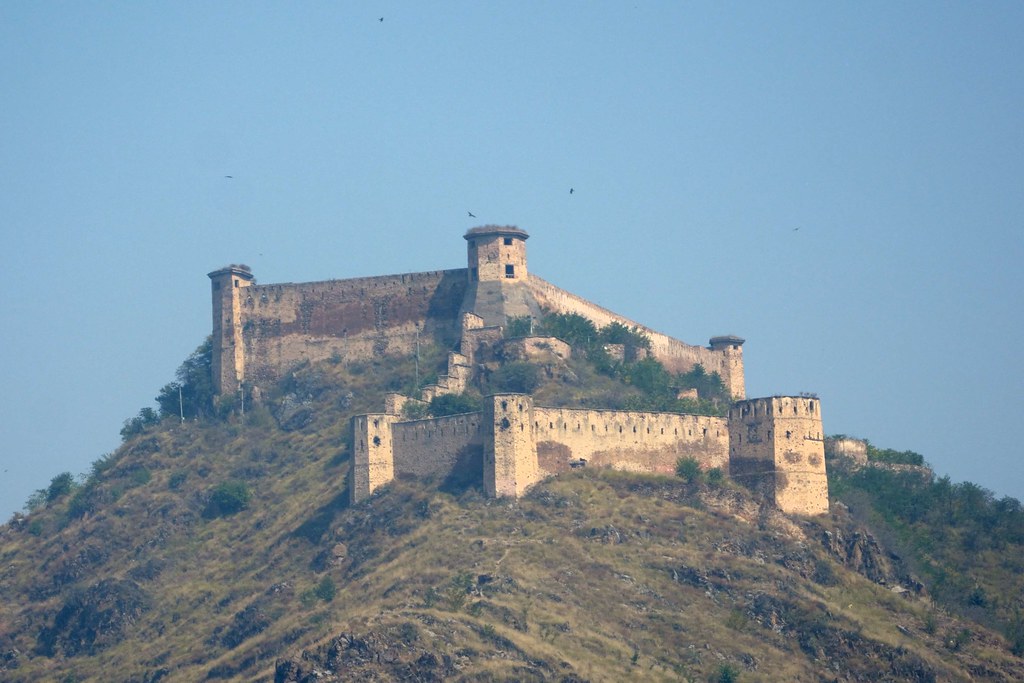
Hari Parbat Fort, The Silent Guardian of Srinagar
A layered history of power, faith, and resilience rising above the heart of Kashmir


Mohammad Muslim
“Empires stamped their authority on Hari Parbat — Mughals, Afghans, Sikhs, Dogras — yet none could claim permanence. The fort outlived them all, turning rulers into chapters and itself into a witness.”
Srinagar is packed with historic layers. The most significant heritage site is the Hari Parbat Fort. The historic structure keeps a watch on Dal Lake, the old Srinagar and the quiet spread of houses and gardens; it perches high on a hill. This fort is not merely a stone structure. The evolution of the Taj Mahal is a tale worth telling.
The tradition of Kashmir is closely associated with hill Hari Parbat. The locals associate it with ancient myths. One of the beliefs that associate the hill with a demon named Jalodbhava’s myth that was defeated by gods. The hill subsequently came to represent protection. This mound was chosen by many rulers through the centuries to control the valley and elevate the viewpoint.
The fort which we see today was built mostly during the rule of Akbar the emperor who carried the Mughal empire to Kashmir in the late 16th century. He commissioned the building of a giant wall enclosing the hill around 1590. This is the wall known as the Nagar Nagore wall which enclosed the area. He had more than defensive capabilities. He wished to erase this entire historical town and built a new city called Nagar Nagar within these walls. While the plan did not have complete success, the walls still signify his ambition.
In the 18th century, Afghan governors strengthened the fort, taking control over it. Atta Muhammad Khan was responsible for the most important addition to the mosque. He built the inner fortifications that give Hari Parbat its present appearance. Thick stone walls, strong bastions, and access control made it a might military base.
The Hari Parbat Fort’s architecture reflects practical design. Unlike Mughal gardens, it does not seek for ornamental beauty. Rather, it emphasizes strength and control. The walls are very high and wide. The fort stands at an elevation that provides a complete view of the surrounding area. You can see Dal Lake, the old city, and the hills of Kashmir from the top. The positioning of this area made observing movements and protecting straightforward.
It’s open space inside the fort but constructed. The place was designed to accommodate soldiers, store weapons and carry out administration. The design included water supply systems and storage areas. Each component was designed with a reason. The fort wasn’t built for comfort. It was there for the sake of power.
However, Hari Parbat is not all about military history. It is also regarded as holy. At the foot of the hill, you will see the Sharika Devi Temple, which is dedicated to the Goddess Sharika. Believed by devotees, the goddess will protect the valley. The temple attracts many devotees during festivals.
The shrine of Makhdoom Sahib is near the temple. Many Muslim visitors come to worship at his shrine. The coexistence of both sites upon the same hill denotes Kashmir’s long-established reputation for serving as a shared spiritual space.
A gurdwara associated with GuruharGobind, who visited the region, is also located nearby. The identity of the hill gets a new sheen. Many faiths are closely tied to few places. Hari Parbat is the point at which beliefs coincide − not clash.
Over the years the fort had many rulers. Kashmir came under Afghan after Mughals. The Sikhs came to dominate this region in the early 19th century. The region was later ruled by the Dogras. Every ruling power used the fort in its own way. Some made it stronger. It was used to house prisoners and military garrisons. In spite of it all, the structure remained intact.
During Dogra rule, the fort saw limited use compared to earlier times. Focus shifted to other administrative centers. However, its symbolic importance stayed intact. It remained a marker of authority.
In modern times, the fort is under the control of Indian security forces, and public access inside the fort is restricted. Visitors can approach the outer areas and view the structure from below. The climb up the hill offers a clear sense of its scale. The walls stretch across the slope, blending into the natural landscape
Walking around the base of Hari Parbat gives a strong connection to Srinagar’s old city. Narrow streets, traditional wooden houses, and local markets surround the area. Life moves at a slower pace here compared to the newer parts of the city. You see artisans, small shops, and daily routines that have continued for generations.
The fort also connects with nearby heritage zones. The old city of Srinagar, often called Shehr-e-Khaas, lies close by. This area holds historic mosques, shrines, and homes built in traditional Kashmiri style. Structures made of wood and brick, with intricate lattice work, reflect a distinct architectural identity.
Efforts have been made to preserve this heritage. Conservation projects aim to restore parts of the old city and improve access to sites like Hari Parbat. However, challenges remain. Urban pressure, lack of awareness, and limited funding slow down progress.
Despite these issues, Hari Parbat continues to attract attention from historians, writers, and travelers. Its value lies not just in what it shows, but in what it represents. It holds the memory of shifting empires. It reflects the cultural mix of Kashmir. It stands as a quiet observer of change.
The view from the hill remains one of its strongest features. Early morning brings a calm atmosphere. The mist lifts slowly from Dal Lake. The city begins to wake. In the evening, the light fades over the mountains. The fort stands still, unchanged by time.
For students and researchers, Hari Parbat offers a clear case of layered history. You can trace political control through its construction phases. You can study religious coexistence through the sites around it. You can observe how geography shapes defense strategy.
Visitors can have the experience directly. The paths you walk on, existed centuries ago. You live in the same hillside that rulers lived. The fort is very much the opposite of life below. The sharp contrast impresses the observer.
It is important to maintain Hari Parbat. It’s not only about saving a wall. It’s about safeguarding a record of identity. Kashmir has a complicated history. Websites like this one helps with decoding this complexity. They provide the proof, not merely the tales.
The local communities additionally have a role. Awareness of heritage can foster respect and care. People support the site in large numbers when they realize the site’s worth. Cultural programs, tourism and education are ways to build that.
Srinagar’s Heritage is epitomized in the Hari Parbat Fort. No decoration and no fame, it doesn’t seem to matter. This is strong because can be found. It stands strong and has a history of centuries.
When you see it from a distance, you may think it is just another fort. Study it closely and you will learn more It shows how power drifted, how faith remained, and how a place can be both contention and coalescence. Srinagar is known for its lakes, gardens and apple orchards. Hari Parbat gives something deeper yet. It provides circumstances. It ties the city to the past. It serves as a reminder of the stories attached to different places.
In the end, Hari Parbat Fort is not just a destination. It is a record. A record of rulers, beliefs, and resilience. A record that continues to stand, silent but strong, over Srinagar.
“At the foot of the same hill, a temple bell rings, a shrine glows with devotion, and faith does not compete — it coexists. Few places carry such quiet proof that belief can share space without losing itself.”
Comments are closed.