
The Hidden Mathematics of Housewives: How Everyday Home Tasks Reflect Pure Mathematical Thinking

Malik Mushtaq

“The home is a dynamic laboratory of applied mathematics. Within its walls, income is optimized, time is sequenced, resources are forecasted, and priorities are balanced — all through silent but disciplined reasoning.”

Mathematics is often imagined as a world of blackboards filled with formulas, classrooms echoing with equations, and examinations that test one’s ability to manipulate numbers. For many, it is a subject confined to textbooks and associated with scientists, engineers, economists, and students preparing for competitive exams. Yet this perception overlooks a profound reality: mathematics is not limited to academic spaces. It lives quietly in our homes, woven into everyday decisions, calculations, and routines. If we observe closely, we will discover that some of the most consistent practitioners of applied mathematics are housewives, whose daily responsibilities demand constant numerical reasoning, logical planning, and resource management.

The home, in many ways, is a dynamic laboratory of practical mathematics. Without chalkboards or calculators, countless women engage daily in estimation, budgeting, proportional thinking, time management, and forecasting. Their work rarely receives intellectual recognition because it is informal and unpaid. However, the mental discipline required to run a household efficiently mirrors many principles taught in formal mathematical education. The difference lies not in complexity, but in context. Where classrooms offer abstract problems, homes present real-life variables whose solutions carry immediate consequences.

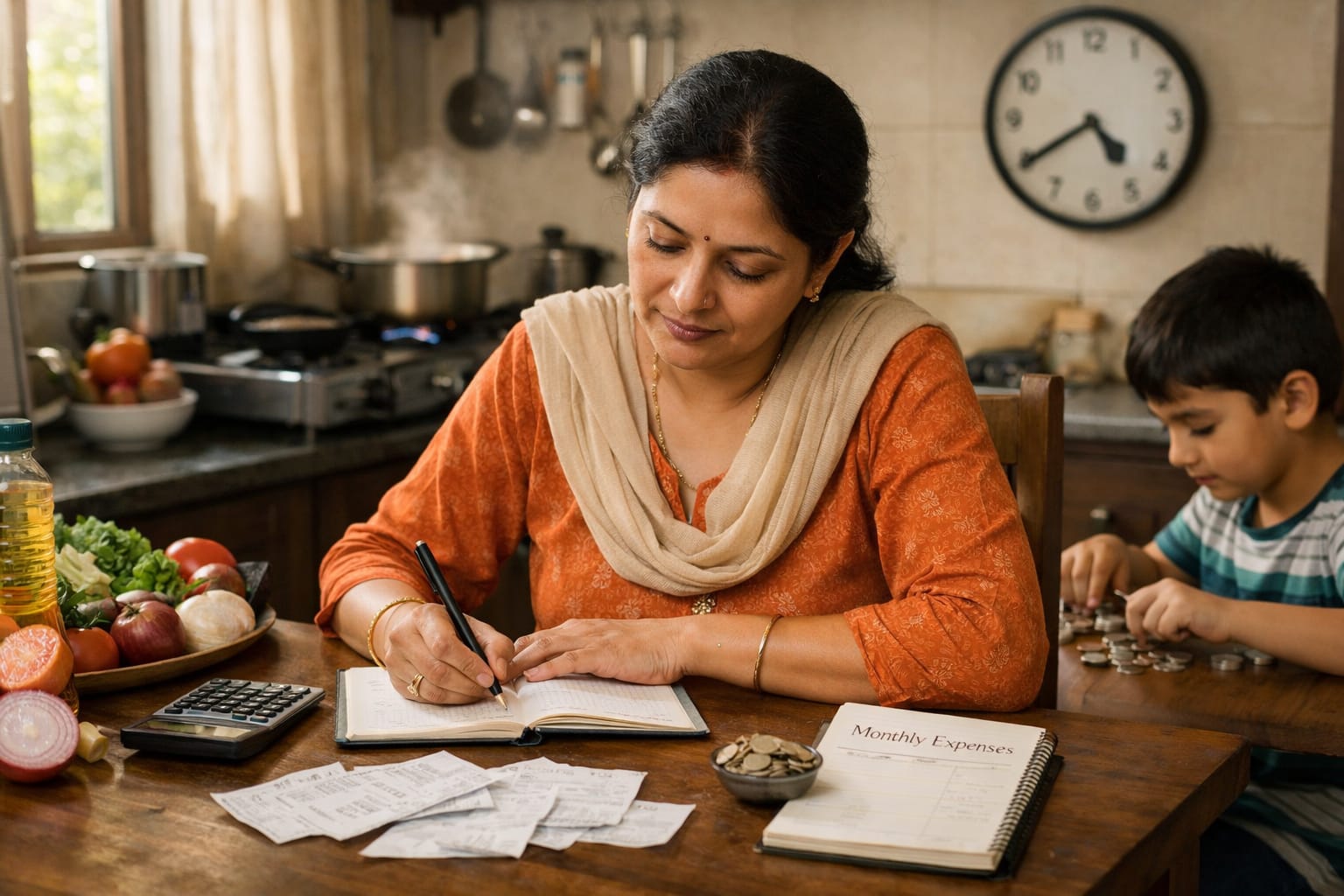
One of the clearest demonstrations of mathematical thinking in domestic life is household budgeting. In many families, the responsibility of managing monthly finances rests primarily with the housewife. She begins with a fixed income and must determine how it will be distributed across essential categories such as food, utilities, education, healthcare, clothing, savings, and emergencies. This is not a random allocation of money; it is a carefully structured plan built on addition, subtraction, comparison, and prioritization.

Before the month even unfolds, she mentally maps expected expenditures. If school fees are due, provisions must be adjusted. If electricity bills are likely to rise during extreme weather, extra funds must be reserved. Should an unforeseen medical expense arise, she recalibrates spending elsewhere to maintain balance. In effect, she continuously solves problems involving constraints and trade-offs. Limited income must satisfy unlimited needs, and stability depends on precise distribution. Economists might describe this as resource optimization; within the household, it is simply responsible management.

This financial vigilance does more than prevent overspending. It shields families from instability. A well-planned budget ensures that essentials are covered, savings are maintained where possible, and unnecessary waste is avoided. The mental calculations may be silent, but they are deliberate. Each purchase is weighed against overall priorities. Each adjustment reflects analytical thinking. Far from being a passive activity, budgeting requires foresight and disciplined reasoning.

The kitchen provides another vivid example of mathematics in action. Cooking is often celebrated as an art, but its foundation rests firmly on numerical precision. Every meal involves measurement and proportion. Ingredients must be balanced carefully to achieve the desired taste and texture. When the number of people at the table changes, quantities must be recalculated. A recipe designed for two must be adapted seamlessly for five or six without compromising quality.

This scaling process involves intuitive multiplication and division. Too little adjustment results in shortage; too much leads to waste. Baking, in particular, demands exactness. A slight imbalance in flour, sugar, or baking powder can alter texture entirely. Timing adds another mathematical layer. Different dishes require different durations of heat. Coordinating multiple preparations simultaneously involves estimating intervals and aligning sequences so that everything is ready together. In such moments, the kitchen becomes a site of logistical coordination where numbers and time interact continuously.

Beyond food preparation, the management of time itself reflects strong mathematical awareness. A typical day in a household follows a structured rhythm. Breakfast must be prepared before children leave for school. Cleaning must be completed before midday tasks. Lunch must align with family schedules. Errands must be fitted between domestic responsibilities. If one task takes longer than expected, the entire sequence must be reorganized.

This careful orchestration depends on estimating durations, sequencing activities logically, and minimizing inefficiencies. Without structured planning, daily responsibilities would overlap chaotically. Time, like money, is a limited resource. Allocating it wisely requires analytical judgment. The ability to structure a day so that multiple responsibilities are fulfilled smoothly demonstrates a disciplined understanding of intervals and order.

Shopping offers yet another arena for everyday mathematics. In markets and stores, housewives routinely engage in rapid mental calculations. They compare prices across vendors, evaluate whether bulk purchases offer better value, and estimate the total cost of items before reaching the counter. If vegetables are priced per kilogram, they quickly compute the cost of two or three kilograms. If discounts are offered, they assess whether the reduction is genuine or marginal.

Such decisions demand attention and reasoning. Staying within budget requires continuous awareness of cumulative spending. Even bargaining reflects numerical evaluation. Determining how much a seller might reasonably reduce a price involves estimation and strategic thinking. These calculations occur swiftly, often without written notes, yet they demonstrate strong arithmetic ability.

Resource management within the household further highlights practical mathematical reasoning. Supplies such as rice, flour, cooking oil, electricity, and water must be used efficiently. A housewife observes consumption patterns and anticipates when replenishment will be necessary. If a certain quantity of rice lasts a specific number of days, she projects future needs accordingly. Preparing food in appropriate quantities avoids both shortage and waste. Monitoring utility usage helps prevent inflated bills.

Such forecasting resembles inventory management in professional environments. The principles are identical: track usage, predict demand, and ensure timely replenishment. The difference lies in scale, not sophistication. At home, these processes unfold informally, guided by experience sharpened through repetition.

Housewives also contribute significantly to early mathematical education. Before children enter formal schooling, many learn counting, comparison, and pattern recognition at home. A mother teaching her child to count fruits, identify shapes, or distinguish between larger and smaller objects lays the foundation for numerical literacy. Through simple daily interactions, she introduces abstract concepts in tangible ways. In doing so, she not only practices mathematics herself but also cultivates it in the next generation.

Despite the evident analytical demands of household management, society often underestimates its intellectual dimension. Domestic work is frequently perceived as routine physical labor rather than strategic planning. Yet every day presents variables requiring adaptation. Unexpected guests may arrive. Expenses may increase suddenly. A child may fall ill. Each situation calls for reassessment and recalculation. Plans are adjusted, priorities are reordered, and resources are redistributed.

In professional settings, such adaptive problem-solving would be recognized as management or administration. Within the home, it is rarely acknowledged as intellectual labor. The invisibility of these calculations contributes to the misconception that household work lacks complexity. In truth, it requires continuous decision-making under constraint, a hallmark of applied mathematics.

Recognizing the mathematical intelligence embedded in domestic life has broader implications. It challenges the narrow idea that mathematical skill belongs exclusively to formal education or technical professions. It encourages educators to connect classroom concepts to everyday experiences, making mathematics more accessible and meaningful. When students understand that proportions relate to cooking or budgeting, abstract numbers gain practical relevance.

More importantly, such recognition fosters respect. Household work sustains families and supports the productivity of those engaged in external professions. The stability of a home often depends on careful planning and thoughtful management. Acknowledging the analytical skills involved in this process elevates the dignity of domestic labor and affirms the intellectual capabilities of those who perform it.

Mathematics, at its core, is about reasoning through relationships and making informed decisions. It is about balancing inputs and outputs, anticipating outcomes, and solving practical problems. These processes unfold daily within households across the world. They may not be recorded in ledgers or presented in formulas, but they are undeniably mathematical in nature.

The hidden mathematics of housewives reminds us that numbers are not confined to classrooms. They are present in the division of income, the measurement of ingredients, the coordination of schedules, and the forecasting of needs. Every meal prepared, every budget balanced, every resource managed reflects quiet analytical strength.

When we broaden our understanding of mathematics to include lived experience, we discover that it thrives in ordinary spaces. The home, far from being separate from intellectual activity, is one of its most vibrant arenas. Within its walls, countless calculations are made daily to ensure comfort, stability, and continuity.

Thus, it can truly be said that mathematics is not merely a subject studied in schools; it is a life skill practiced instinctively. And in this daily practice, housewives stand as remarkable examples of applied mathematical thinking. Their work proves that mathematics is not only about equations on paper, but about the art of managing life with logic, precision, and care.

Comments are closed.