

Dr. Reyaz Ahmad
“Harmony begins within the human heart, but it must not remain confined there — it must extend into families, institutions, and the global conscience.”
As the crescent moon of Shawwal rises and Muslims across continents gather in prayer and celebration, Eid al-Fitr arrives not simply as a religious festival but as a moral summons. From the crowded mosques of India to the quiet suburban homes of London, from the illuminated skyline of Sharjah to rural villages across Africa, the message of Eid travels far beyond ritual. It speaks to a world in search of balance, dignity, and peace. It reminds humanity that harmony begins within the human heart—but it must not remain confined there. It must extend outward into families, institutions, public life, and the global conscience.
This year, that message carries particular urgency. In the United Arab Emirates, authorities have officially announced that Eid al-Fitr will be observed on Friday, March 20, 2026. At the same time, international leaders have used the Ramadan season to emphasize unity and reconciliation. The Secretary-General of the United Nations, in his Ramadan message, urged the global community to bridge divisions, protect human dignity, and deliver hope in troubled times. When spiritual reflection and diplomatic appeals converge around the same theme, it is worth paying attention.
Eid al-Fitr marks the conclusion of Ramadan, a month defined by fasting, prayer, self-restraint, and reflection. Yet the deeper meaning of Eid lies not in the ending of the fast but in what the fast was meant to cultivate. Hunger in Ramadan is not an exercise in deprivation for its own sake. It is a disciplined interruption of ego. It asks the body to step back so that the soul may step forward. It invites the individual to reconsider habits of consumption, entitlement, and indifference. In that sense, Eid is less a finish line and more a beginning—a test of whether the patience, humility, and compassion learned during Ramadan will endure beyond it.
In a world marked by polarization and fatigue, this spiritual logic is profoundly relevant. The modern global citizen lives in an age of contradiction. We are more connected than any generation before us through travel, trade, and digital technology. A message written in one corner of the world can be read instantly in another. Yet despite this unprecedented connectivity, societies remain fractured by war, suspicion, inequality, and ideological hostility. We see more of each other but understand less. We hear more voices but practice less empathy. The paradox is stark: proximity has increased, but compassion has not kept pace.
Eid al-Fitr offers not merely celebration, but correction.
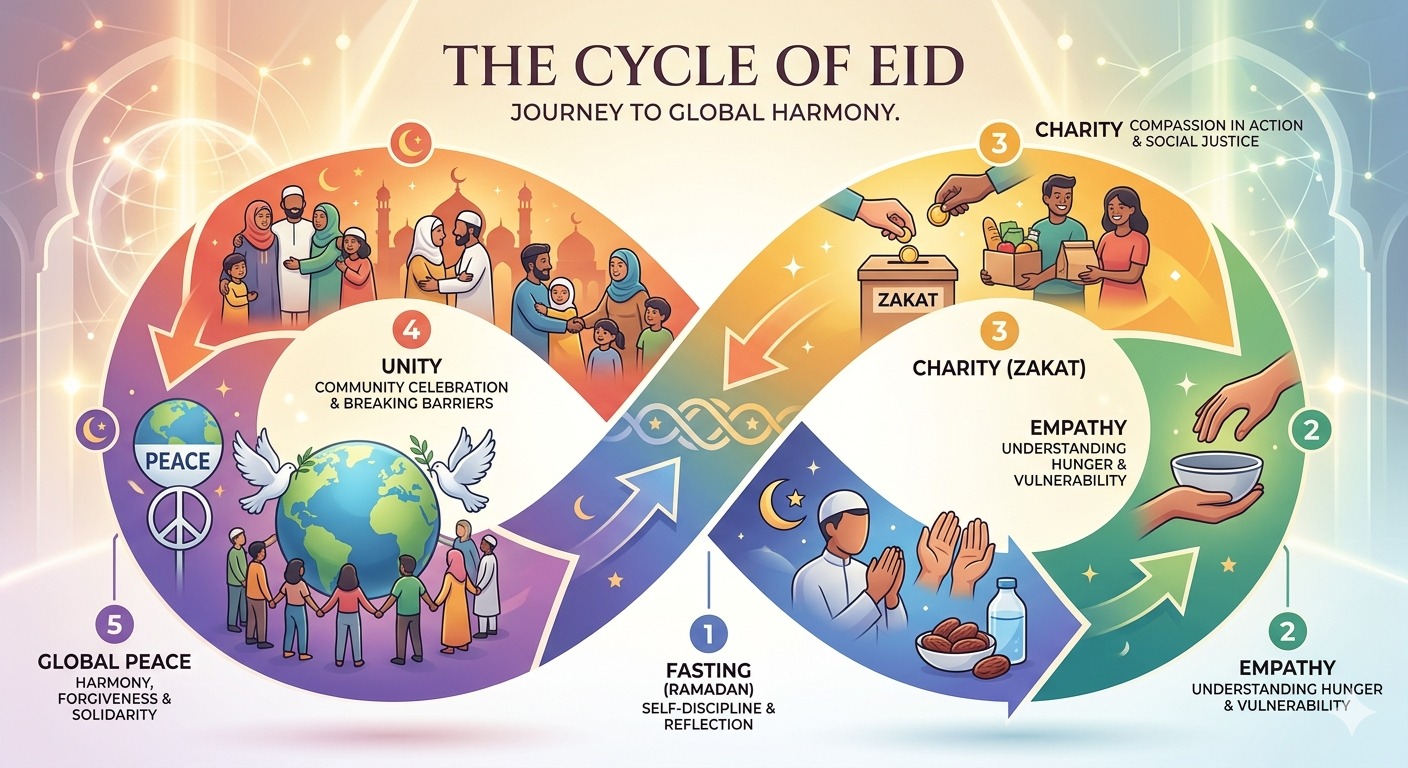
Its first lesson is empathy. Ramadan teaches through lived experience what speeches often fail to convey through argument. Hunger softens the illusion of self-sufficiency. Thirst humbles privilege. Even a temporary experience of deprivation offers a glimpse—however faint—into what millions endure daily without choice. This is why fasting is not intended as a private spiritual accomplishment. It is moral training. It conditions the heart to recognize vulnerability as a shared human condition.
In a time when refugee crises, economic disparities, and food insecurity dominate headlines, empathy is no longer optional; it is urgent. Hunger has no religion. Human vulnerability has no passport. The lesson of Ramadan extends beyond the Muslim community. It forms part of a broader ethic of global citizenship. When a believer breaks the fast at sunset, gratitude for sustenance should be accompanied by awareness of those who may not have the same assurance. When Eid morning dawns, joy should not eclipse solidarity.
This moral energy naturally flows into the second lesson of Eid: justice.
Eid al-Fitr is inseparable from Zakat al-Fitr, the obligatory charity given before the congregational prayer. Its purpose is clear—to ensure that even the poor can participate in the dignity and happiness of the day. Celebration, in this framework, cannot exclude the vulnerable. Joy that ignores suffering becomes morally shallow. Islam embeds this principle within the structure of the festival itself, transforming charity from optional generosity into communal responsibility.
This is not merely a ritual requirement; it is a social philosophy. A society that permits humiliation, entrenched inequality, or systemic neglect cannot convincingly claim to be at peace. Stability without justice is fragile. Prosperity without inclusion breeds resentment. Eid’s insistence on shared dignity is therefore both spiritual and political in the broadest sense. It reminds communities that peace requires structures of fairness, not just moments of festivity.
The global landscape in 2026 underscores this point with painful clarity. In Gaza, agencies affiliated with the United Nations continue to report severe restrictions on humanitarian operations and mounting civilian hardship. In Yemen, international assessments indicate that over 22 million people require assistance this year. In Sudan, conflict that erupted in 2023 has driven mass displacement across the region. These crises are not abstractions. They represent disrupted childhoods, grieving families, and uncertain futures. Against such realities, Eid greetings alone are insufficient. The moral voice of the festival must translate into advocacy, generosity, and sustained concern.
The third lesson of Eid is reconciliation.
The day is traditionally marked by greeting, embracing, visiting, and forgiving. Estranged relatives are encouraged to reconnect. Old grievances are softened by goodwill. At first glance, these gestures may seem limited to personal relationships. Yet their implications are civilizational. Many of today’s conflicts endure not solely because solutions are unattainable, but because pride is unwilling to bend. Political negotiations stall. Social tensions calcify. Ideological disputes harden into identity battles. The inability to say, “Let us begin again,” prolongs suffering.
Eid offers what might be called an amnesty of the heart. It invites individuals to release resentment and to rediscover the moral strength found in forgiveness. Reconciliation does not erase injustice, nor does it deny accountability. Rather, it creates space for restoration. It insists that dignity can be reclaimed through humility. If this principle were extended beyond households into institutions and public discourse, its impact could be transformative.
Imagine if communities institutionalized the practice of listening before judging. Imagine if public life allowed room for apology and repair without humiliation. Imagine if nations invested as much energy in reconciliation as they do in rivalry. The ethics embodied in Eid challenge not only private behavior but collective culture.
In multicultural societies, this potential becomes especially visible. Eid can function as a living classroom of coexistence. Schools can use it to teach students about respect and pluralism. Workplaces can recognize it as part of inclusive corporate culture. Neighborhoods can host open houses that welcome neighbors of different faiths and backgrounds. Such gestures may appear small, yet they counteract narratives of division with experiences of shared humanity.
Social media, too, presents both risk and opportunity. Platforms often amplify outrage, misinformation, and hostility. Yet they can also serve as channels of digital diplomacy. A message of mercy can travel as quickly as a message of anger. A photograph of communal prayer can challenge stereotypes. A story of interfaith solidarity can disrupt suspicion. The choice rests with users: whether to inflame resentment or to cultivate understanding.
For global citizens, the call of Eid in 2026 is therefore clear. Celebration is not the problem. Joy is not a distraction from moral responsibility. On the contrary, joy grounded in gratitude becomes a source of moral energy. Families should gather. Children should laugh. Traditional dishes should be shared. Yet alongside these expressions of festivity must come conscious acts of widening the circle.
Invite someone who feels alone. Repair one fractured relationship. Support one struggling household. Speak one word that lowers tension rather than heightens it. These gestures do not solve geopolitical conflicts overnight. But they build the culture within which peace becomes possible.
The crescent moon that signals Eid is slender and delicate. It does not dominate the sky. Yet its appearance transforms anticipation into celebration. Its symbolism is powerful. Light does not need to be overwhelming to overcome darkness. It needs only to persist. In times marked by war, displacement, fear, and polarization, small acts of conscience accumulate. They form habits. Habits shape cultures. Cultures influence institutions.
Eid al-Fitr thus matters not only to Muslims, but to the wider human family. Its core values—gratitude over entitlement, generosity over indifference, reconciliation over revenge—are universal in relevance. They speak to the conditions necessary for sustainable peace. Conference halls and diplomatic treaties play essential roles in resolving conflict. But without transformed hearts and inclusive societies, agreements remain fragile.
As Muslims gather this year—from Ajman to Delhi, from London to Nairobi—the festival offers an opportunity to model what it teaches. Let gratitude become visible in service. Let generosity become structured through sustained support. Let reconciliation extend beyond ritual greeting into genuine healing. The month of Ramadan may have ended, but its ethical momentum should not.
Eid lasts a day or two. Its lesson must endure for the year.
In 2026, amid the uncertainties of a restless world, that lesson is both simple and radical: peace is built not only through power, but through character. It grows when individuals choose humility over arrogance, when communities choose solidarity over exclusion, and when societies choose justice over complacency. The crescent has appeared. The question now is whether humanity will allow its light to guide the path forward.
Comments are closed.