

S. Ahmad
Empowering women is widely recognised as one of the most effective pathways to strengthening families, communities and national development. Over the past decade, India has witnessed a significant shift in policies aimed at expanding women’s participation in the economy. With a stronger focus on financial inclusion, entrepreneurship and skill development, government initiatives have sought to widen women’s access to credit, markets and technology. The broader vision behind these efforts is to ensure that women are not merely beneficiaries of welfare programmes but active participants in economic growth and nation-building.
This policy direction has been guided by a women-centric development framework that seeks to improve both opportunity and agency. Through a mix of financial schemes, community-based institutions and digital platforms, women across rural and urban India are increasingly gaining access to the resources required to start businesses, improve livelihoods and build financial independence. These interventions are also aligned with the larger national aspiration of building a developed India by 2047, where women contribute as equal stakeholders in economic progress.
A critical element of this effort is strengthening financial security for girls and young women. Ensuring that families invest in the future of their daughters—particularly in education and long-term financial stability—has far-reaching implications for social mobility and gender equality. Programmes designed to support savings for the girl child seek to encourage early financial planning while reinforcing the importance of investing in girls’ futures.
One such initiative is the Sukanya Samriddhi Yojana, introduced in 2015 under the Beti Bachao Beti Padhao campaign. The scheme encourages parents and guardians to create long-term savings accounts for their daughters, with the aim of supporting education and other future needs. Deposits can begin with a minimum amount of ₹250 and extend up to ₹1.5 lakh annually, while the account currently offers an interest rate of 8.2 per cent compounded annually. Contributions are permitted for fifteen years and the account matures twenty-one years after it is opened. The savings enjoy tax benefits under Section 80C, and both the interest earned and the maturity amount remain tax-free. Partial withdrawals are allowed once the girl turns eighteen or completes the tenth standard, enabling families to use the funds for higher education or other significant expenses. Since its launch, the scheme has seen strong public participation, with deposits exceeding ₹3.33 lakh crore by December 2025.
Alongside financial security for the girl child, improving rural livelihoods has emerged as a key pillar of women’s economic empowerment. Across rural India, women are increasingly participating in organised community groups that enable them to access credit, training and livelihood opportunities. These networks not only create income-generating avenues but also strengthen social solidarity and collective decision-making within communities.
At the centre of this transformation is the Deendayal Antyodaya Yojana – National Rural Livelihoods Mission, a flagship initiative of the Ministry of Rural Development. The programme mobilises rural women into self-help groups, enabling them to save regularly, access affordable credit and build small enterprises. The collective structure of these groups fosters financial discipline and mutual support, allowing women to gradually expand their economic activities and increase household incomes.
The scale of the mission is considerable. More than 10 crore rural women households have been mobilised into over 90 lakh self-help groups, forming one of the largest networks of women-led community institutions globally. The programme has also supported women farmers—often referred to as Mahila Kisans—through training in improved agricultural practices, with more than 4.6 crore women benefiting from such interventions by October 2025. A number of participants have moved beyond agriculture to establish micro-enterprises in fields such as handicrafts, food processing and rural services through initiatives like the Start-up Village Entrepreneurship Program, which has supported more than five lakh enterprises.
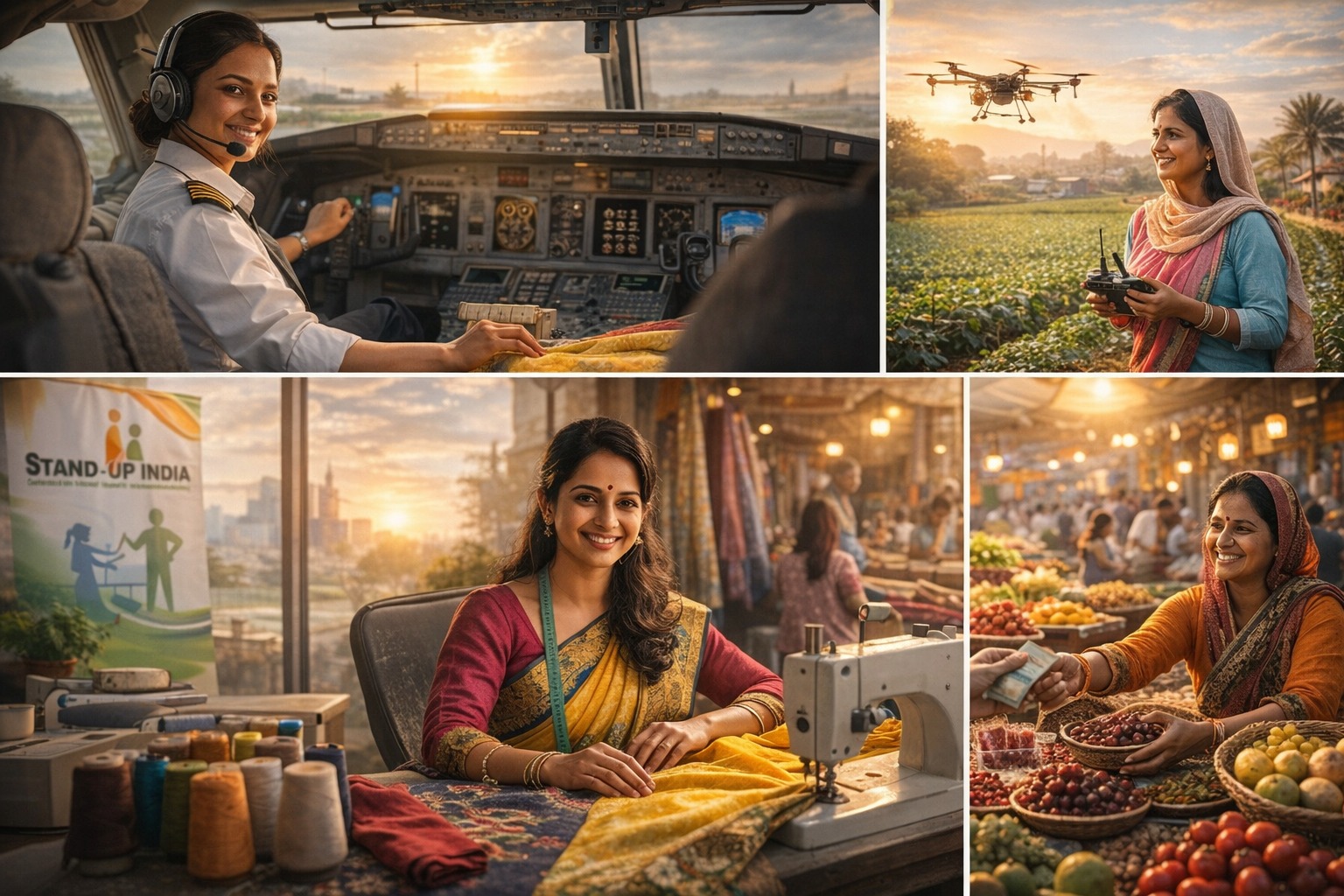
Another dimension of rural transformation is the introduction of technology-led livelihoods. The NaMo Drone Didi Yojana represents an effort to integrate advanced technology with women’s economic empowerment. Under the scheme, selected self-help groups are provided drones that can be used to offer agricultural services such as spraying fertilisers and pesticides. This initiative not only helps farmers adopt precision agriculture techniques but also generates new income streams for women operating these services.
The government provides financial support covering up to 80 per cent of the drone package cost, subject to a ceiling of ₹8 lakh. Training is also a key component of the programme. One member of each group receives specialised instruction to become a certified drone pilot, while another member is trained to assist with maintenance and technical operations. By equipping rural women with advanced technology, the scheme seeks to expand their economic roles while modernising agricultural practices.
Entrepreneurship has also been promoted as a major pathway for women’s economic advancement. When women establish and run businesses, the impact often extends beyond individual earnings to generate employment and improve household stability. Recognising this potential, the government has introduced programmes aimed at nurturing women entrepreneurs and helping them scale their enterprises.
The Lakhpati Didi Scheme is one such initiative linked to the self-help group ecosystem. It seeks to support women whose households earn more than ₹1 lakh annually through sustainable livelihood activities. The concept goes beyond income targets and focuses on building entrepreneurial capacity, financial literacy and leadership among rural women. The government has set a target of creating six crore Lakhpati Didis nationwide. To accelerate this effort, a national campaign launched in January 2026 aims to train fifty lakh self-help group members through a network of community resource persons. Digital tools such as the LokOS application and the Digital Aajeevika Register are also being used to track income levels and monitor the progress of potential entrepreneurs.
Expanding market access for women-led enterprises has become equally important. The Union Budget for 2026–27 proposed the SHE-Mart initiative, which envisages the creation of community-owned retail outlets in every district. These outlets are intended to serve as dedicated platforms for marketing products manufactured by women from self-help groups and rural enterprises. By creating structured market linkages, the initiative aims to help women move from small-scale production to organised entrepreneurship.
Similarly, the Womaniya Initiative under the Government e-Marketplace seeks to enhance the participation of women-led micro and small enterprises in public procurement. The programme connects women entrepreneurs directly with government buyers through a digital platform, thereby reducing reliance on intermediaries and expanding their access to institutional markets. Partnerships with organisations such as the Self-Employed Women’s Association and UN Women have supported training and capacity-building initiatives for women entrepreneurs participating in the platform. As of January 2026, more than two lakh women-led enterprises had registered on the platform and secured procurement orders worth over ₹80,000 crore.
Financial inclusion programmes have further strengthened this ecosystem. The Pradhan Mantri Mudra Yojana provides collateral-free loans to micro and small enterprises, enabling entrepreneurs to establish or expand businesses without pledging assets. A significant proportion of these loans has been availed by women, reflecting the growing participation of women in the small enterprise sector.
Equally transformative has been the Pradhan Mantri Jan Dhan Yojana, launched as a national mission for financial inclusion. By enabling millions of individuals to open bank accounts with minimal documentation and zero balance requirements, the scheme has brought a large number of women into the formal banking system. Direct benefit transfers, insurance coverage and access to overdraft facilities have further strengthened financial security for women who previously had limited control over household finances.
Urban women engaged in informal economic activities have also been supported through the PM SVANidhi Scheme, which provides working capital loans to street vendors. Introduced in the aftermath of the COVID-19 pandemic, the scheme offers collateral-free credit along with interest subsidies and incentives for digital transactions. It has since been extended until March 2030 and aims to benefit over 1.15 crore vendors across the country.
Meanwhile, the Stand-Up India Scheme has encouraged women and individuals from Scheduled Caste and Scheduled Tribe communities to establish enterprises by providing bank loans ranging from ₹10 lakh to ₹1 crore. The scheme also offers mentorship and application support through its digital portal, enabling first-time entrepreneurs to navigate the process of launching and managing businesses.
Taken together, these initiatives reflect the growing emphasis on women-led development in India’s policy framework. Women are increasingly moving beyond traditional roles to become entrepreneurs, technology users and leaders within their communities. From managing enterprises and participating in public procurement to operating agricultural drones and organising self-help groups, their expanding participation is reshaping local economies.
India’s development trajectory increasingly recognises that empowering women economically is essential for achieving inclusive growth. As access to finance, technology and markets continues to expand, women across the country are gaining greater control over their livelihoods and futures. In this evolving landscape, strengthening women’s financial independence is not only a matter of social equity but also a key driver of sustainable national progress.
Comments are closed.