
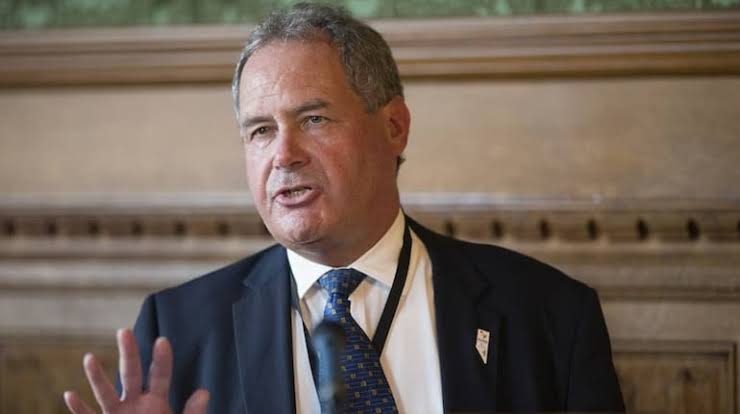
My Call for Abrogating Article 370 Dates Back Over Three Decades: British MP Bob Blackman
Says Entire Union Territory Should Reunite with India

Suhail Khan
Jaipur, Jan 05: British MP Bob Blackman on Monday stated that his advocacy for the abrogation of Article 370 spans over three decades, emphasizing India’s position on Jammu and Kashmir and calling for the Kashmir valley’s full integration with the country.
Addressing a gathering at the Constitutional Club in Jaipur, Blackman according to Kashmir Convener Correspondent said, “My advocacy for integrating Jammu and Kashmir began in 1992, not 2019.” He said, “This was during the tragic exodus of Kashmiri Pandits from their homeland. We organized significant demonstrations in the UK to highlight this grave injustice, where people were driven from their ancestral homes solely because of their faith and identity.”
The Conservative MP stated he has consistently denounced cross-border terrorism and criticized Pakistan’s administration of parts of the former princely state. “I have consistently condemned terrorism in the Kashmir valley, as well as Pakistan’s unlawful control over portions of Jammu and Kashmir,” he asserted. “From the very beginning, I have maintained that the entire original territory of Jammu and Kashmir should be fully integrated with India.”
Notably, in July 2025, he strongly condemned a terrorist attack in Pahalgam that resulted in 26 fatalities. On social media, he expressed horror at the targeting of innocent civilians and, while noting a return to calm, warned that stability remained tenuous. He urged the British government to support India unequivocally in combating terrorism.
Addressing the UK Parliament, Blackman referenced India’s subsequent counter-terrorism measures, labeling the tourist site assault a “barbaric act.” He welcomed a lull in India-Pakistan tensions but cautioned against complacency, describing the ceasefire as fragile.
Furthermore, during an international counter-terrorism outreach event in June, Blackman characterized Pakistan as a “failed state” with ambiguous civil-military control, accusing it of fostering terrorism directed at India. He called for unified international solidarity with New Delhi in addressing these security challenges.
Meanwhile, Nearly eight months after the deadly Pahalgam terror attack, a top Lashkar-e-Taiba (LeT) commander was among the seven accused named in an NIA chargesheet in connection with the case. In total, the chargesheet names five individual suspects and two terror outfits—the Pakistan-based Lashkar-e-Taiba (LeT) and The Resistance Front (TRF)—for the Pahalgam attack.
The chargesheet issues by the agency last month of which a copy lies with Kashmir Convener highlights Pakistan’s conspiracy, the roles of the accused, and the supporting evidence in the case. It charges LeT/TRF with planning, facilitating, and executing the Pahalgam attack. Sajid Jatt, a top LeT commander who was the main handler of the attack, has been named in the 1,597-page chargesheet.
The NIA chargesheet also names three Pakistani terrorists—Suleman Shah, Habeeb Tahir (aka Jibran), and Hamza Afghani—who were gunned down in an encounter with security forces near Srinagar in July.
The LeT/TRF, as well as the four accused individuals, have been charged under relevant provisions of the Bharatiya Nyaya Sanhita (BNS), 2023, the Arms Act, 1959, and the Unlawful Activities (Prevention) Act, 1967. In its chargesheet, the NIA has also invoked penal sections against the accused for waging war against India.
Additionally, two more suspects—Parvaiz Ahmad and Bashir Ahmad—who were arrested by the NIA on June 22 for allegedly harboring the three terrorists, have also been chargesheeted.
During questioning, the two men disclosed the identities of the three terrorists involved in the Pahalgam attack and confirmed that they were Pakistani nationals affiliated with LeT.
Comments are closed.