From an ancient lake and prehistoric foragers to the Valley’s first farming communities, the human story of Kashmir began thousands of years before its kingdoms entered written history.
The Kashmir Valley was once occupied by a vast lake. Over geological time, tectonic uplift and changing climate transformed the basin. The eventual drainage of the lake through the Baramulla gorge created a landscape of river channels, wetlands, forests and fertile terraces.
The Jhelum established its course through the valley while streams descending from the surrounding mountains deposited fresh sediments and reshaped the land. The change was not sudden. Glaciers advanced and retreated in the surrounding mountains, vegetation shifted with temperature and rainfall, and the valley gradually developed conditions capable of supporting diverse forms of life.
The karewa formations, remnants of ancient lake sediments, created elevated terraces overlooking rivers and wetlands. Fresh water, aquatic resources, forests, grasslands and grazing animals made the landscape increasingly attractive to human communities.
Long before farming settlements appeared, prehistoric human groups were present in the Kashmir Valley. The earliest securely documented evidence for their presence comes not from houses or cemeteries but from stone tools and animal remains found in Pleistocene deposits.
The most striking discovery is at Galander near Pampore, about 17 km south of Srinagar. There, remains of the extinct straight-tusked elephant Palaeoloxodon were found in close association with 87 stone tools in Middle Pleistocene channel deposits. The assemblage is provisionally dated to roughly 400,000 to 300,000 years ago.
The evidence does not prove that these early humans hunted the elephants. No cut marks were identified on the elephant bones and researchers have therefore described the evidence as human exploitation or interaction with elephant carcasses rather than confirmed hunting. Three bone flakes, however, suggest that early humans struck elephant bones, possibly to obtain marrow.
Other stone tools have been reported from the Lidder valley near Pahalgam, around Manasbal, at Bomai and at Balapura on the Rambiara river. These finds indicate that prehistoric people used different parts of the valley and its surrounding mountains, including river terraces, lake margins and high-altitude areas. It is not yet possible to name these earliest inhabitants, identify their languages or establish their ethnic identity.
No securely identified human skeletons establish what the earliest populations looked like or where their immediate ancestors originated. Their tools nevertheless place Kashmir within the wider prehistoric world of the northwestern Indian subcontinent and adjoining parts of Asia.
The landscape encountered by these early inhabitants was not the cultivated valley of today. It was a largely natural environment of forests, open grasslands, marshes, rivers and wetlands. Pollen, charcoal and other environmental evidence suggest a changing mosaic of woodland, scrub and open habitats. Trees and plants represented in the wider archaeological and palaeoenvironmental record include pine, spruce, deodar, birch, oak, walnut, elm, ash and other species.
Their presence varied with altitude, moisture and climate. This environment supported a varied animal population. At Gufkral, excavations recovered remains of wild sheep, wild goat, wild cattle, red deer, wolf, Himalayan ibex and bear. Fish and other aquatic resources would also have been available in the valley’s rivers, lakes and wetlands.
For early communities, survival depended on understanding seasonal movement, water availability, animal behaviour and the distribution of edible plants. Stone tools helped them process carcasses, work hides, cut wood and exploit natural materials. Rock shelters and protected locations offered refuge from severe weather.
The archaeological record reveals a long period of adaptation, though it cannot reconstruct every detail of daily life. A profound change began with the emergence of Neolithic communities, roughly between 3000 and 2000 BCE. The Neolithic, or New Stone Age, did not mean that hunting and gathering disappeared overnight. Instead, cultivation, animal management and more permanent settlement gradually became more important alongside older ways of obtaining food.
The most important evidence comes from Burzahom in Srinagar district and Gufkral in the Tral area of Pulwama. These are the two systematically excavated Neolithic sites of the Kashmir Valley and they provide the clearest picture of some of its earliest known farming communities. At Burzahom, excavations conducted by the Archaeological Survey of India between 1960 and 1971 revealed deep circular and oval pits cut into the karewa soil.
Some were nearly four metres deep and narrowed towards the opening. Postholes around their edges indicate that wooden posts supported roof structures, while birch was likely used as a covering material to protect inhabitants from the valley’s cold winters. The people of Burzahom used polished stone axes, bone implements, antler tools, harpoons, needles and hunting weapons. Plant remains from the site include wheat, barley and lentil, some of which were wild forms and some cultivated. Stone querns used for grinding grain were also recovered, supporting the interpretation that cereal processing had become part of everyday life.
At Gufkral, botanical and animal remains point to a mixed economy of cultivation, animal husbandry and hunting. Cereals and pulses, including wheat and barley, have been reported from the site, while sheep and goats were among the domesticated animals. Bones of wild animals show that hunting remained important. The shift towards food production changed more than diet.
Cultivation required knowledge of seasons, soils, seed selection and water. It encouraged communities to remain longer in particular places, develop storage methods and manage domesticated animals. Gradually, people became more closely tied to particular territories and their resources. Burzahom also reveals social and ritual practices. Human burials were found within habitation areas, sometimes accompanied by animal remains.
Red ochre and other burial practices indicate deliberate treatment of the dead. The presence of domesticated dogs in some burials further suggests a close relationship between people and animals. Particularly striking are skulls showing evidence of trepanation, the removal of part of the skull. Seven complete and four incomplete examples have been reported from Burzahom. The procedure demonstrates knowledge of a difficult intervention, but its purpose remains uncertain. It may have been medical, ritual or related to treatment after death.
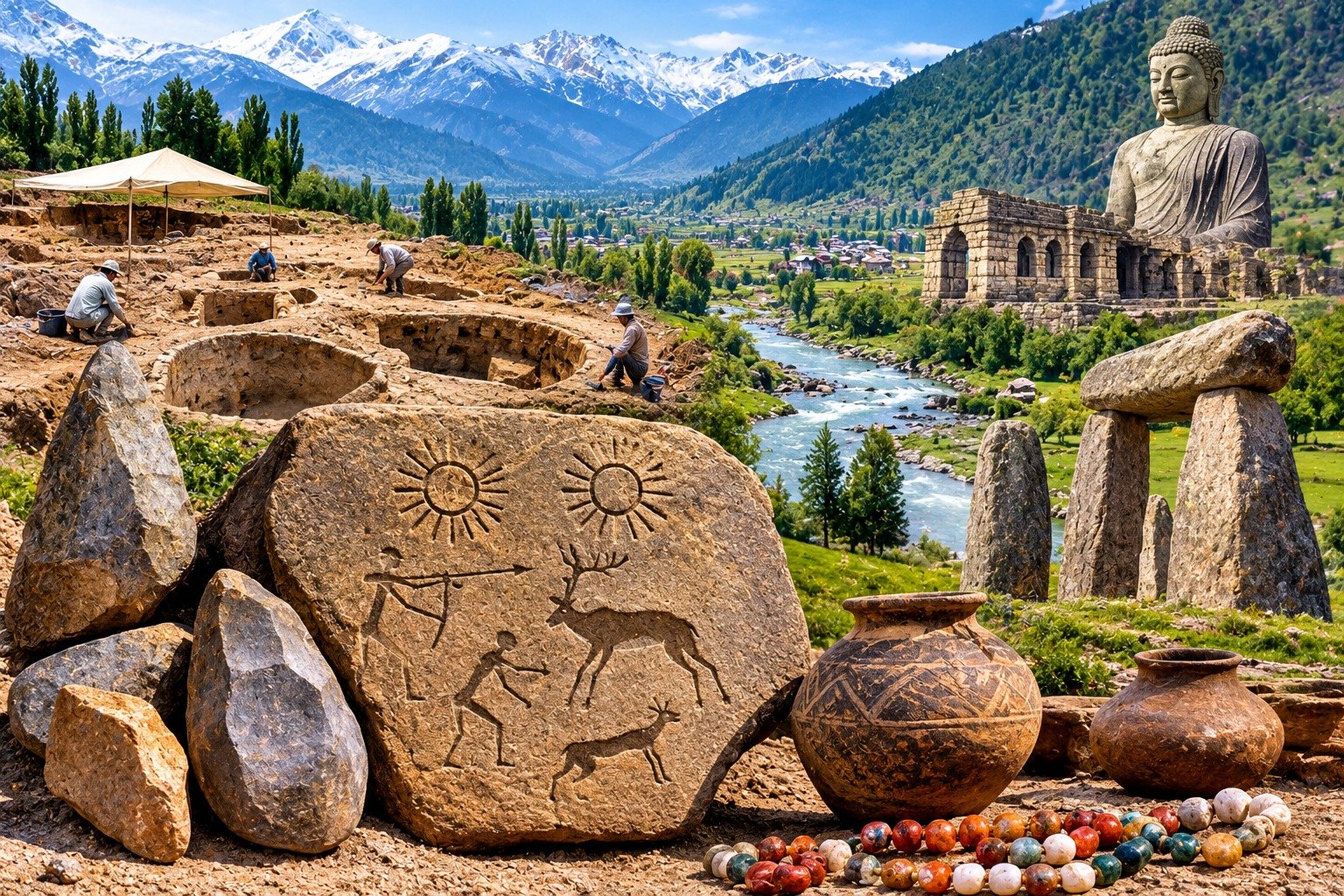
One of Burzahom’s best-known finds is an engraved stone slab from the Neolithic phase. It depicts two human hunters attacking a stag, accompanied by a dog. Above them are two rayed circular symbols. Scholars have interpreted these symbols as solar disks and some have suggested that the scene may represent the movement of the sun, but this remains an interpretation rather than an established fact.
The engraved slab suggests that these communities observed the world around them and expressed ideas through images. It also shows that Neolithic life in Kashmir involved more than immediate survival. Over generations, settlement patterns and material culture changed. Pit dwellings were gradually supplemented and replaced by structures built at ground level using mud and other locally available materials. Pottery became more widespread, tools developed in form and finish, and craft production became increasingly specialised. Beads made from materials including agate and carnelian were found at Burzahom, including a deposit of 950 beads.
These finds may point to wider contact or exchange, but the direction, distance and scale of such exchange cannot yet be established from the beads alone. The Megalithic phase, represented by large standing stones and other stone arrangements, added another visible dimension to the region’s past.
At Burzahom and other locations, these monuments suggest changing traditions of commemoration and burial. Their construction would have required the movement and placement of substantial stones, indicating organised collective effort, though their precise meaning remains unknown.
By the middle of the first millennium BCE, Kashmir was entering a more clearly recognisable Early Historic phase. Excavations at Semthan in Anantnag district have yielded Northern Black Polished Ware, metal objects and other finds that indicate growing connections with the wider northwestern subcontinent. Increasing craft specialisation and exchange transformed the character of settlements.
The valley was gradually moving beyond a predominantly village-based economy towards more complex forms of social and political organisation. The spread of Buddhism in the following centuries added another dimension. By the Kushan period, Kashmir was connected with wider religious and intellectual networks extending into Central Asia and beyond.
The emergence of Buddhist centres, followed by the rise of powerful regional kingdoms such as the Karkotas, reflected the valley’s growing political and cultural importance. The foundations of Kashmir’s later civilisation were laid much earlier. They were established by prehistoric people who explored the valley’s forests and riverbanks, learned to exploit its resources, developed tools, cultivated crops and gradually created more permanent settlements. Their achievements may appear modest beside the monuments and political institutions of later centuries, but they represent the essential beginning of organised human life in Kashmir.
Today, the archaeological sites of Burzahom and Gufkral preserve fragments of this distant world. Stone tools in river terraces, charcoal in ancient occupation layers, animal bones, crop remains and the outlines of prehistoric dwellings reveal a story that written history could never have recorded. The human past of Kashmir is inseparable from its geological and ecological history.
The ancient lake created the sediments, changing climate transformed vegetation, rivers shaped the terrain and the natural environment provided the conditions in which human communities could survive and develop. Across many thousands of years, the valley moved from a geological landscape into a living human world.



Comments are closed.