

Yousuf Mir
“The most dangerous thing about greed is that it first persuades a person to cross small boundaries and then gradually erases those boundaries altogether.”
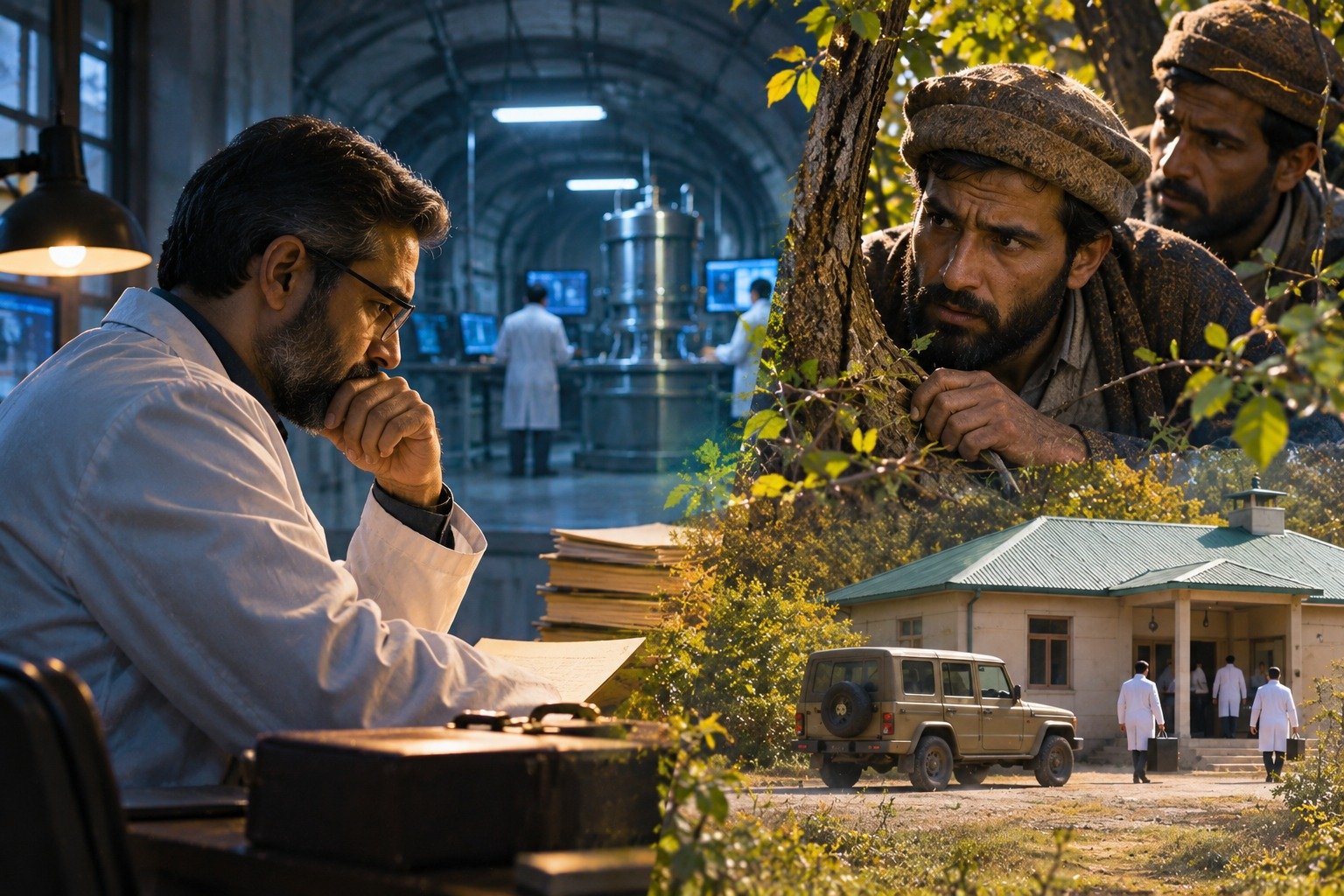
A small bungalow stood in the middle of a vast open field that stretched as far as the eye could see. The field was surrounded by dense growth of thorny acacia trees and bushes. It was not a natural forest but an area developed under a social forestry scheme.
The trees and bushes had been planted in such a way that the vast field remained hidden from public view. Anyone standing outside could hardly imagine the open space beyond the thick vegetation. There were no signs of ordinary human activity or movement in the surrounding area.
A narrow, unpaved track led to the field. Vehicles were rarely seen using that road.
Simnan and Adnan were shepherds who grazed their flocks in the area from time to time. They usually returned before sunset because there was no settlement or lighting inside the forest. Apart from the fear of wild animals, the loneliness of the place was unsettling.
One day, the weather was clear. Their sheep and goats were busy grazing, and they had stayed longer than usual. Since the sun was still fairly high, they decided to delay their return. Suddenly, they heard the sound of a vehicle engine. Both men were startled.
“Where has a vehicle come from in this deserted place?” Adnan whispered.
Simnan signalled him to remain quiet. The sound grew louder and then suddenly stopped. Peering through the bushes, they saw a khaki-coloured vehicle moving along the narrow track before stopping in front of the bungalow. A few people got out and entered the building. The two shepherds remained hidden until the vehicle eventually drove away.
The following day, Simnan and Adnan discussed the bungalow. They had seen it before but had never paid much attention to the unusual movement around it.
“Perhaps it is some government property,” Simnan remarked. “But why all this secrecy?”
Adnan thought for a moment before replying, “If it is an ordinary government place, why don’t people visit it openly?”
From then on, they began watching the track whenever they grazed their animals in the area. A few days later, the khaki vehicle appeared again, but on a different day of the week. On its next visit, it arrived on yet another day.
They gradually noticed that the vehicle came every week, but never on a fixed day. Sometimes it was Sunday, sometimes Monday, and sometimes Tuesday. The visitors arrived in the morning and left before darkness. Their movements were marked by a degree of caution that was quite unlike those of ordinary visitors.
After several weeks of observation, the shepherds realised that the vehicle entered the bungalow and returned from there. There was no visible sign of any large building outside. Yet the behaviour of the visitors suggested that the place was far more than an ordinary residence.
One day, Adnan asked, “If it is only a bungalow, why do these people visit it every week with such secrecy?”
Simnan did not reply. He, too, had become curious about the mystery surrounding the place.
Neither of them knew that a large scientific research laboratory existed deep beneath the bungalow. It was connected with a highly sensitive project whose unauthorised disclosure could threaten both national security and the integrity of the institution. The bungalow was actually the entrance to this underground facility, and the visitors were key members of the research centre.
The institution was headed by Dr Kamran, an intelligent scientist who had earned a distinguished position through hard work, ability and professional integrity in the early years of his career. His opinions carried weight, and his decisions were generally trusted. Most of the people working under him considered him a principled officer.
Then, at an international scientific conference, he met a foreign scientist. Initially, their discussions revolved around research, emerging technologies and scientific possibilities. Kamran felt that his knowledge and experience were being recognised and appreciated abroad as well.
Gradually, their meetings became more frequent. Sometimes he received expensive equipment as gifts, sometimes rare books, and sometimes invitations to participate in international projects. Kamran regarded all this attention as recognition of his professional abilities.
One day, the foreign scientist asked for his opinion on a limited aspect of the research. Kamran considered it an ordinary scientific question and answered it. Another question followed, and then another. Each was connected to the previous one. Every time, Kamran convinced himself that he was not revealing any secrets but merely helping a fellow scientist in a professional capacity.
He failed to realise that the selection and sequence of these questions, along with his answers, were being used as part of a much larger plan.
Sometime later, he was offered money. This time, Kamran hesitated. For the first time, he sensed that the relationship might have a purpose beyond what he had initially imagined.
He thought for a while. His institution’s oath, his responsibilities and the secrets entrusted to him came to mind. But almost immediately, his mind found another way to justify the situation. He convinced himself that he was not providing anything in return that could harm the institution.
The most dangerous thing about greed is that it first persuades a person to cross small boundaries and then gradually erases those boundaries altogether.
Kamran could no longer manage the operation alone. He needed people who could support his plan and help him gain access to sensitive information. Slowly, he brought two of his trusted scientists, Dr Haris and Dr Waqar, into his confidence.
Haris was given a formal promotion, while financial benefits were arranged for Waqar. Both were also promised further privileges and higher positions in the future. Their ambitions, financial interests and hopes of advancement brought them closer to Kamran.
One day, Kamran called them into his office.
“I trust both of you,” he said, “but trust alone is not enough for this task. We must also reach those who possess information about certain important aspects of the project.”
He mentioned two women, Naila and Saila.
Both were highly capable scientists who held important positions in the research centre. Their opinions were considered essential in several areas of their work. However, because of their social backgrounds, they had not received the respect and acceptance they deserved. Despite being educated and professionally competent, they faced obstacles in social relationships and marriage prospects. People acknowledged their abilities but were unwilling to look beyond their backgrounds.
Kamran knew about their situation. He instructed Haris and Waqar to gain the women’s confidence. They were to appreciate their work, recognise their abilities and make them feel that their efforts were valued by the institution.
Haris and Waqar followed his instructions. They spoke respectfully to Naila and Saila, praised their work and offered assistance whenever needed. Kamran also made certain professional facilities more accessible to them so that this growing closeness would not appear unusual.
For Naila and Saila, this behaviour was an unexpected change. For the first time, they began to feel that perhaps their education and professional abilities were being given greater importance than their social backgrounds. In an environment where they had often been overlooked, this respect seemed like a blessing. They considered it recognition of their hard work and a welcome change in their lives.
They had no idea that their trust was being used as part of a conspiracy.
Gradually, Haris and Waqar began discussing matters related to sensitive aspects of the research with them. Sometimes they asked about scientific findings, and at other times about technical procedures. The conversations were carefully presented so that nothing would arouse suspicion. Some of the information they obtained proved useful to Kamran’s plan.
Both women considered their colleagues trustworthy. They never suspected that the relationships being built with them concealed personal interests and an intention to betray the institution.
Another senior scientist at the research centre was Dr Salman. He had spent many years protecting the principles of the institution and safeguarding its sensitive project. He was among Kamran’s old colleagues and had begun noticing changes in his behaviour.
Kamran was becoming increasingly secretive. He sometimes made decisions without consulting the relevant experts, showed unusual interest in access to confidential information and became unnecessarily defensive when questioned about certain matters.
One day, Dr Salman stopped him for a private conversation.
“Kamran, I have known you for years. I have never doubted your abilities, but some of your recent decisions are difficult to understand. This institution’s sensitive projects are far more important than our personal interests. We have taken an oath to protect them.”
Kamran looked at him.
“Do you really think I need you to remind me of my oath?”
“When circumstances begin to contradict that oath, someone has to remind us of it,” Salman replied.
Displeasure spread across Kamran’s face.
“Mind your own responsibilities, Salman. Suspecting everything is not wisdom.”
Salman fell silent, but his doubts had grown stronger.
There was another employee at the research centre named Farid. To most people, he appeared to be an ordinary computer operator. Quiet, reserved and focused on his work, he rarely engaged in unnecessary conversation or tried to display his abilities.
However, Farid’s actual responsibility was far greater than his apparent position suggested. He secretly held the second most important responsibility within the institution’s internal security system.
His true identity and role were known only to a few senior officials. His duties included monitoring unauthorised access to sensitive information, suspicious activities and potential threats to the institution’s security.
Farid noticed certain unusual activities in the computer records. Access timings for confidential files, the movement of certain information and communication records began to form a pattern. He did not rush to accuse anyone. Instead, he preserved the available evidence within his authorised access and informed the head of internal security.
As the investigation progressed, Kamran began to sense that someone was getting close to his operation. He instructed Haris and Waqar to keep an eye on Farid.
“He is just an ordinary computer operator,” Kamran said. “He should know his limits.”
Haris informed him that Farid was unusually careful in his work and sometimes asked questions that suggested he was closely examining the records.
Kamran’s suspicion gradually turned into certainty. He feared that if Farid handed over all the evidence to the relevant authorities, the conspiracy he had carefully built over the years would be exposed.
One day, Kamran summoned Farid to his office.
“Never forget your position, Farid.”
Looking directly into his eyes, Farid replied, “I have not forgotten my responsibilities, sir.”
The brief response displeased Kamran. He tried to intimidate Farid and restrict his activities, but Farid made no change in his behaviour that could reveal his real assignment.
The danger facing Kamran and his associates was now growing. They realised that Farid knew something about their activities. Together, they began plotting to eliminate him, believing that silencing Farid would close the path leading to the evidence.
What they did not know was that Farid had already secured the necessary evidence and informed the relevant internal security authorities.
A few days later, an attempt to transfer sensitive information without authorisation reached its final stage. Kamran and his associates were convinced that they would succeed this time. They believed every necessary arrangement had been completed and that nobody knew what they were doing.
At the appointed time, the surveillance system detected suspicious activity. The unauthorised transfer was blocked, and the relevant security measures were activated. It was no longer merely a matter of irregularities in the records. There was now clear evidence of an attempt to transfer sensitive information outside the institution.
Realising the danger, Kamran made a final attempt to bring Farid under control, but it was already too late.
Suddenly, internal security personnel entered the research facility. They had the necessary evidence and clear orders for action. Kamran, Haris, Waqar and the other individuals involved in the conspiracy were taken into custody. The transfer of sensitive information was stopped, and the institution’s systems were secured.
Naila and Saila were also questioned. They explained what they knew and described their conversations with Haris and Waqar. It soon became clear that their trust and professional closeness had been exploited.
There was no evidence that either woman had knowingly attempted to harm the institution’s interests. They had themselves fallen victim to a deception carefully designed to exploit their trust and social disadvantages.
Dr Salman also provided information about the events. His earlier suspicions had now been supported by evidence. He was deeply saddened that a man who had been trusted for years had sacrificed his oath and responsibilities for personal gain.
During the investigation, information provided by Simnan and Adnan also came to light. Their observations about the unusual movement of vehicles at the bungalow and the visitors arriving on different days helped confirm the secret location and routine of the research facility. Thus, what had seemed like ordinary observation by two shepherds became a useful link in the investigation.
After the operation was completed, the head of internal security called all the concerned officers and employees together. The atmosphere was serious. Everyone wanted to know how the complicated conspiracy had been exposed and how Farid had helped protect the institution despite the enormous risks.
The head of internal security called Farid forward.
“Most of you know Farid as a computer operator,” he told the gathering, “but his actual responsibility was far more important. He held the second most important position in the institution’s internal security system.
In carrying out his duties, he demonstrated exceptional honesty, alertness and professional caution. He not only preserved crucial evidence but also saved the institution’s sensitive project from a major threat.”
A deep silence fell over the gathering. Several people looked at Farid in amazement. Those who had considered him an ordinary employee were now beginning to understand the importance of his actual role.
The head of internal security picked up a medal.
“Farid has demonstrated loyalty to his conscience, his oath and his responsibilities. In recognition of his services, he is being awarded the medal of ‘The Hero of Conscience’.”
He placed the medal on Farid’s chest. The hall erupted in applause.
Farid quietly touched the medal. His father’s words echoed in his mind: a person’s true standing is determined not by his position but by his character. He remembered the days when his quiet nature had been mistaken for weakness and nobody had even imagined the responsibility he secretly carried.
When the applause subsided, the head of internal security made another announcement.
“Taking into account Farid’s integrity, competence and exceptional services, the senior management has decided to appoint him as the head of the institution. His appointment will take effect after the necessary administrative approval.”
Once again, the hall resounded with applause.
Farid bowed his head and accepted the honour. For him, this moment was not merely about promotion or success. It was a confirmation of his belief that when a person remains faithful to his responsibilities, even silent efforts eventually find their rightful recognition.
On one side stood Kamran, who had used his knowledge, authority and the trust placed in him for personal gain. In his pursuit of wealth and advancement, he had forgotten his oath. On the other side stood Farid, who had protected the institution without revealing his true responsibility and had refused to sell his conscience even in the face of danger.
That day, the institution had not merely foiled a conspiracy. It had also witnessed a truth that is often overlooked behind positions and outward appearances.
Farid had made his choice. He was truly the Hero of Conscience.
“Knowledge, authority and position mean little when a person abandons his conscience for personal gain. True honour belongs to those who remain loyal to their principles, even when doing so comes at a cost.”
Comments are closed.