As global markets demand cleaner production and responsible sourcing, India’s textile industry has a unique opportunity to combine its centuries-old traditions with modern innovation to emerge as a global leader in sustainable manufacturing.
For centuries, textiles have been woven into the very fabric of India’s civilisation. From the fine muslins of Bengal and the vibrant ikat weaves of Odisha to the intricate pashmina of Kashmir and the resilient jute of eastern India, the country’s textile heritage reflects not only artistic excellence but also an enduring relationship with nature. Long before sustainability became a global buzzword, Indian communities practised a culture of repairing, reusing, recycling and respecting resources. Old cotton garments became quilts, worn sarees were transformed into household essentials, and textile scraps found new life as rugs, mats and handcrafted products. Waste was rarely viewed as waste; it was simply another resource waiting to be reinvented.
Today, as the world grapples with climate change, resource depletion and mounting textile waste, this traditional wisdom is acquiring renewed relevance. The global fashion and textile industry, once driven almost exclusively by low-cost production and rapid consumption, is undergoing a profound transformation. Consumers are increasingly questioning where their clothes come from, how they are produced and what environmental footprint they leave behind. International buyers are demanding traceability, ethical sourcing and lower carbon emissions, while governments across the world are introducing stricter sustainability regulations. In this changing landscape, competitiveness is no longer determined solely by price and production capacity. It is increasingly shaped by environmental responsibility.
For India, this transition presents not merely a challenge but an extraordinary opportunity.
The country’s textile and apparel industry is among the most significant pillars of the national economy. Contributing nearly two per cent to the country’s Gross Domestic Product and around eleven per cent to manufacturing Gross Value Added, the sector occupies a strategic place in India’s industrial ecosystem. It directly employs more than 45 million people, making it one of the largest providers of employment after agriculture. Millions of women, artisans, weavers, farmers, designers, traders and entrepreneurs depend on textiles for their livelihoods. India’s position as the world’s sixth-largest exporter of textiles and apparel further underlines the sector’s global importance.
Yet the industry’s economic success also brings significant environmental responsibilities.
Textile manufacturing is among the world’s most resource-intensive industries. Conventional production consumes enormous quantities of water and energy, relies heavily on chemicals during dyeing and finishing, and generates substantial volumes of waste throughout the production cycle. The rise of fast fashion has only intensified these concerns by encouraging shorter product life cycles and higher consumption patterns. Around the world, discarded clothing has become one of the fastest-growing categories of municipal waste, placing enormous pressure on landfills and natural ecosystems.
For export-oriented economies like India, these concerns have direct commercial implications. Major international markets, particularly in Europe and North America, are steadily moving towards sustainability-linked trade standards. Buyers increasingly seek suppliers capable of demonstrating environmental compliance, responsible sourcing, circular production practices and transparent supply chains. Sustainability has therefore evolved from being a matter of corporate social responsibility into a decisive factor influencing market access and long-term competitiveness.
India’s response to this changing reality reflects an important strategic shift. Rather than treating sustainability as a regulatory obligation, policymakers and industry leaders are beginning to view it as an engine of industrial transformation. The emphasis is gradually moving beyond simply producing more textiles towards producing them more responsibly, more efficiently and with greater value addition.
At the heart of this transformation lies the concept of the circular economy.
Unlike the traditional linear model of “take, make and dispose”, a circular economy seeks to keep materials in productive use for as long as possible. Products are designed for durability, repairability and recyclability. Raw materials are recovered and reintroduced into manufacturing instead of being discarded. Waste becomes an input rather than an endpoint. Such an approach not only conserves natural resources but also reduces production costs, lowers emissions and creates new business opportunities.
For India’s textile industry, circularity is not an unfamiliar concept imposed by modern environmental thinking. It resonates deeply with practices that have existed for generations across rural and urban communities alike. What is changing today is the scale at which these principles are being integrated into organised manufacturing and national industrial policy.
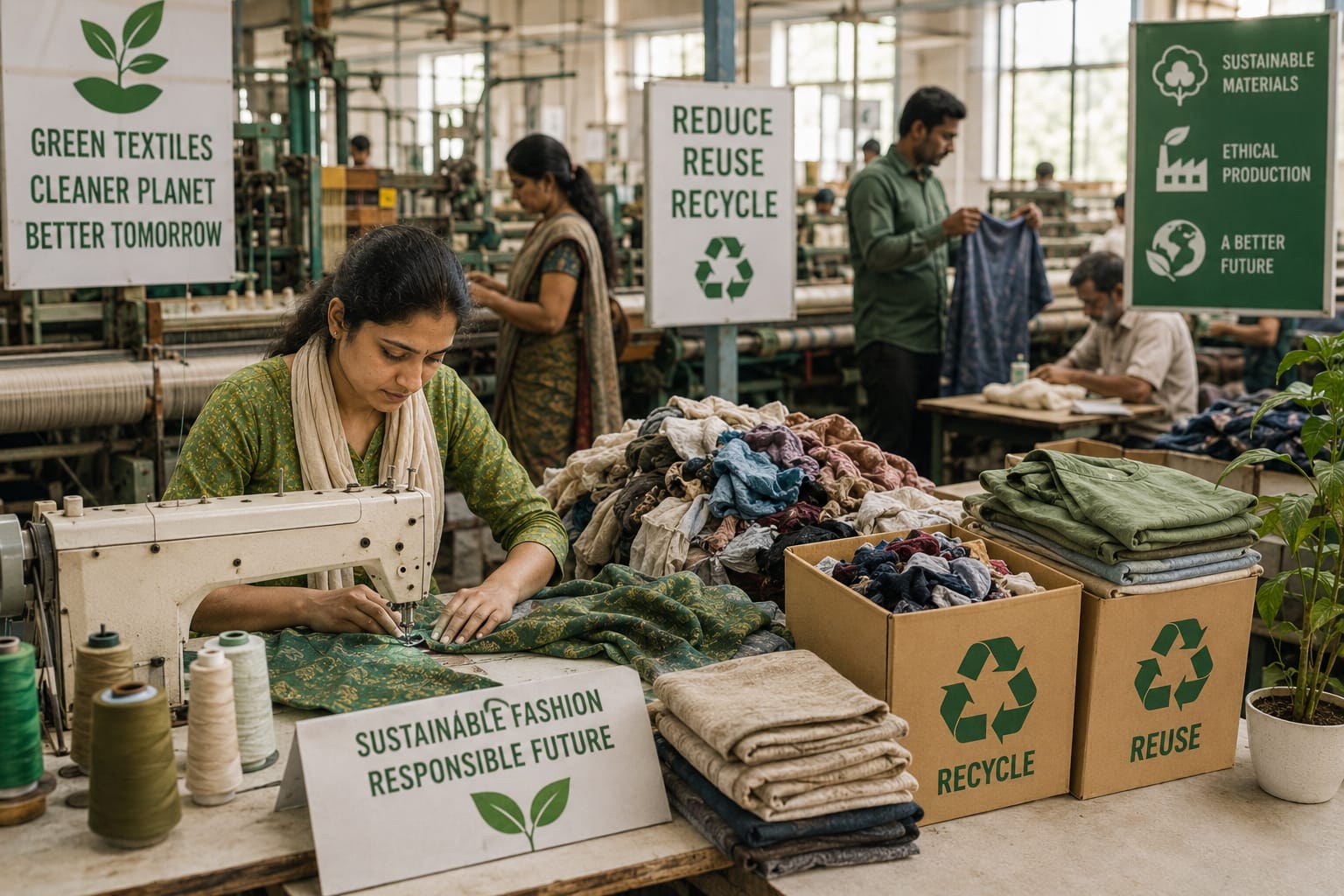
The numbers themselves illustrate both the challenge and the opportunity. India manages nearly 7.8 million tonnes of textile waste every year. Encouragingly, more than seventy per cent of this waste already finds its way into recycling, upcycling, reuse or other recovery pathways. Nearly ninety-five per cent of pre-consumer textile waste—factory scraps, cutting waste and production leftovers—is collected and reintroduced into manufacturing through established value chains. Even post-consumer textile waste, traditionally more difficult to process, is increasingly being diverted away from landfills through organised collection and sorting networks.
Behind these statistics lies a vast ecosystem that often goes unnoticed. Millions of informal workers, waste collectors, women entrepreneurs and small enterprises form the backbone of India’s textile recovery network. Their work not only reduces environmental impact but also sustains livelihoods for an estimated forty to forty-five lakh people. In many ways, these workers have practised circular economy principles long before the term entered policy discussions.
Across the country, remarkable examples are demonstrating how circularity can evolve from a traditional practice into an organised industrial model.
Navi Mumbai’s Municipal Textile Recovery Facility has pioneered an integrated approach that combines collection, sorting, technology, upcycling and livelihood generation under one roof. By recognising textile waste as an economic resource rather than a disposal problem, the facility has processed thousands of discarded garments while simultaneously supporting women artisans and creating new market opportunities for upcycled products.
Panipat, long known for its textile industry, has emerged as one of India’s largest recycling hubs. Every day, thousands of tonnes of textile waste flow into the city, where specialised enterprises convert discarded fibres into blankets, carpets, yarn and industrial materials. What once represented industrial waste has become the foundation of an entire local economy, demonstrating that environmental sustainability and economic productivity can reinforce rather than contradict each other.
Similarly, Delhi’s Katran Market in Mongolpuri illustrates the strength of India’s informal recycling ecosystem. Here, textile cutting waste arriving from garment manufacturing centres across northern India is meticulously sorted by colour, quality and fibre type before being supplied to recycling clusters. This seemingly ordinary marketplace performs an essential function in maintaining material value throughout the supply chain, reducing waste while generating employment for hundreds of families.
These success stories reveal an important lesson. Circularity is not merely about sophisticated recycling technologies or advanced industrial infrastructure. It is equally about recognising the value embedded in materials, creating efficient recovery systems and ensuring that every participant in the value chain—from factory worker to artisan, recycler to entrepreneur—becomes part of a more sustainable production ecosystem.
India’s textile transformation, therefore, is no longer confined to producing fabrics and garments. It is increasingly about redesigning the entire lifecycle of textiles—from the fibres that farmers cultivate to the products consumers eventually discard. Sustainability is emerging not as a peripheral concern but as the organising principle shaping the future of one of India’s oldest and most important industries.
Weaving a Greener Future: Why Sustainability Will Define India’s Textile Leadership
If India’s traditional practices provide the philosophical foundation for a circular textile economy, policy reforms and technological innovation are now providing the institutional framework to scale it up. The transition towards sustainability is no longer confined to niche enterprises or environmentally conscious brands. It is gradually becoming embedded across the textile value chain—from fibre cultivation and manufacturing to waste recovery, certification and global marketing.
This transformation begins at the source: the raw materials.
The environmental footprint of any textile product is largely determined by the fibres from which it is made. Cotton cultivation, for instance, has historically required significant quantities of water and chemical inputs, while synthetic fibres derived from petroleum have contributed to growing concerns over microplastic pollution and carbon emissions. Recognising these challenges, India is encouraging a gradual shift towards certified organic cotton, sustainable jute and a new generation of natural fibres that reduce dependence on environmentally intensive materials.
Certification frameworks under the National Programme for Organic Production are helping Indian organic cotton gain wider acceptance in international markets, particularly in Europe, where sustainability standards are becoming increasingly stringent. At the same time, initiatives such as Jute-ICARE are modernising one of India’s oldest natural fibre industries by improving seed quality, retting techniques and scientific cultivation practices. The programme’s steady expansion across multiple states demonstrates how sustainable agriculture can simultaneously improve farmer incomes and strengthen industrial competitiveness.
Equally significant is the growing emphasis on alternative natural fibres such as flax, ramie and sisal. These fibres require comparatively fewer synthetic inputs and offer considerable potential for diversified textile applications, composites and technical products. Their promotion reflects a broader recognition that sustainability begins not in the factory but in the field.
However, sustainable fibres alone cannot guarantee sustainable textiles. The manufacturing process itself must undergo a profound transformation.
Textile processing remains one of the most resource-intensive stages of production. Dyeing, bleaching and finishing consume enormous volumes of water while relying on chemicals that, if inadequately treated, can pollute rivers and groundwater. Around the world, several textile manufacturing hubs have faced criticism for their environmental footprint, making cleaner production technologies essential not only for ecological protection but also for maintaining access to export markets.
India’s response has increasingly focused on modernising industrial infrastructure rather than merely regulating pollution. The PM Mega Integrated Textile Region and Apparel (PM MITRA) Parks exemplify this new approach. Conceived around the vision of “Farm to Fibre to Factory to Fashion to Foreign,” these integrated manufacturing hubs seek to bring every stage of textile production within a common ecosystem supported by shared infrastructure.
What distinguishes these parks from conventional industrial estates is the emphasis on sustainability. Common Effluent Treatment Plants, wastewater recycling systems, scientific waste management facilities and shared utilities significantly reduce environmental costs while enabling economies of scale. By integrating sustainability into industrial planning rather than treating it as an afterthought, the PM MITRA model seeks to demonstrate that environmental responsibility and manufacturing competitiveness can advance together.
The significance of this approach extends beyond large industries. India’s textile sector is overwhelmingly driven by micro, small and medium enterprises, which account for a substantial share of production and employment. These enterprises often possess the entrepreneurial flexibility necessary for innovation but lack the financial resources to invest in cleaner technologies independently.
Recognising this reality, government initiatives are increasingly targeting MSMEs through financial incentives, technical support and capacity building. Schemes promoting green technologies, clean energy adoption and circular manufacturing practices help smaller enterprises modernise without bearing prohibitive costs. Interest subsidies, capital assistance and awareness programmes are enabling businesses to adopt energy-efficient machinery, reduce waste generation and improve resource productivity.
Such interventions are particularly important because sustainability should not become a privilege available only to large corporations. If India’s green textile transition is to be truly transformative, it must include the thousands of small weaving units, dyeing facilities, garment manufacturers and artisan enterprises that collectively constitute the backbone of the industry.
Another important shift is taking place in how industries perceive environmental performance. Traditionally, pollution control was viewed as a compliance burden—a regulatory requirement that increased operational costs. Increasingly, however, environmental efficiency is becoming an economic asset.
The introduction of the Indian Carbon Market and the Carbon Credit Trading Scheme reflects this changing philosophy. By assigning measurable targets for greenhouse gas emission intensity and creating financial incentives for industries that exceed environmental performance standards, India is gradually embedding sustainability into business economics. Textile enterprises capable of reducing emissions through cleaner technologies and efficient energy use may not only lower production costs but also generate additional value through carbon credits.
Although carbon markets remain relatively new in India, they indicate an important policy direction. Environmental responsibility is no longer being framed solely as an ethical obligation but as an opportunity for innovation, efficiency and competitive advantage.
Chemical management represents another crucial dimension of sustainable manufacturing. Hazardous dyes and persistent organic pollutants have long posed challenges for textile-producing nations. India’s efforts to eliminate harmful chemicals from the textile and fashion supply chain therefore carry significance beyond regulatory compliance. Cleaner chemicals improve workplace safety, reduce environmental contamination and make recycled fibres easier to process within circular production systems.
Pilot projects involving hundreds of factories across multiple textile clusters have already demonstrated that reducing hazardous chemical use can simultaneously lower greenhouse gas emissions and improve environmental performance. These initiatives also prepare Indian exporters for evolving international regulations that increasingly restrict the use of environmentally harmful substances in consumer products.
The industry’s sustainability journey, however, does not end when a garment leaves the factory.
Perhaps the most overlooked stage of the textile lifecycle is what happens after consumption. Every discarded shirt, saree, curtain or bedsheet represents both an environmental challenge and an economic opportunity. If managed inefficiently, textile waste occupies landfill space, releases greenhouse gases and squanders valuable resources. If recovered intelligently, the same material can become the raw input for an entirely new production cycle.
India’s growing focus on post-consumer textile recovery reflects this understanding. The recently strengthened Solid Waste Management framework introduces circular economy principles more explicitly into waste governance while emphasising segregation, resource recovery and extended producer responsibility. Such measures encourage industries and local governments to view waste management as part of industrial planning rather than merely a municipal sanitation function.
Research and innovation are also expanding the possibilities of textile recycling. Under the National Technical Textiles Mission, several projects are exploring technologies capable of converting textile waste and agricultural biomass into advanced functional materials, including carbon fibres and specialised technical textiles. These innovations demonstrate that sustainability need not be confined to conventional recycling but can become a driver of high-value manufacturing.
The publication of a comprehensive national assessment of India’s textile waste value chain marks another significant step. Reliable data is indispensable for effective policymaking. By identifying where waste is generated, how it moves through recovery systems and where opportunities for value addition exist, such mapping exercises help transform circularity from an abstract aspiration into a practical industrial strategy.
Equally important is the growing emphasis on standards, certification and traceability.
Global consumers today increasingly seek assurances that the products they purchase have been manufactured responsibly. Eco-labelling, sustainability certifications and digital traceability systems therefore serve not merely as marketing tools but as instruments of trust. India’s efforts to strengthen initiatives such as Eco-Mark, Kasturi Cotton and Silk Mark enhance the credibility of Indian textiles while enabling buyers to make informed choices based on environmental performance and responsible sourcing.
This emphasis on traceability is likely to become increasingly significant as international markets tighten environmental due diligence requirements. Transparent supply chains capable of demonstrating sustainability at every stage—from farm to finished garment—will enjoy distinct commercial advantages in an increasingly competitive global marketplace.
The emerging textile landscape therefore reveals a profound shift in industrial thinking. Sustainability is no longer confined to isolated environmental projects or corporate social responsibility initiatives. It is steadily becoming integrated into agriculture, manufacturing, finance, waste management, certification, public procurement and international trade.
This integrated approach reflects an important realisation: the future competitiveness of India’s textile industry will depend not simply on producing more, but on producing better, cleaner and more responsibly than ever before.
The article is based on the inputs and background information provided by the Press Information Bureau (PIB). Author is Writer, Policy Commentator. He can be mailed at kcprmijk@gmail.com


Comments are closed.