
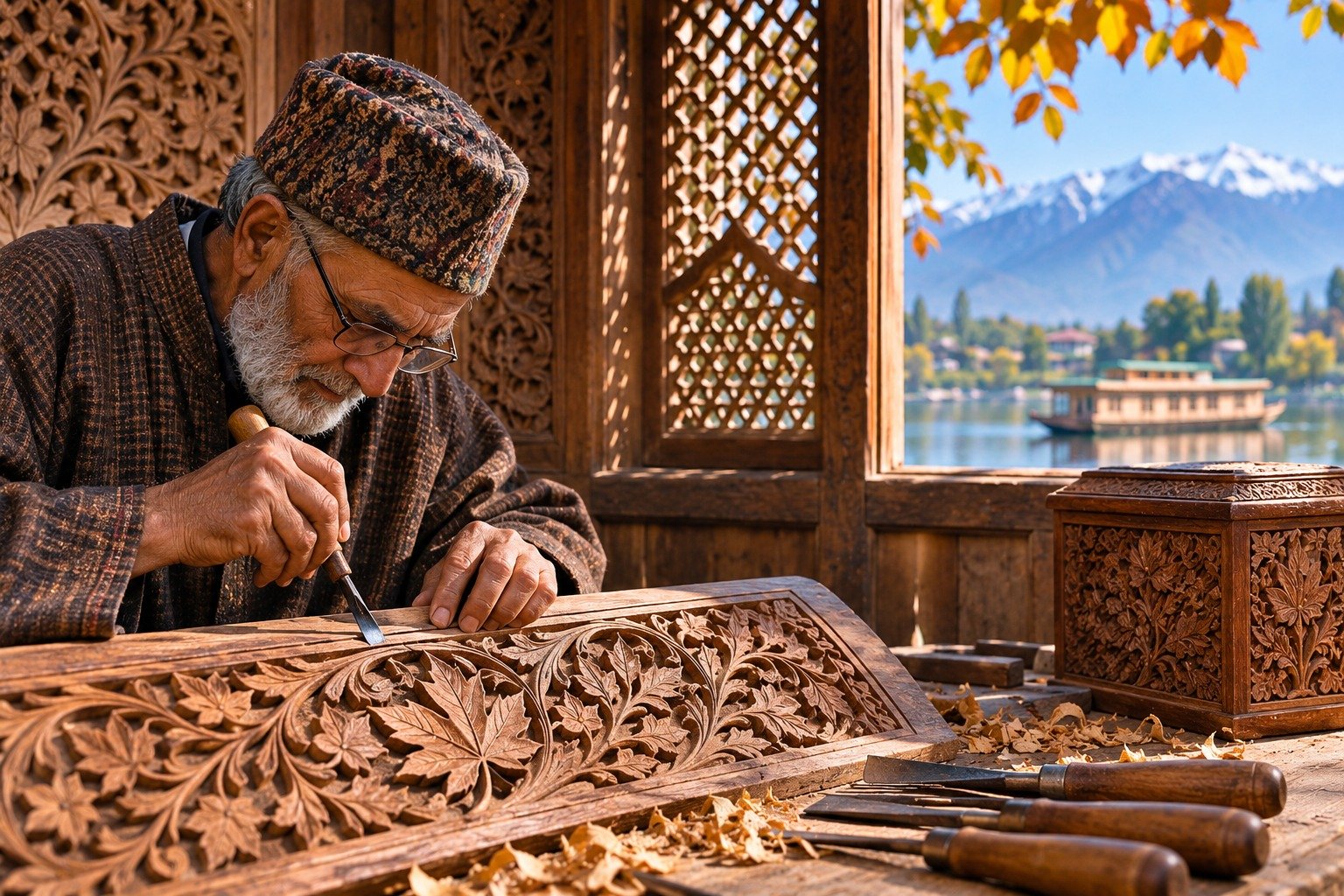
The Wood That Remembers
The carvers have kept their side of the bargain for centuries. It is now our turn to keep ours.


Mohammad Muslim
Kashmir has faced many hard years, and its people have shown remarkable strength. Our crafts are part of that strength. They show that creativity survives difficulty. They also give young people an identity they can be proud of, rooted in something real and made by hand.
Walk into an old shrine in Srinagar and look up. The ceiling is often a quiet marvel of tiny wooden pieces fitted together without a single nail, forming stars, flowers and patterns that seem to go on forever. Walk past an old Kashmiri house and look at the window. A fine wooden lattice lets in light but keeps out prying eyes. These are not decorations in the causal sense. They are the visible memory of a people, written in walnut.
Kashmiri wood carving is one of the oldest crafts of the Valley, yet we speak about it as if it belongs only in museums and tourist brochures. That is a mistake. This craft is still alive, and it is fighting for its future.
The story of Kashmiri carving is tied to the story of Kashmir itself. The Valley sat on old trade routes that connected South Asia with Persia and Central Asia. Ideas moved along those routes as freely as merchants did. In the 14th century, Mir Sayyid Ali Hamadani and his companions arrived in Kashmir, and with them came skills in architecture, shawl making, papier-mache and woodwork. Later rulers, most notably Sultan Zain-ul-Abidin in the 15th century, gave artisans royal support and encouraged them to teach others.
Kashmiri hands did not simply copy what came from outside. They absorbed it and made it their own. The chinar leaf, the iris, the almond blossom, the vine and the lotus found their way into the carvings. A visitor from Isfahan or Bukhara might recognise the skill, but the spirit was unmistakably local.
Why walnut?
The craft owes much to the walnut tree. Kashmiri walnut wood is dense and fine grained, and it carves well without splitting. It also takes on a rich, deep colour over time. Carvers work on it with simple tools, often a set of chisels and gouges that have been in the family for years. A single panel can take weeks. A large screen or a full set of furniture can take months.
There are several forms of the craft. Khatamband is the art of fitting small geometric pieces into a ceiling. Pinjrakari is the making of lattice windows and screens. Then there is the deep relief carving seen on tables, chests, bed frames and doors. Each form asks for patience, and each carries a quiet pride that is hard to describe to anyone who has not watched a master at work.
The most famous examples stand in places many of us know well. The Shah-i-Hamadan Mosque, also called Khanqah-e-Moula, in Srinagar is admired for its painted and carved wooden interior. The old houses of downtown Srinagar, with their carved balconies and windows, tell the same story in a more everyday voice. Even the houseboats on Dal Lake, with their carved ceilings and panelled walls, show how the craft entered the lives of ordinary people and visitors alike.
It would be comforting to say that all is well. It is not.
Many of the best carvers are now elderly. Their sons and daughters, having watched their fathers work long hours for modest pay, often choose other careers. This is not hard to understand. A young person who can earn a steady wage elsewhere will not easily choose a craft that demands years of training before it pays properly. When a master dies without a student, a whole body of knowledge goes with him. No book can replace it. The market has also changed. Machine-made furniture and cheap imitations are easy to find, and many buyers cannot tell the difference or do not care. A hand-carved panel that took a month to finish must compete with a machine-cut copy sold for a fraction of the price. The artisan is asked to match a price that his labour can never match.
Then there is the wood itself. Walnut trees take decades to mature, and the cost of good timber has gone up. Rules on cutting walnut trees exist for good reasons, because the tree is valuable for its fruit as well as its wood. But carvers say that access to quality timber is getting harder and more expensive. A craft that depends on one tree must also care for that tree.
First, we must pay artisans fairly. Applause is pleasant, but it does not feed a family. Buyers, hotels, offices and government departments can choose genuine Kashmiri carved work over factory goods. Public institutions in particular can set an example by furnishing their spaces with local handmade pieces.
Second, the Geographical Indication tag given to Kashmir walnut wood carving should mean something on the ground. A tag is only as strong as the system that backs it. Buyers should be able to check that what they are paying for is truly handmade in Kashmir. Honest labelling protects both the customer and the carver.
Third, training must be improved. Apprenticeships should come with a stipend, so that a young learner does not have to choose between learning and earning. Craft schools can pair master carvers with students and also teach basic business skills, such as pricing, photography and online selling. Many artisans make beautiful work but have no way to reach buyers outside the Valley. Social media and online marketplaces can help here, and young people are well placed to lead that effort.
Fourth, we should plant more walnut trees and plan for the future of the timber supply. A craft cannot survive if its raw material disappears.
It is easy to talk about handicrafts only in terms of exports and revenue. Those numbers matter, but they are not the whole story. A carved ceiling tells us that people once sat in a cold winter, with a small tool and a great deal of patience, and decided that even a plain roof deserved beauty. That decision says something about who we are.
Kashmir has faced many hard years, and its people have shown remarkable strength. Our crafts are part of that strength. They show that creativity survives difficulty. They also give young people an identity they can be proud of, rooted in something real and made by hand.
If we let this art fade, we will not just lose an industry. We will lose a language that our ancestors spoke in wood, and we will not easily learn it again.
Comments are closed.