
The Right Direction
(This story highlights the importance of giving children the right direction in the proper use of modern technology and the internet.)

Usuf Mir
The old world had its strengths. The new world had its opportunities. A child needs wisdom to take the best from both. Ahead of them was a rapidly changing world filled with technology, information and countless opportunities. The question was no longer whether that world was good or bad.
Hanan and Manan lived in a small town called Aamir Abad. They were neighbours. They had very good relations and were close friends, classmates and well-wishers. They married in the same year, Hanan in April and Manan in November. Hanan worked as an employee in a Government office, while Manan was engaged in business.
Both were well educated and wanted their children to receive a good education and build a better future. As their children grew up, a new concern began to occupy their minds regarding the excessive use of modern technology and the internet.
The world in which their children were growing up was very different from the one they had known. Their own childhood had been spent with books, teachers, playgrounds and friends. Their children, on the other hand, were growing up in a world of smartphones, computers, the internet and digital learning.
Hanan was often worried.
“Our children spend too much time with these things. In our time, we studied from books, went outside to play and spent time with our friends. We were physically active and remained connected with people.”
Manan did not agree with him.
“That was our time, Hanan. Today, children have opportunities that we never had. They have computers and access to the internet. Through it, they can reach the unfathomable depths of knowledge and benefit from learning resources available throughout the world.”
“But can they use all these things properly?” Hanan asked.
“That is the real question,” Manan replied.
Their conversations often ended without a conclusion. Both wanted their children to have a bright future.
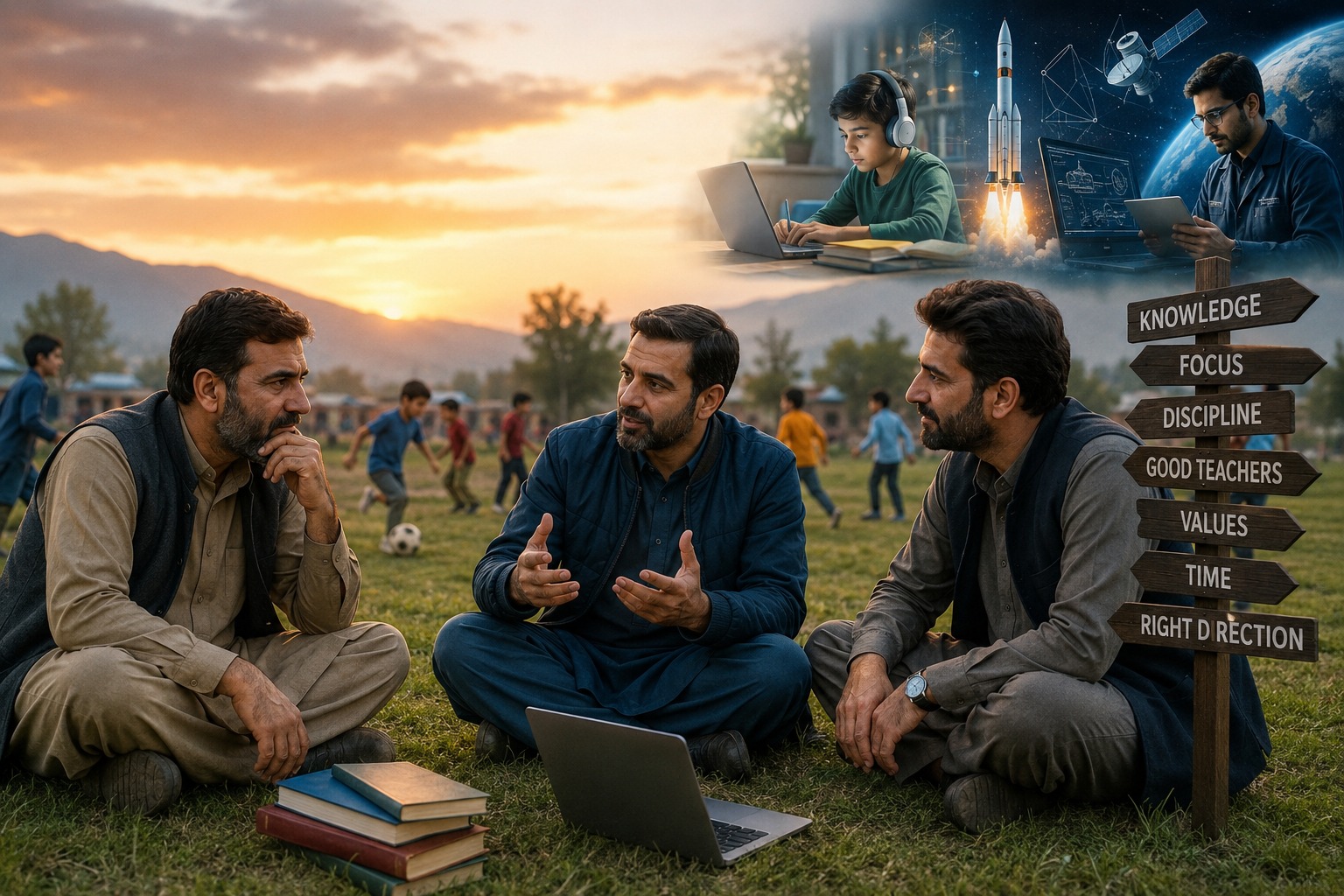
One Sunday, the two friends were sitting together in an open field outside the town. People were walking around and children were playing nearby. Hanan was talking about the harmful effects of excessive mobile-phone use when Manan said,
“Perhaps we are looking at the problem from the wrong angle. Perhaps the gadget itself is not the problem.”
“Then what is the problem?” Hanan asked.
“Perhaps the way it is used,” Manan replied.
Just then, they noticed Sahil approaching them. Sahil was their old classmate and a good friend. He lived in a nearby village and had come to the town that Sunday for some work. As he passed by, he saw them sitting together. Hanan and Manan stood up to welcome him.
Sahil smiled and asked, “Is there some serious discussion going on?”
“Yes,” Manan replied. “We were discussing our children’s use of modern technology and the internet, and how it may affect their future.”
They invited him to sit with them. Hanan and Manan briefly explained their concern. Sahil listened quietly.
When they had finished, he smiled.
“I think both of you are right, but you are looking at only one side of the matter.”
“How?” Hanan asked.
Sahil looked at them.
“A computer is a tool. The internet is a facility. Both can be extremely useful for a child, but the important thing is how the child uses them and, above all, whether he has the right direction.”
Manan looked at Sahil carefully.
“You sound as if you have already gone through such an experience yourself.”
“Yes,” Sahil replied. He paused for a moment. “My own son, Zaffer, was also attracted to the mobile phone like other children. At first, I was very worried. I thought perhaps I should keep him completely away from this technology. But then I realised that I could not protect my child from the new world by closing its door.”
“So what did you do?” Hanan asked.
“I changed my approach. I did not want to keep my child away from the modern age. I wanted to teach him how to live in this world.”
The two friends listened to him attentively.
Sahil said, “First of all, I created in him an interest in reading. I wanted him to develop a genuine desire for knowledge. I talked to him about his future. I told him that education could open the doors of the whole world before him. He could become a doctor, an engineer, a soldier, a scientist, a teacher or anything he wished to become. But all these possibilities required proper education and continuous learning.”
He smiled.
“I did not simply tell him, ‘Study because I say so.’ I tried to make him understand why he should study.”
“And did it have an effect?” Hanan asked.
“Fortunately, it did. Once the desire to learn developed in him, his attitude also began to change.”
Sahil then explained that he introduced his child to technology himself.
“I did not simply hand him a mobile phone and leave him alone with it. I showed him different useful things. I introduced him to educational material, learning resources and positive content. I wanted his relationship with technology to become a means of learning rather than useless entertainment.”
Gradually, the child’s ability to understand and learn developed. Technology was no longer merely a means of passing time. It became a means of learning.
“Then came the stage of hard work,” Sahil said. “Once he developed a desire to learn and understood the value of knowledge, he began to work harder on his own. He started completing his work on time and became more serious about his studies.”
Hanan nodded.
“But children nowadays lose their focus very quickly.”
“That is another important point,” Sahil replied. “A child must learn to keep his attention focused.”
He looked towards the road leading to the town.
“Imagine a child who has to travel one kilometre to reach school. He leaves home at nine o’clock and has to reach school by half past nine. He has only twenty-five minutes.”
Sahil smiled.
“He is riding his bicycle. After a few minutes, he sees a street performer showing some tricks. He stops to watch. A little further ahead, he sees a wedding procession with music and dancing. He stops again. Then he sees another crowd, perhaps a protest or some other event, and out of curiosity, he stops there too.”
Hanan smiled.
“By then, the school bell must have rung.”
“Exactly,” Sahil said. “What he saw was not necessarily bad. The street performance was not bad. The wedding was not bad. The protest was not necessarily bad. But none of them was his purpose at that moment.”
He looked at his friends.
“His purpose was to reach school. If he keeps stopping for everything he sees along the way, he may enjoy the journey, but he will miss his destination.”
The two friends remained quiet.
Sahil continued, “A child faces a similar situation in the digital world. A mobile phone can provide him with messages, videos, games, entertainment and information within seconds. The internet can take him anywhere. But if he cannot decide what deserves his attention, he may spend hours and still fail to reach the place he wanted to reach.”
“So the child needs to learn to keep his attention focused,” Manan said.
“Exactly. Attention and concentration.”
Sahil thought for a moment.
“Think of a radio. If it is not tuned to the correct frequency, you hear noise instead of a clear voice. You turn the dial until the unwanted noise disappears and the real sound becomes clear.”
He looked at them.
“A child’s mind can be like that. If his attention keeps moving from one thing to another, the important voice of learning becomes mixed with noise. He must learn to focus his mind towards his goal.”
Hanan nodded.
“And what about the teachers?” he asked.
“That is also an essential part,” Sahil replied. “I arranged good teachers for my child and tried to place him under the guidance of teachers who were experts in their subjects. I wanted him not only to learn the subjects but also to learn how to learn. A good teacher can correct mistakes, build confidence and show the right path.”
He paused.
“I also wanted my child to receive moral education. Knowledge without character is incomplete. A child should learn how to respect others, behave responsibly and understand the difference between right and wrong.”
Manan agreed.
“That is something we often forget.”
“Yes,” Sahil said. “Sometimes we become so concerned about marks that we forget about the person behind those marks.”
He became thoughtful for a moment.
“There is one more thing I taught my child.”
“What?”
“Time.”
Hanan smiled.
“You have mentioned time before, but what exactly do you mean?”
Sahil looked around the field.
“Let me give you a simple example. Take the eggs under a hen. They do not hatch simply because we want them to. The hen has to sit on them continuously for the required period. If it leaves them too early, the process is disturbed. Valuable things need continuous care.”
He looked at his friends.
“Education is also like that. You cannot give your child attention for a few days and expect a complete and perfect result. You cannot study for a short while, leave everything for several weeks and then expect success. Anything truly worth achieving requires time.”
For a while, the three friends remained silent.
Then Hanan asked, “So, from your experience, what did you finally learn?”
Sahil smiled.
“I learned that there is no war between the old system and the new system. Books are useful. Computers are useful. The internet is useful. Teachers are necessary. Outdoor games are necessary. Family life is necessary. Friends are also necessary. The problem begins when one thing takes the place of everything else.”
Manan looked at him.
“So you did not completely stop your child from using the mobile phone?”
“No. I controlled its use, gave it a purpose and made sure that technology remained a servant, not a master.”
He added, “I wanted my child to understand that a gadget is not his destination. It is only a means of reaching the destination.”
Hanan looked towards the children playing nearby.
“I think we have been asking the wrong question. We have been arguing about whether the old system is better or the new system.”
Sahil nodded.
“The better question is: What direction are we giving our children?”
There was a brief silence.
Then Hanan suddenly asked, “And where is your son today?”
Sahil’s face lit up with pride.
“He is working as a space engineer. He is part of a team working on advanced satellite technology.”
Manan looked at him in surprise.
“A space engineer?”
“Yes,” Sahil replied. “The same child who, like other children, was once attracted to the mobile phone.”
He smiled.
“Today he works with computers, studies scientific information and uses the internet every day. He is using the same technology that once had the potential to distract him. The difference is that he learned how to use it.”
Hanan looked at Sahil attentively.
“So technology really helped him reach there.”
“Of course,” Sahil replied. “But technology alone did not take him there. His desire to learn, his ability to understand, his hard work, his focus, his teachers, his character and the time he gave to his education all worked together.”
The sun was slowly moving towards the horizon. Sahil stood up.
“Parents have a responsibility to provide the right environment. Teachers have a responsibility to guide children, but children also have to develop discipline and focus within themselves.”
He looked at Hanan and Manan.
“And remember one more thing. Time itself is never bad. The world changes. Technology changes. Methods of learning change. But whether this change becomes positive or harmful depends on how human beings use it.”
The three friends began walking towards the town.
This time, their discussion was different. They were no longer arguing about whether books were better than computers or computers better than books, nor whether the old days were better than the present.
They had understood something more important.
The old world had its strengths. The new world had its opportunities. A child needs wisdom to take the best from both.
Ahead of them was a rapidly changing world filled with technology, information and countless opportunities. The question was no longer whether that world was good or bad.
The question was whether they would teach their children how to find the right direction within it.
“Parents have a responsibility to provide the right environment. Teachers have a responsibility to guide children, but children also have to develop discipline and focus within themselves.”
Comments are closed.