

The Moral Test of Power

Abid Hussain Rather

Abid Hussain Rather


“Having power is not the same as knowing how to use power. As technology gives humanity greater control over nature and over the lives of others, the greatest sign of strength may not be greater power, but the wisdom and restraint to use it responsibly.”

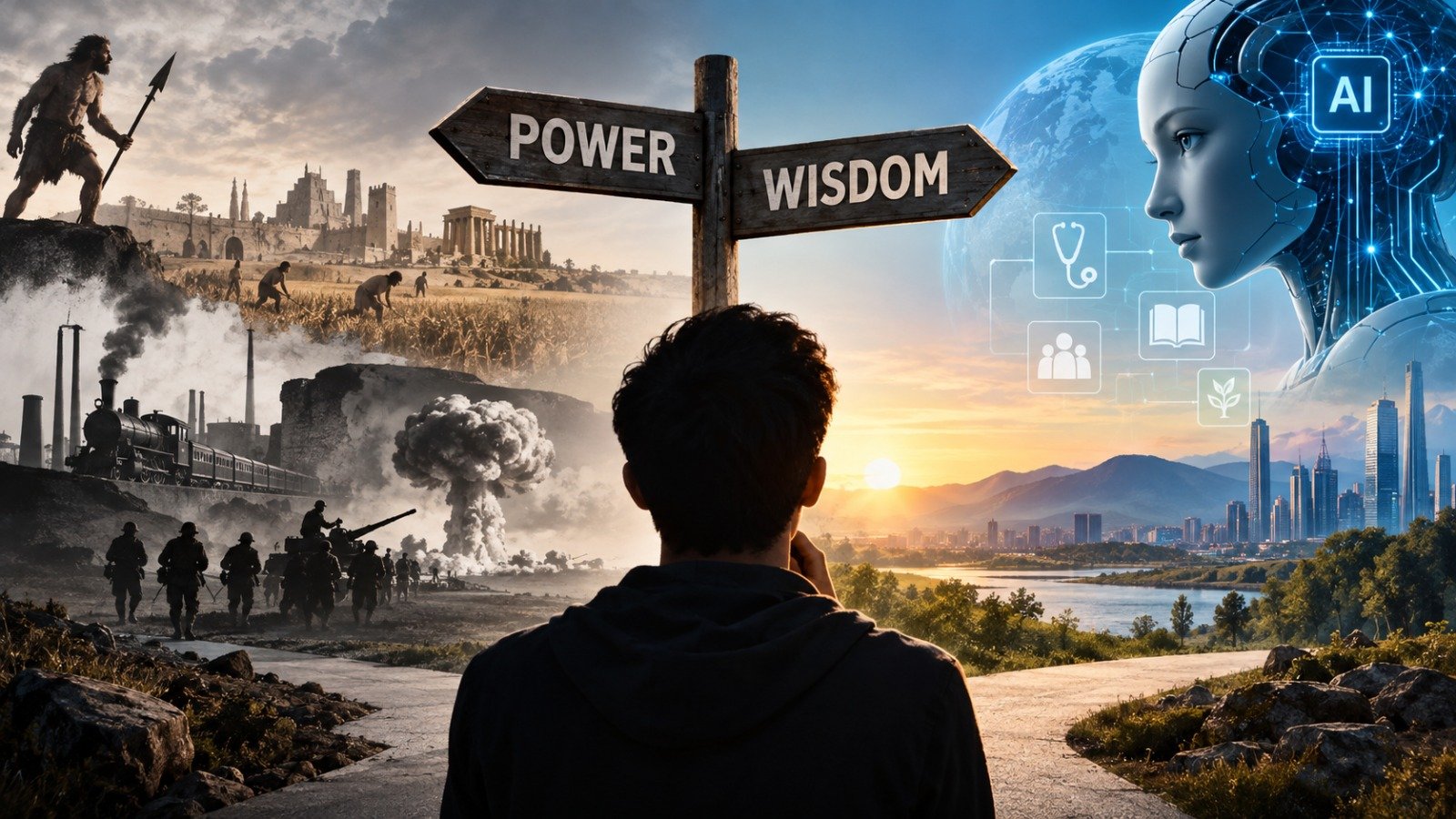
When we turn the pages of human history we find that it is usually narrated as a story of kings, wars, empires and revolutions. But there is another story running quietly behind all these events and that is the story of human beings searching for power. From the first stone tool made by early humans to today’s artificial intelligence, every major step in civilization has increased our ability to control nature, change our surroundings and influence the lives of others. Human beings have always been eager to become stronger, faster, more knowledgeable and more capable. But there is one question that we often forget to ask: As our power has increased, has our wisdom increased at the same speed? This is perhaps the most important question of our time.

The journey began with simple tools. Early humans had little physical power compared with the forces of nature. They used stones and sticks to hunt, protect themselves and find food. Their survival depended mainly on physical strength, cooperation and their ability to understand their environment.

Then came the phase of agriculture. Agriculture was not simply a method of producing food. It changed human society completely. People began to settle in one place. Villages became towns and towns became cities. Food could be stored. Population increased. Organized societies emerged. With the emergence of cities, there was formation of governments, laws, taxation, writing and administration. Human power was no longer limited to the strength of an individual. It became organized power. Great civilizations appeared in different parts of the world. Egypt, Mesopotamia, Persia, India, China, Greece and Rome built impressive societies. They developed systems of government, trade, science, architecture and communication. But this progress also brought another reality. Power could be used not only to build but also to control and oppress. Strong rulers could protect their people, but they could also exploit them. Armies could defend a society, but they could also destroy another society. This is the reason  why moral values have always been important. Here we can get the clue that power without responsibility can become dangerous.

Then came the machine, and the meaning of power changed again. Gunpowder changed warfare. The printing press changed the spread of knowledge. Ships connected distant parts of the world. The Industrial Revolution brought steam engines, factories, railways and large scale production. Human beings were no longer dependent only on their muscles. Machines multiplied physical strength. A machine could do the work of many people. A train could carry hundreds of people and huge quantities of goods. Factories could produce products on a scale that earlier generations could never imagine. But technological progress also created new forms of inequality, exploitation and competition. Industrial power became closely connected with economic and political power.

Then humanity entered the nuclear age. The discovery of nuclear energy was one of the greatest achievements of science. But the creation of nuclear weapons also gave humanity the ability to destroy cities and kill enormous numbers of people within a very short period of time. For the first time, human beings possessed a level of destructive power that could threaten their own civilization. The nuclear age taught us an important lesson: having power is not the same as knowing how to use power. Sometimes the greatest sign of strength is restraint.

The arrival of computers created another revolution. Machines were no longer being used only to increase physical strength. They began to increase human intellectual ability. Computers could calculate, store and process huge amounts of information. The internet then connected people across the world. Information became one of the most valuable forms of power.

Today, we are standing at the beginning of another major transformation: artificial intelligence. Artificial intelligence can analyse enormous amounts of information, recognize patterns, generate text and images, translate languages and assist people in solving difficult problems. It has the potential to bring transformative changes in  medicine, education, science, business and many other fields. There is much to celebrate. AI may help doctors identify diseases earlier. It may help students learn more effectively. It may assist scientists in discovering new medicines. It may help people with disabilities communicate and perform everyday tasks. But every powerful technology brings new risks. Artificial intelligence can also be used to spread false information. Fake photographs, videos and voices can be created with remarkable ease. People may be deceived by material that appears genuine but is completely false. Privacy is another major concern. Modern technologies can collect and analyse enormous amounts of personal information. If such power is placed in the wrong hands, it can be used for manipulation or surveillance.

There is also the question of who controls powerful technology. If advanced AI systems, huge databases and enormous computing resources are controlled by only a small number of companies or governments, their influence could become extraordinarily large. The gap between those who control technology and those who simply use it could increase. Therefore, the debate about artificial intelligence should not be limited to technology. It must also be a debate about morality. The real question is not only “What can AI do?” We must also ask, “What should AI be allowed to do?” These two questions are very different. Human beings have repeatedly demonstrated their ability to create powerful technologies. We learned to control fire, metals, steam, electricity and the atom. We developed computers and connected the world through the internet. Now we are creating machines capable of performing tasks associated with human intelligence.

But technological progress alone can not guarantee a better future. A powerful machine in the hands of an irresponsible person can become dangerous. A powerful technology guided by wisdom and compassion can become a blessing. This means that the greatest challenge of the modern age may not be building more intelligent machines. It may be building more responsible human beings. The future of artificial intelligence will ultimately depend on human choices. Will we use technology to improve education, cure diseases, reduce poverty and make life easier? Or will we use it for deception, surveillance, exploitation and war? The machine will not decide the answer. But we will have to decide it. Humanity has travelled a remarkable distance—from stone tools to artificial intelligence. Our power has grown beyond anything our ancestors could have imagined. But perhaps our next great step should not be another technological invention. Rather it should be moral progress. Because the real measure of civilization is not how much power humanity possesses. But it is how wisely, fairly and responsibly that power is used. The greatest question of the future, therefore, is not whether machines will become more intelligent. It is whether human beings will become wise enough to use their growing power for the goodness of humanity.


(The author teaches Geography at GDC Anantnag and can be reached at rather1294@gmail.com)

Comments are closed.