

Tamanna Hazarika
“The rise of these sultanas did not just change who sat on the throne; it also marked a move from a very strict style of government toward a more orderly, law-based system.”
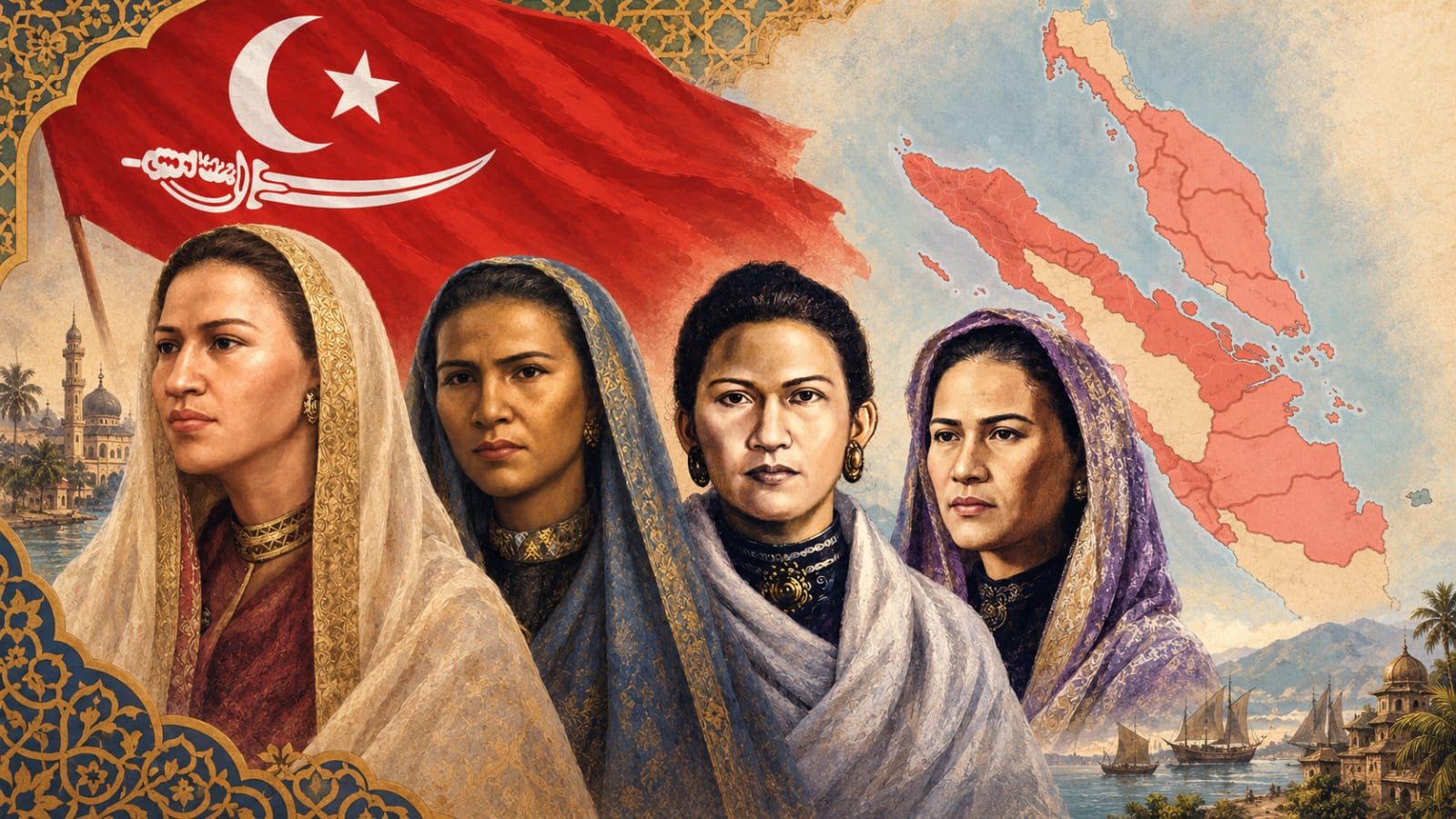
Between 1641 and 1699 the Aceh Sultanate on northern Sumatra was ruled by four consecutive women: Taj ul-Alam Safiatuddin Syah, Nurul Alam Naqiatuddin Syah, Inayat Zakiatuddin Syah, and Zainatuddin Kamalat Syah. This unusual sequence surprised many contemporary visitors and later historians because Aceh was an Islamic kingdom where male rulers were more common.
Under the women, Aceh changed: central royal authority became less absolute, local hereditary leaders and ulama gained more say, and the state shifted toward rule by law and institutions rather than by the single will of a powerful sultan.
Safiatuddin Syah:
Sultana Taj ul-Alam Safiatuddin Syah (1612 – 23 October 1675), who was originally named Putri Sri Alam, who was an important ruler of the Aceh Sultanate. She was the daughter of the powerful sultan Iskandar Muda and later married his successor, Iskandar Thani.
In 1617, her father conquered the kingdom of Pahang on the Malay Peninsula. After this victory, a young prince from the defeated royal family, Iskandar Thani, was taken to Aceh as a prisoner. However, instead of being treated harshly, he was raised in the royal court as a foster son of Iskandar Muda.
A few years later, in 1619, when the prince was only about nine years old, he was married to Putri Sri Alam Permisuri. The young couple was given their own palace near the main royal palace, known as Sri Warna, where they lived under the protection and guidance of the sultan.
When Iskandar Muda died, Iskandar Thani became the new ruler of Aceh. However, his reign did not last long, as he died on 15 February 1641. His sudden death caused great confusion and tension among the nobles and leaders of the kingdom. There were serious disagreements about who should rule next, and some people even lost their lives during these disturbances. After three days of discussion and conflict, the leaders of the kingdom finally reached an agreement.
They decided that the best choice was to make the late sultan’s widow, Putri Sri Alam Permisuri, the new ruler. This decision marked the beginning of her rule as sultana, making her one of the most important female leaders in Aceh’s history. Hence, Safiatuddin Syah became the ruler of Aceh and took the title of sultana. She ruled for a long period, from 1641 to 1675. Putri Sri Alam took the royal title Sultana Taj ul-Alam Safiatuddin Syah, which means “crown of the world” and “pure in faith.”
Her rule has been widely discussed by historians because Aceh was a strongly Islamic kingdom, and female rulers were not very common in such societies. Some historians believe that the nobles of Aceh supported her becoming sultana to reduce the power of the monarchy. Earlier, her father Iskandar Muda had introduced strict administrative reforms that limited the power of local chiefs. After his death, these nobles may have used her rule as a way to regain their influence.
According to this view, their plan worked. During her reign, the sultan’s authority became weaker and was mostly limited to the capital. Real power shifted to local hereditary chiefs, known as uleebalang, and to religious leaders such as imams and ulama, who had strong influence over society and politics. However, not all historians agree with this explanation. Some suggest that her rise to power was influenced by older Southeast Asian traditions, where inheritance through the female line was accepted.
In this view, her becoming sultana was natural and not just a political move by the nobles. Modern studies also show that her period of rule should not simply be seen as a time of decline. Instead, it was a time of more flexible and less harsh governance compared to earlier rulers. Under her leadership, Aceh remained stable and managed to resist outside pressures, especially from European powers.
At that time, many other strong kingdoms in the region—such as Mataram, Ternate, Banten, and Makassar—were losing their independence or coming under the control of the Dutch East India Company. In contrast, Aceh was able to maintain its independence, which shows that her reign still had strength and importance despite the changes in power structure.
During the rule of Taj ul-Alam Safiatuddin Syah, the power of the Aceh Sultanate became weaker, especially in areas far from its central region. On the Malay Peninsula, the kingdom of Johor broke free from Aceh’s control. Pahang was also lost. However, Aceh still managed to keep control of Perak, which was very important because of its rich tin resources. The Dutch East India Company was very interested in controlling the tin trade in Perak. At first, there were conflicts between Aceh and the Dutch. In 1651, several Dutch traders living in Perak were killed, which made the situation worse.
In response, Dutch ships blockaded Aceh at different times, putting pressure on the kingdom. Finally, in 1659, Aceh was forced to sign a treaty with the Dutch. According to this agreement, the VOC would receive half of the tin produced in Perak and also gain monopoly rights over trade in Acehnese ports. The Dutch were also allowed to set up a trading post in Padang on the west coast of Sumatra. However, in reality, this monopoly was not fully enforced.
At the same time, several towns along the west coast of Sumatra became unhappy with Aceh’s rule and began to secretly cooperate with the Dutch. In 1663, a secret agreement called the Painan Treaty was signed between the VOC and some local chiefs who opposed Aceh. The following year, in 1664, a Dutch commander named Jacob Couw arrived with a fleet of about 300 soldiers.
He drove Acehnese forces out of the west coast region, taking control of areas from Indrapura in the south to Tiku in the north. Meanwhile, Aceh continued to face more Dutch naval blockades and had to sign further agreements under pressure.
Even so, many local Malay communities on the west coast still preferred Aceh’s rule over Dutch “protection”, so Aceh’s cultural and political influence remained in the region for a long time. On the east coast, Aceh also faced losses. The region of Deli broke away from Acehnese control in 1669, further weakening the sultanate’s power. This was everything that happened during the reign of Safiatuddin Syah, who ruled the Aceh Sultanate from 18 February 1641 till her death on 23 October 1675.
Safiatuddin Syah was also very significant in history because she was the first of four women who ruled Aceh one after another. Her leadership showed that women could successfully govern a powerful kingdom, and she helped set an example for future female rulers in the region. Her reign was peaceful compared to earlier times, and she focused on maintaining stability in the kingdom, supporting trade, and encouraging Islamic learning.
Naqiatuddin Syah:
Sultana Nurul Alam Naqiatuddin Syah was the fifteenth ruler of Aceh. She became queen in 1675 and ruled until her death on 23 January 1678. She was the second of four women rulers (sultanas) who governed Aceh one after another during this period. The previous ruler, Sultana Taj ul-Alam, died in October 1675. She had no children and no close family members who could inherit the throne. Once again, the kingdom chose a woman as ruler. This time it was Sri Para Puteri, who took the royal name Sultana Nurul Alam Naqiatuddin Syah.
The written sources from that time do not clearly explain how she was connected to the previous sultan’s family. However, a manuscript kept at Universiti Kebangsaan Malaysia claims that she was the daughter of Malik Mahmud Qithul Kahar Syah, who was the son of Sulayman, son of Abdul Jalil, son of Sultan Alauddin al-Kahar. If this is true, it would mean she still belonged to the broader royal lineage, but this information has not been fully confirmed and needs more careful historical checking.
Some historians argue that the relatively gentle and stable rule of Taj ul-Alam helped make it acceptable to place another woman on the throne. Her reign showed that a female ruler could govern without chaos or breakdown of order. In contrast, the earlier glory days under Sultan Iskandar Muda had brought great power and expansion, but at a very high price. His rule is often described as harsh, heavy-handed, and very demanding on the population, with strict control and forceful policies.
By comparison, the period of the sultanas is seen as a time when the government moved away from personal despotism—that is, rule based mainly on the ruler’s will and fear—and instead put more emphasis on laws and institutions. This shift meant that rules and legal procedures increasingly protected not only the local people, but also foreign traders and visitors. For a trading state like Aceh, this change was important. It helped create a more predictable environment for commerce, diplomacy, and everyday life, where rights and duties were framed by written law and established customs, rather than the sudden decisions of a single powerful ruler.
In simple terms, the rise of these sultanas did not just change who sat on the throne; it also marked a move from a very strict style of government toward a more orderly, law-based system that tried to safeguard the interests of both subjects and outsiders.
Historical records say that during the rule of Sulṭāna Nurul Alam Naqiatuddin Syah, the kingdom of Aceh was divided into three main regions called sagis. These regions were known as the XXII Mukims, XXVI Mukims, and XXV Mukims, and their names came from the number of districts (mukim) in each area. However, many historians believe that these three regions already existed before her time. So, instead of creating them, she may have officially recognized them and confirmed their importance. This arrangement also strengthened the power of local chiefs, known as ulee-balangs.
From this time onward, it seems that every new ruler of Aceh needed the approval of these three sagis before becoming sultan or sultana. This shows that political power was shared between the royal court and regional leaders.
Not many other events from her reign are clearly recorded. However, historians do know that a major disaster occurred during this period. A large fire broke out in the capital city of Kutaraja, destroying important buildings such as the Baiturrahman Grand Mosque and the royal palace. Many valuable royal items, including treasures and heirlooms, were also lost in the fire. Some traditional stories (not confirmed by reliable sources) say that Nurul Alam had a daughter named Puteri Raja Setia.
This daughter is believed to have succeeded her as queen, taking the title Sultan Inayat Zakiatuddin Syah. If this is true, Nurul Alam may have been married to a ruler named Sultan Muhammad Syah, who is mentioned as the father of this next queen in an important historical text called Bustanus Salatin.
During her short reign, the kingdom was facing challenges, including weakening control over distant regions and pressure from foreign trading powers. Even so, her rule shows that women could hold the highest position of authority in Aceh and play an important role in its political life.
Zakiatudin Syah:
Sultan Inayat Zakiatudin Syah (around 1645 – 3 October 1688) was the sixteenth ruler of the Aceh Sultanate. She was also the third female ruler (sultana) to govern the kingdom one after another, showing that women held an important place in Aceh’s leadership during that time. She ruled from 1678 to 1688. Her rule is often seen as a period of calm and balance, helping maintain order in Aceh.
Her birth name was Puteri Raja Setia, but not much is clearly known about her family. Different historical sources give different versions, and there are no strong records to confirm the truth. According to the chronicle Bustanus Salatin, which is considered fairly reliable, she was the daughter of a ruler named Sultan Muhamed Syah, although this king is not well known in other records. However, some smaller historical writings claim that she was actually the daughter of her predecessor, Nurul Alam Naqiatuddin Syah.
Another source, a manuscript from Universiti Kebangsaan Malaysia, gives yet another version of her family tree, saying that her father was Malik Radliat Syah, who came from a line of earlier Acehnese sultans.
A foreign visitor, the English sea captain William Dampier, came to Aceh during her reign. He wrote that the queen of Aceh was usually chosen from the royal family and was often an unmarried woman. When Puteri Raja Setia became ruler in January 1678, after the death of Nurul Alam Naqiatuddin Syah, she took the royal title Sultanah Inayat Zakiatuddin Syah. Her rise to the throne seems to have been smooth, without any major conflict or opposition.
Another English traveller who visited Aceh in 1684 described her as being about 40 years old, with a strong and commanding voice. Some foreign visitors even made strange claims, wondering if she was really a woman or possibly a eunuch in disguise. These ideas were likely based on misunderstandings or cultural differences.
Foreign visitors noticed that during Sultana Inayat’s rule, Aceh had become a busy and attractive port. Many Indian traders, people from Madras, and adventurous merchants from different regions came there, hoping to profit from trade in pepper and other goods. Like the first female ruler (sultana) Taj ul-Alam, Sultana Inayat loved culture and learning. She supported the famous Islamic scholar Abdul Ra’uf of Singkel.
At least one of his books, a commentary explaining Imam Nawawi’s collection of hadiths was written on her orders and dedicated to her. In 1683, an embassy sent by the sharif of Mecca came to Aceh. They had first tried to contact the Mughal emperor Aurangzeb in India but had failed, so they turned instead to Aceh.
In the next year, 1684, English representatives from Madras arrived. They asked Sultana Inayat for permission to build a trading post in Aceh. The English had been buying Acehnese pepper for a long time and now wanted a new base because they had lost access to Banten in Java in 1682, when Amangkurat II of Mataram closed that port to them. At that time, the queen ruled with the help of a council of twelve orang kayas (rich men) or powerful nobles. These orang kayas received the English visitors politely and with friendliness.
The English argued that a fortified post in Aceh would help protect the kingdom. They said it would discourage the Dutch East India Company from trying to blockade or control the Acehnese coast. However, even though the English tried to make a strong case, the Acehnese court eventually rejected their proposal.
Sultana Zakiatudin Syah died on 3 October 1688. After her death there was a short period of conflict and power struggles among the orang kayas, as they tried to decide who should rule next. This internal fighting ended when a new queen, Sultana Kamalat Syah, was chosen and crowned as the fourth and final female ruler of Aceh.
Zakiatudin Syah’s reign was mostly peaceful compared to earlier periods that had conflicts and political struggles. During her time as queen, the kingdom remained stable, and there were no major wars or rebellions. This allowed trade, administration, and daily life in the sultanate to continue smoothly.
Kamalat Syah:
Sultan Zainatuddin Kamalat Syah (died in 1700) was the seventeenth ruler of the Aceh Sultanate. She became queen in 1688 and ruled the kingdom until 1699. Zainatuddin Kamalat Syah was the fourth and last queen in a line of female rulers who governed Aceh one after another. After her rule ended, this period of women leading the kingdom also came to an end, and male rulers consolidated power again.
When the elderly queen, Sultana Inayat Zakiatuddin Syah, passed away in October 1688, another woman, Sultana Zainatuddin Kamalat Syah, took her place on the throne. It is not clearly recorded how Kamalat Syah was related to the earlier queens, so historians today are not certain about her family background. A manuscript kept today at Universiti Kebangsaan Malaysia, gives one possible family line. It says that Sultana Zainatuddin Kamalat Syah was the daughter of Syekh Muhammad Fadlil Syah, also known as Teungku di Kedirian.
He was the son of Abdullah Fadlil, who was the son of Muhyuddin Fadlil, who in turn was the son of Sultan Sri Alam. In simple terms, this text suggests that she came from a respected religious and royal family, possibly linked to an earlier sultan. However, modern scholars still need more proof to confirm that this family tree is correct, so it cannot be taken completely in account.
Her rise to power was not smooth. The powerful nobles of the kingdom, known as orang kayas, did not all agree with her appointment. Some of them preferred a man as ruler instead of another female sultan. Four of these leading nobles gathered armed supporters and marched toward the capital, trying to challenge her right to rule and perhaps replace her with a male candidate. This created a serious threat to her new government and showed that her authority was not fully accepted at first. Despite this early resistance, the rebellion did not last long for reasons that are not fully clear.
The opposition movement soon weakened and then faded away. In the end, the orang kayas gave up their efforts, and Sultana Zainatuddin Kamalat Syah was formally recognized as the legitimate ruler. Her eventual acceptance on the throne shows the influence of the noble class in Aceh politics and the continued possibility for women to rule. For almost sixty years, Aceh Darussalam was ruled by women sultans. By the late 1600s, however, more and more people began to insist that the state should have a male ruler instead of a woman.
A Dutch visitor named Jacob de Roy, who was in Aceh in 1696, wrote that the reigning sultana, Zainatuddin Kamalat Syah, officially had very wide powers. She could call together the council of important nobles. In practice, though, she could not simply do whatever she wanted. Many decisions had to be discussed, and she needed the agreement of most of her counsellors before acting.
This shows that her authority was limited by the elites around her. De Roy also reported that groups of people sometimes gathered in the capital, Kutaraja, to protest in favour of having a male king. These public displays suggest that opposition to female rule was not just quiet court gossip but could appear openly on the streets.
At the same time, some members of the court tried to use the situation to their own advantage. The syahbandar, or harbour master, came up with a plan. He wanted to marry the queen to his son, who was a captain of the royal guard and enjoy great favour with Zainatuddin Kamalat Syah. If this marriage succeeded, his family would gain enormous influence. The harbour master understood that such a match would anger many of the orang kayas, who would fear losing their own status.
Because of this, he asked Jacob de Roy to help negotiate the marriage, hoping that a foreign intermediary might smooth over tensions or at least make the process seem more neutral. Another Dutch writer, Francois Valentijn, later claimed that this marriage did in fact take place, although historians still debate how reliable this information is.
In 1699, a fatawa, supposedly arrived from Mecca. It was said to be issued by a judge (qadi) named Malik al-Adil. The fatwa declared that it was against the principles of Islam for a woman to rule. There is still uncertainty about this document, some scholars think it may have been genuine, while others suspect that people in Aceh used the name and authority of Mecca to give religious weight to a decision they already wanted to make. In other words, the fatwa might have been a tool in a political struggle rather than a purely religious ruling.
After the fatwa appeared, the sultana was removed from power. She was replaced by a man of Arab origin, Badr ul-Alam Syarif Hasyim Jamaluddin, who claimed descent from the Prophet’s family (a sayyid). Choosing a ruler with sayyid ancestry helped give the new regime extra religious and moral prestige. Some later writers have speculated that Badr ul-Alam may have become Zainatuddin’s husband, though this remains uncertain and is based more on inference than firm evidence.
Zainatuddin herself died only a year later, in 1700, marking the end of the long period of female rule in Aceh and the start of a new era under male sultans backed by religious arguments and foreign connections.
The era of the four sultanas shows that women could rule effectively in early modern Southeast Asia and that political power could adapt to changing circumstances. Though Aceh lost some outlying territories and faced growing pressure from the Dutch, the sultanas maintained internal stability, promoted learning, and kept the port of Kutaraja an attractive place for traders. The end of female rule in 1699—brought about by political opposition, a contested fatwa, and the rise of a male ruler claiming religious prestige—did not erase the legacy of these queens.
Instead, their six decades of leadership remain an important example of flexible government, the role of women in Muslim polities, and the complex interaction between local politics and global trade in the seventeenth century.
Bibliography:
-
Khan, Sher Banu A. Latiff. (2009). Rule Behind The Silk Curtain: The Sultanahs of Acheh 1641-1699. Doctoral Thesis, Queen Mary, University of London.
-
Graf, Arndt. Schroter, Susanne. Wieringa, Edwin. (2010) Aceh: History, Politics and Culture. ISEAS Publishing, Singapore.
-
Stibbe, D.G. Spat, C. (1917). Encyclopaedie van Nederlandsch-Indië . Vol. 1. S-Gravenhage : Nijhoff ; Leiden : Brill Publishers.
-
Locher-Scholten, Elsbeth. Rietbergen, Peter. (2004). Hof en handel. KITLV Press, Leiden.
-
Lombard, Denys. (1967). Le Sultanat d’Atjéh au temps d’Iskandar Muda, 1607-1636. École francais d’Extrême-Orient, Paris.
-
Hashjmy, A. (1977). 59 Tahun Aceh Merdeka di bawah Pemerintahan Ratu. Bulan Bintan, Jakarta.
-
Niemeijer, Hendrik E. “Maritime Connections and Cross Cultural Contacts Between The People of The Nusantara and The Europeans in The Early Eighteen Century” Jurnal Sejarah Citra Lekha Vol 1 No 1, 2016.
-
Azra, Azyumardi. (1995). Jaringan Ulama Timur Tengah dan Kepulauan Nusantara Abad XVII dan XVIII. Mizan, Bandung.
-
Azra, Azyumardi. (2006). Islam in the Indonesian World. Mizan Pustaka.
Comments are closed.