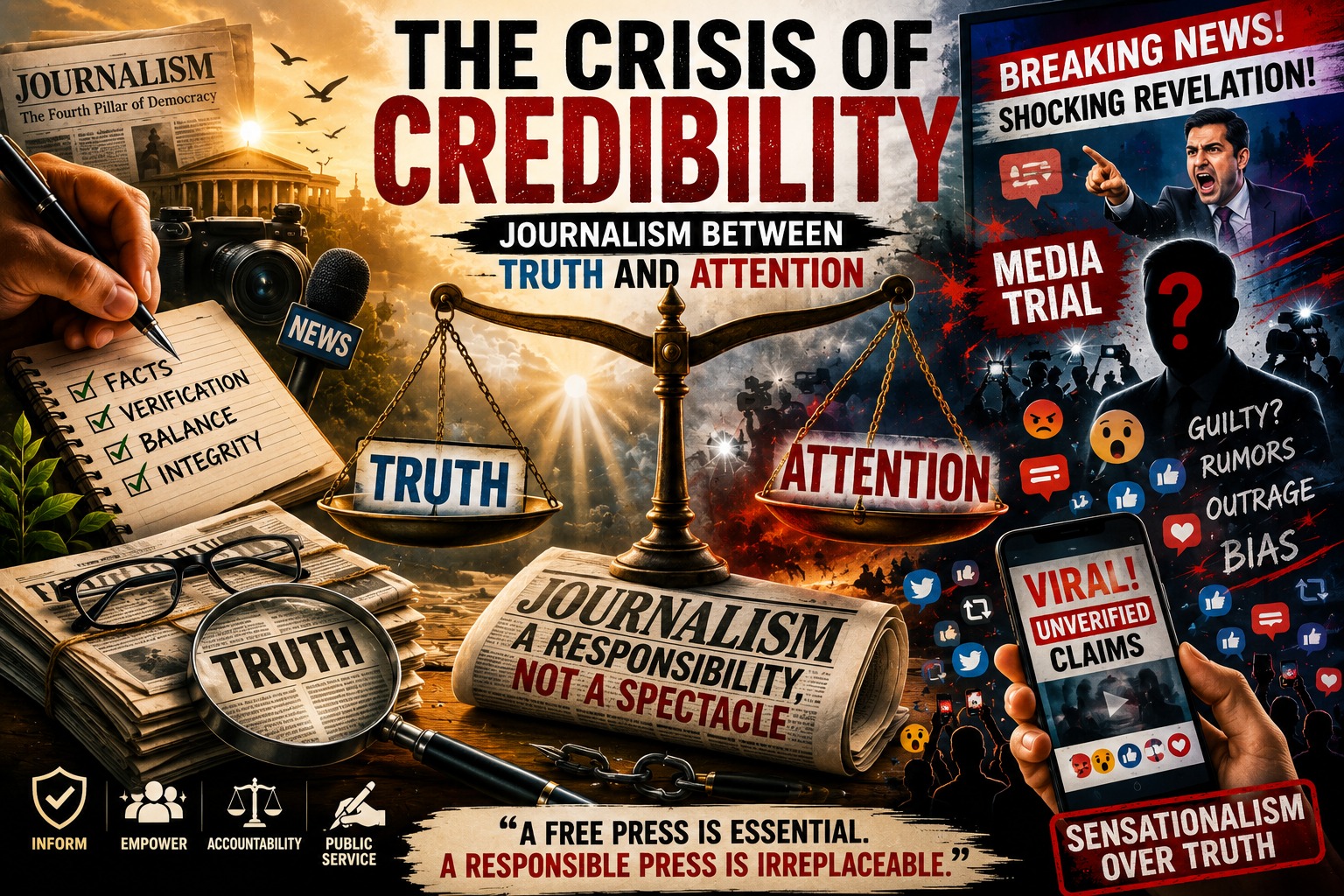


The Crisis of Credibility: Journalism Between Truth and Attention

Tawheed Sheikh 

“A free press remains one of democracy’s greatest safeguards, but its strength ultimately rests on its commitment to fairness, accountability and ethical responsibility.”

Journalism has traditionally been regarded as the fourth pillar of democracy. Alongside the legislature, executive and judiciary, the press serves as an essential institution that informs citizens, exposes wrongdoing and holds those in power accountable. At its best journalism is a public service built on facts, verification, balance and integrity. Yet in recent years, a growing number of people have begun questioning whether modern journalism is fulfilling that role or drifting away from it.

The rise of smartphone journalism, social media platforms and the relentless competition for attention has fundamentally changed the media landscape. News no longer waits for the evening bulletin or the next morning’s newspaper. Information spreads instantly, often without verification. In this environment, being first has become more valuable than being accurate. As a result, many media organizations and online commentators appear increasingly willing to sacrifice caution for speed and sensationalism.

A journalist’s responsibility is to report facts, provide context and present verified information to the public. However, many contemporary media personalities have expanded their role far beyond reporting. They investigate, interpret, prosecute, judge and sometimes even pronounce a social sentence before any official inquiry has reached a conclusion. Through dramatic headlines, emotionally charged debates and one-sided narratives, individuals are often portrayed as guilty long before the legal system has examined the evidence.

This phenomenon, commonly referred to as a “media trial,” poses a serious challenge to the principles of justice. In any democratic society, presumption of innocence is a cornerstone of the legal system. Every citizen has the right to a fair investigation and an impartial hearing before being judged. When media organizations effectively conduct public trials, they risk undermining this principle and influencing public opinion in ways that may be impossible to reverse.

History has repeatedly demonstrated that public perception can be more enduring than legal verdicts. Even when individuals are ultimately cleared of allegations, reputational damage inflicted by relentless media scrutiny often remains. Careers can collapse, families can suffer social stigma and years of hard-earned credibility can disappear almost overnight. In many instances, corrections and retractions receive only a fraction of the attention given to the original accusations.

The problem is further amplified by social media algorithms. Digital platforms reward content that generates strong emotional reactions—anger, outrage, fear, or shock. Nuanced reporting rarely becomes viral, while sensational claims spread with remarkable speed. Consequently, journalists and content creators face growing pressure to produce emotionally charged narratives rather than carefully researched reporting. The distinction between journalism, entertainment and activism becomes increasingly blurred.

Another significant development is the rise of citizen journalism and self-proclaimed media experts. While the democratization of information has expanded public participation in public discourse, it has also created an environment where opinions are frequently presented as facts. Many individuals operate without editorial oversight, ethical standards, or professional training. Although some contribute meaningfully to public understanding, others fuel misinformation, rumour, and character assassination.

Television journalism has likewise undergone a profound transformation. Prime-time debates often resemble theatrical courtroom proceedings more than genuine efforts to inform the public. Anchors frequently dominate discussions, interrupt opposing viewpoints, and present personal interpretations as definitive conclusions.

The objective shifts from fostering understanding to generating engagement, ratings, and advertising revenue.

The consequences extend beyond individual cases. Constant exposure to sensational and emotionally charged news can have a profound effect on public mental well-being. Citizens increasingly find themselves trapped in a cycle of outrage, controversy and anxiety. Rather than cultivating an informed public, such reporting often contributes to exhaustion, cynicism and distrust.

Furthermore, sensational journalism can deepen social polarization. Complex issues are frequently reduced to simplistic narratives of heroes and villains, leaving little room for nuance or thoughtful debate. Citizens retreat into ideological echo chambers, trusting only information that confirms their existing beliefs. Journalism, which should ideally serve as a bridge between competing perspectives, instead risks becoming an accelerant of division.

Underlying many of these developments is the economic reality of modern media. The digital attention economy rewards visibility, engagement and immediacy. Clicks, views and shares have become critical measures of success. In such an environment, controversy is profitable. Outrage drives traffic, traffic drives revenue and revenue becomes the dominant incentive. Unfortunately, truth, complexity and careful analysis often struggle to compete within this system.

Yet acknowledging these challenges does not require abandoning faith in journalism itself. Across the world, dedicated reporters continue to uncover corruption, expose abuses of power and bring important stories to public attention. Investigative journalism remains one of democracy’s most valuable safeguards. The profession continues to produce work of immense public value, often under difficult and dangerous circumstances.

The challenge therefore is not to weaken journalism but to strengthen its ethical foundations. Media organizations must recommit themselves to accuracy, fairness, transparency and accountability. Reports should clearly distinguish between verified facts, analysis and opinion. Corrections should be given prominence rather than buried in obscurity. Most importantly, journalists must resist the temptation to become judges and instead remain faithful to their primary responsibility: informing the public.

Governments and regulatory institutions also have a role to play. They should encourage professional standards and transparency while safeguarding freedom of expression. Efforts to address irresponsible journalism must never become instruments of censorship. A free press remains indispensable to democratic life, even when it falls short of its ideals.

Citizens, too, bear responsibility. Media literacy has become an essential civic skill in the digital age. Audiences must learn to evaluate sources critically, seek multiple perspectives, and resist the impulse to share unverified information. An informed public is the strongest defence against misinformation and manipulation.

Ultimately, democracy depends on informed citizens, and informed citizens depend on trustworthy journalism. When journalism abandons facts for spectacle, society suffers. When it prioritizes outrage over truth, public trust erodes. And when it assumes the roles of investigator, prosecutor, judge and jury, it risks becoming part of the problem rather than part of the solution.

The future of journalism will be shaped not only by technological change but also by the choices made by journalists, media institutions, policymakers and citizens. If journalism is to regain and preserve public trust, it must reaffirm its fundamental purpose: the disciplined pursuit of truth in service of the public interest. In an age saturated with information, credibility remains journalism’s most valuable asset and its most fragile one.


Writer can be reached at towheedsheikh7@gmail.com

Comments are closed.