

Convener News Desk
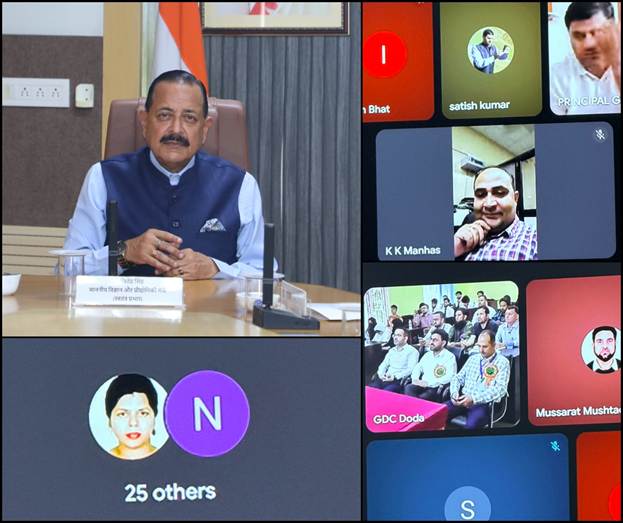
Doda, July 11: Union Minister of State (Independent Charge) for Science & Technology, Earth Sciences, and Minister of State in the Prime Minister’s Office, Dr. Jitendra Singh on Saturday said the National Education Policy (NEP) 2020 has democratized educational opportunities by creating a level playing field for students from Tier-2 and Tier-3 towns such as Doda, enabling them to compete with their counterparts in metropolitan cities.
Virtually addressing a two-day hybrid conference organised by Government Degree College, Doda, on the theme “Implementation of the National Education Policy 2020 in Jammu & Kashmir: Challenges of Inclusion, Equity and Accessibility,” the Minister said the policy has transformed India’s education system by promoting aptitude-based learning, multidisciplinary education and entrepreneurship.
Dr. Singh said NEP 2020 has broken the rigidity of conventional education by allowing students to pursue subjects based on aptitude rather than compulsion while shifting the focus of higher education from degrees to skills, innovation and entrepreneurship.
“A degree is no longer a trophy, and employment no longer means only a government job,” he said, adding that the policy has prepared India’s youth for the emerging knowledge economy.
Congratulating Government Degree College Doda, particularly Principal Dr. Javed Iqbal, for organising the conference, the Minister described the institution as one of the oldest and most distinguished centres of higher learning in the region with a rich academic legacy serving generations of students across the erstwhile Doda district.
Recalling the educational history of the region, Dr. Singh said there was a time when students from remote areas travelled long distances to Doda and Bhaderwah to pursue higher education due to the scarcity of institutions. He said the district possesses a strong academic tradition and has the potential to evolve into a major educational and innovation hub.
Highlighting the transformative impact of NEP 2020, the Minister said students are no longer confined to rigid academic streams but are free to pursue disciplines aligned with their interests and aptitude, resulting in better academic standards and more engaging classrooms.
He cited the example of a literature professor who found science students voluntarily attending literature classes out of genuine interest, describing it as a reflection of the policy’s success in encouraging curiosity-driven learning.
Dr. Singh said India has also moved beyond the mindset that education is solely meant for securing government employment. He observed that the present era belongs to skills, creativity, innovation and entrepreneurship.
Referring to India’s startup ecosystem, he said the country has grown from around 350 startups in 2014 to over 2.3 lakh today, making India the world’s third-largest startup ecosystem. More than half of these startups, he noted, are emerging from Tier-2 and Tier-3 cities, demonstrating that innovation is no longer limited to metropolitan centres.
Highlighting the Lavender Revolution under the CSIR Aroma Mission, Dr. Singh said the success story of Bhaderwah and Doda has shown that entrepreneurship is not confined to information technology or urban centres. What began with a small patch of lavender cultivation has now expanded across Doda, neighbouring districts, the Kashmir Valley and several Himalayan states, generating sustainable livelihoods and strengthening the rural economy.
The Minister encouraged Government Degree College Doda to establish a distinct identity by promoting entrepreneurship in sectors where the region has natural advantages. He suggested developing incubation support for Himalayan products, aroma-based enterprises and allied sectors in collaboration with the Ministry of AYUSH, the Jammu and Kashmir AYUSH Department and CSIR’s Aroma Mission.
He also informed participants that the region is witnessing the establishment of new scientific infrastructure, including a Himalayan laboratory, creating opportunities for greater collaboration between academia, research institutions, industry and startups.
Calling upon educational institutions to familiarise students with flagship entrepreneurship schemes such as the Pradhan Mantri Mudra Yojana and PM Vishwakarma Yojana, Dr. Singh said colleges must ensure that awareness about these initiatives reaches every student so they can transform knowledge and traditional skills into sustainable livelihoods.
Comments are closed.