Srinagar, Nov 16: In an age when a smartphone can turn almost anyone into a publisher, journalism in Kashmir faces a test that goes beyond the speed of breaking news. It is a test of credibility, patience and the willingness to pursue uncomfortable questions.
The rapid expansion of social media has transformed how information travels across Jammu and Kashmir. News, videos and claims reach thousands within minutes, often before their authenticity can be established. While digital platforms have opened space for independent voices and brought local issues into public focus, they have also blurred the distinction between verified journalism and unsubstantiated content.
Amid this changing landscape, journalists working with established media organisations continue to stress the importance of accuracy, public interest and professional responsibility.
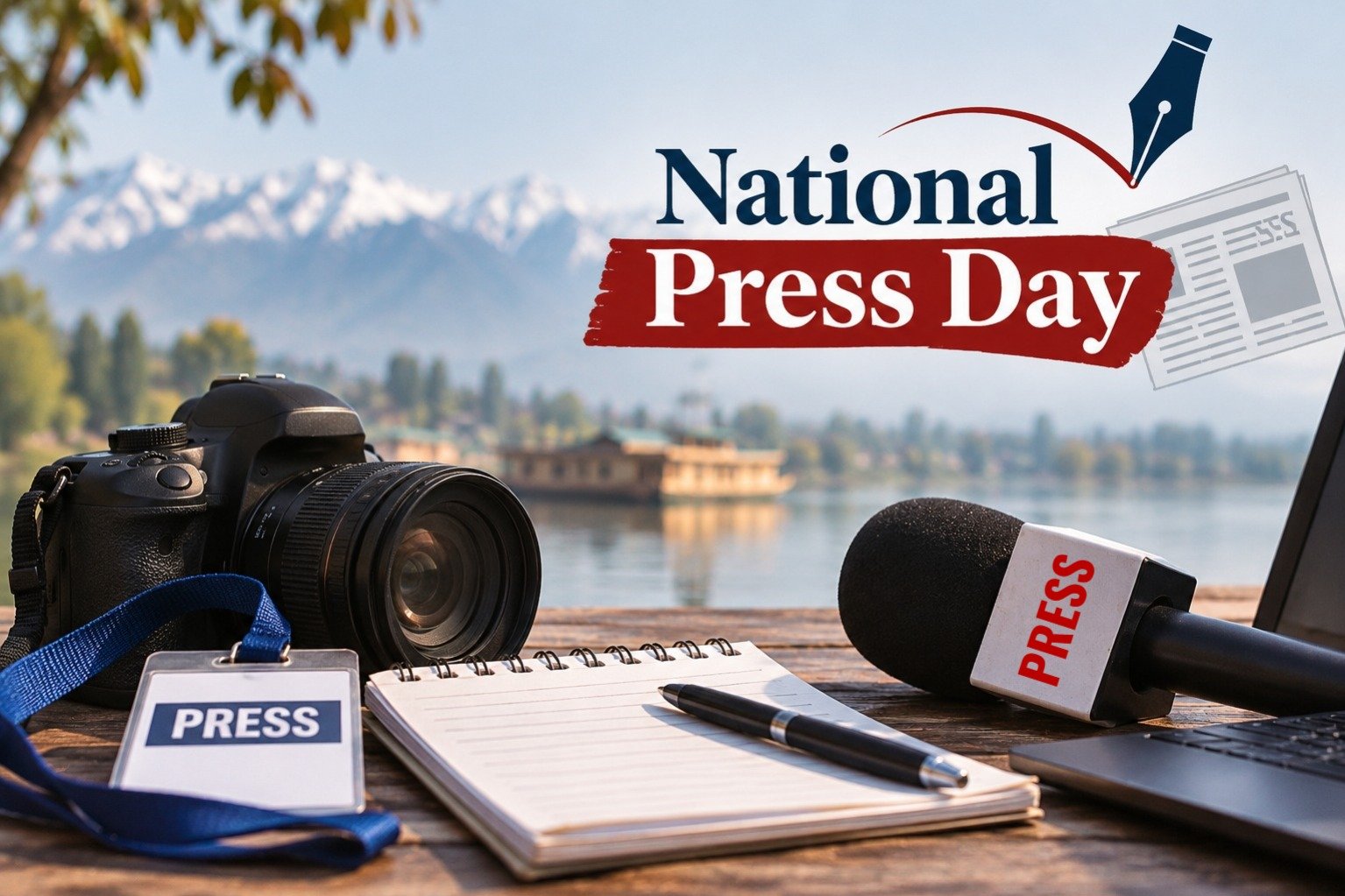
National Press Day, observed on November 16 to mark the establishment of the Press Council of India in 1966, offers an opportunity to reflect on a profession that remains an important link between citizens and those in power.
For Syed Rizwan Geelani of Greater Kashmir, journalism’s fundamental responsibility lies in public service. Reporting, he believes, must bring the concerns of ordinary people to the attention of authorities, particularly grievances that might otherwise remain overlooked.
The value of a report, therefore, goes beyond its publication. Its real impact lies in whether it draws attention to an issue and helps secure a response.
For television journalists, the pressure to deliver news quickly comes with an equally important responsibility to maintain accuracy and context.
Waris Fayaz of NDTV highlights the importance of credibility in an increasingly competitive media environment, where news reaches audiences across multiple platforms simultaneously.
The temptation to be first can be considerable, but reporting sensitive developments and allegations requires particular care. Being first to report an incident, he underscores, cannot come at the cost of getting the facts right.
For regional newspaper journalists, ground reporting remains central to the profession.
Shafat Malik of Rising Kashmir stresses the importance of consistency and responsibility in covering issues affecting ordinary citizens. Much of journalism, he points out, happens away from television studios and social media timelines, involving meetings with people, verification of grievances, seeking official responses and following up on assurances made by authorities.
In Kashmir, where residents regularly approach media organisations with complaints concerning public services, infrastructure, healthcare, education and employment, such reporting remains an important means of highlighting administrative shortcomings.
A report may not resolve a grievance immediately, but it can bring the issue into public discussion and compel the concerned authorities to respond.
The digital transformation has also changed how journalists engage with audiences.
Arawat Mehraj of Republic Media Network points to the changing patterns of news consumption and the growing influence of digital platforms. While social media has made information more accessible, it has also increased the responsibility of journalists to distinguish verified reporting from speculation.
The distinction between a content creator and a journalist has consequently become more significant. Independent digital reporting has its place in the media landscape, but professional journalism rests on verification, fairness and accountability.
The concern is not that people are using digital platforms to express themselves or highlight local developments, but that the alleged misuse of journalistic identity and circulation of unchecked information can undermine public confidence.
For Kashmir’s news industry, the discussion also extends to the role of news agencies, which have traditionally served as a vital link between reporters and media organisations.
Mohd Aslam Bhat, Editor-in-Chief of Kashmir News Service (KNS), one of the region’s oldest news wire agencies, has witnessed the changing nature of news dissemination and the growing influence of digital platforms.
News agencies continue to provide reports to newspapers, television channels and digital publications, making factual accuracy and editorial discipline essential to the wider media ecosystem.
For an agency, credibility is built over time through consistency, accuracy and reliable reporting. In an increasingly crowded digital environment, these standards remain central to maintaining the trust of subscribers and readers.
The changing media environment has also brought regulation into focus.
The Jammu and Kashmir Government is working on a new Media Policy-2026 to address concerns arising from the growth of social media news platforms and the alleged misuse of journalism.
During Legislative Assembly proceedings on September 30, Information Minister Sakina Itoo informed the House that a committee headed by senior National Conference MLA Ali Mohammad Sagar had examined the issue and given the Information Department four months to formulate fresh guidelines.
The proposed framework has revived a wider debate over how digital media can be made accountable without restricting independent reporting.
The experience of the Jammu and Kashmir Media Policy-2020 remains relevant. Introduced amid concerns over misinformation and professional standards, the earlier policy faced criticism from sections of the media fraternity over provisions relating to content scrutiny and the powers available to the administration.
The challenge for the present government will be to establish transparent standards that address impersonation, deliberate misinformation and proven professional misconduct while safeguarding journalistic independence.
Regulation, in other words, must not become a substitute for editorial independence.
Beyond the debate over social media and government policy lies a more fundamental question: what does journalism mean to the people who depend on it?
In Kashmir, a journalist’s day can begin with a complaint from a village and end with a response from a government department. It may involve a family waiting for compensation, patients struggling with inadequate medical facilities, students facing institutional difficulties or residents demanding basic infrastructure.
Such stories may not always dominate online trends, but they remain essential to public accountability.
Professional journalism also demands the willingness to question all sides, including political representatives, government institutions and powerful private interests, while maintaining fairness and giving those concerned an opportunity to respond.
This responsibility assumes particular importance in a region where the media has often operated under difficult circumstances and where public trust in information remains crucial.
National Press Day is not merely an occasion to recognise the profession. It is also a reminder of the standards that give journalism its meaning.
The growing number of digital platforms may have changed how news is produced and consumed, but the responsibility to establish facts, provide context and serve the public interest remains unchanged.
For Kashmir’s professional journalists, the real measure of their work lies not in the number of views a report attracts or how quickly it is published, but in whether it informs the public, raises questions that matter and brings neglected grievances into the open.
In a media environment increasingly shaped by instant reactions and competing narratives, the quiet work of verification, ground reporting and follow-up journalism continues to matter.
Anyone can publish information, but earning public trust through honest journalism takes time, responsibility and courage.


Comments are closed.