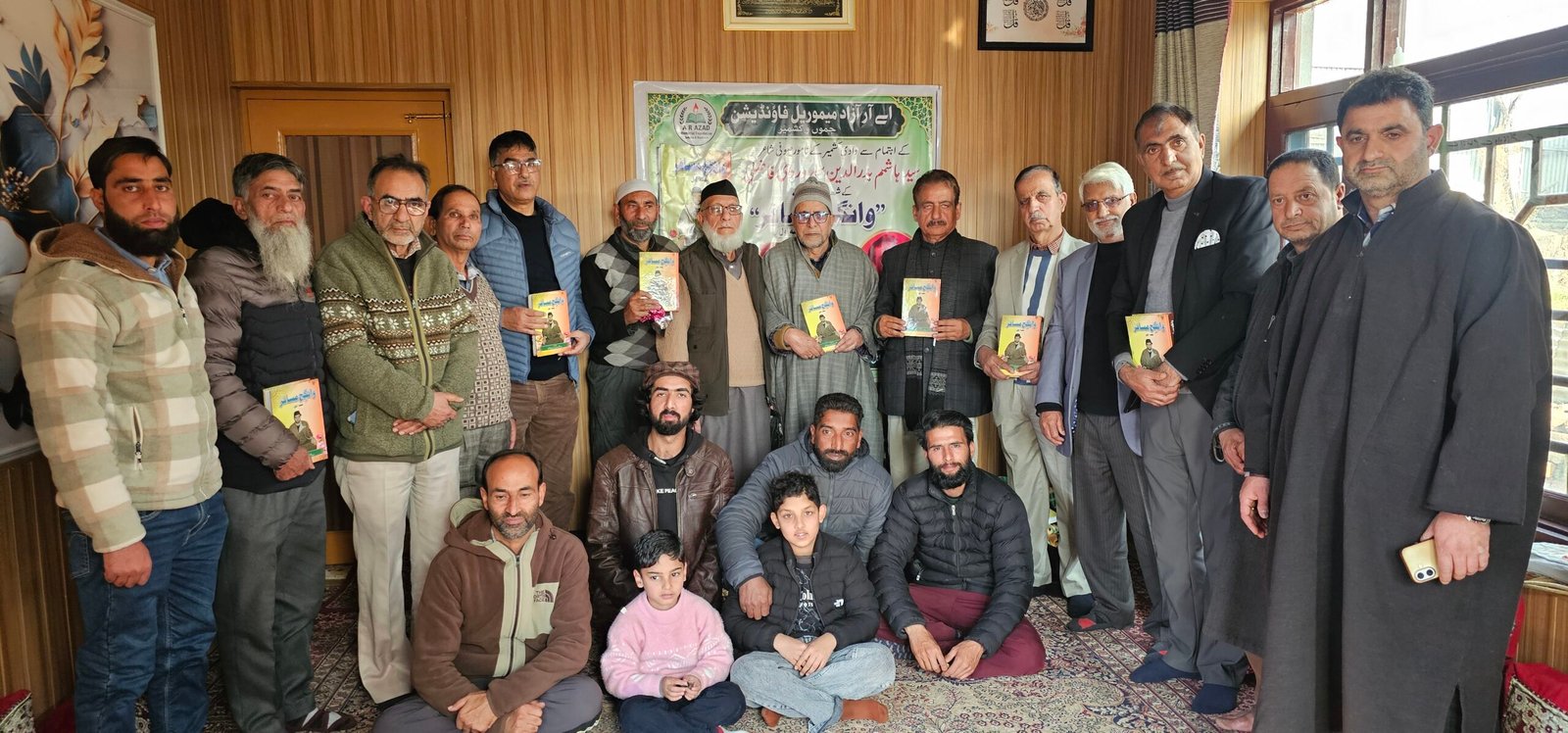
Pampore, November 16: Abdul Rahman Azad Memorial Foundation on Monday organised a literary function at Dusoo, Pampore, to formally release the poetry collection “Wangij Musafir” by renowned Sufi poet Syed Hashim Badruddin Suhrawardi Fazili.
The event witnessed the participation of prominent writers, poets and literary personalities, who gathered to celebrate and promote the Kashmiri language and its rich literary traditions.
Renowned writer, poet, critic and Sahitya Akademi Convenor for the Kashmir Chapter, Professor Shad Ramzan, attended the occasion as the chief guest and formally unveiled the poetry collection.
Prominent poets and literary figures, including Mohammad Subhan Shaukeen, Shakeel Azad, Mushtaq Kulgami, Ayoub Javaid, Azam Farooq, Sheikh Gulzar, Sanaullah Sanobar and Mohi-ud-Din Majrooh, among others, were also present.
Following the book release, a literary Mushaira was organised under the chairmanship of Mohammad Subhan Shaukeen, during which participating poets recited their compositions and enthralled the audience.
The Mushaira showcased various dimensions of Kashmiri poetry, highlighting diverse intellectual themes, literary expressions and profound Sufi sentiments.
The programme aimed to promote the Kashmiri language and literature, preserve the region’s rich Sufi poetic heritage and familiarise the younger generation with its literary and cultural traditions. The release of “Wangij Musafir” was described as a meaningful contribution towards preserving and strengthening Kashmir’s literary legacy.
Speaking to Kashmir Convener, Professor Shad Ramzan said that the poetry collection “Wangij Musafir” by Sufi poet Syed Hashim Badruddin Suhrawardi Fazili comprises around 250 pages and contains Sufi poetry deeply rooted in Kashmir’s rich spiritual and literary heritage.
He said that Sufi poetry represents a longstanding literary tradition in Kashmir, beginning with Lal Ded and continuing through successive generations to the present day. He added that the collection reflects this traditional Sufi spirit, poetic wisdom and spiritual message, which need to be preserved and conveyed to the common people.
Professor Ramzan emphasised that organising literary gatherings and Sufi assemblies is essential to keeping this valuable tradition alive. He said that reading and promoting such literary works is equally important, adding that failure to preserve this heritage and pass it on to younger generations would amount to doing injustice to Kashmir’s cultural legacy and depriving future generations of a valuable inheritance.
He also appreciated the efforts of individuals working towards promoting and preserving Kashmir’s literary heritage, particularly Shakeel Azad. He said that organisers play a vital role in bringing such literary events to life and ensuring that the voices of poets and writers reach a wider audience.
Professor Ramzan expressed gratitude to all those who attended the literary gathering and said that he felt delighted to be part of the Sufi literary programme.
Speaking to Kashmir Convener, Sufi poet Syed Hashim Badruddin Suhrawardi Fazili said that his poetry collection “Wangij Musafir” encompasses various forms of Sufi and spiritual poetry, including Sufiyat, Naat, Manqabat, Ghazals, Ishq-e-Majazi, Wasil, Firaq and other poetic compositions.
He said that the book comprises several parts, with the present volume representing one completed section of the larger work.
The poet further explained that the literary and spiritual knowledge reflected in the collection was shaped by the guidance, teachings and blessings of several spiritual mentors and distinguished personalities, including Sayyid Meerakh Shah Kashani Sahab, Syed Ghulam Mohi-ud-Din Noori Sahab of Zaina Kadal, Gaffar Soub Kral, his grandfather Syed Ghulam Mustafa Suhrawardi, Sultan Soub Badasgome, and Syed Saleem Chishti Khawaja of UP, Jairpore Road.
He acknowledged the invaluable guidance and contribution of these spiritual personalities in shaping his literary and Sufi journey, adding that their teachings and influence are reflected in his poetic compositions.


Comments are closed.