
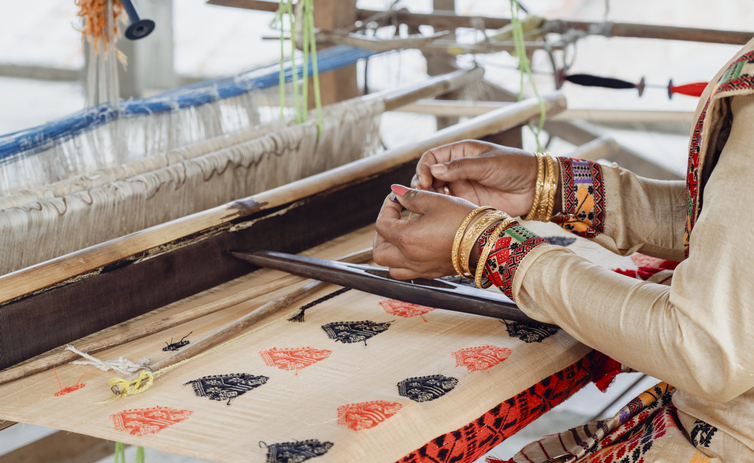

National Handloom Day 2026: Celebrating Weavers, Renewing Traditions, Expanding Horizons

S Ahmad


Observed on 7 August, National Handloom Day celebrates India’s weaving heritage. It recognises 35.22 lakh weavers and allied workers, over 72% of whom are women. In 2026, the occasion reflects a sector firmly rooted in regional knowledge. Handlooms are also finding new expression through design, digital platforms and global markets. Government support, awards, market access and authenticity safeguards are carrying these traditions from rural communities to wider national and international audiences.

Every piece of handwoven fabric tells a story. It carries the rhythm of a loom that has echoed through generations, the patience of skilled hands, and the cultural memory of a community that has preserved its craft against the odds. In an era increasingly defined by automation, mass production and fast fashion, India’s handloom sector stands as a reminder that true value often lies not in speed, but in skill; not in uniformity, but in uniqueness.

As India observes National Handloom Day on August 7, the occasion is more than an annual celebration of traditional textiles. It is an opportunity to recognise one of the country’s oldest and most sustainable industries—an industry that continues to support millions of livelihoods, empower rural women, preserve cultural heritage and contribute to economic growth. More importantly, it invites the nation to rethink the place of handloom in a rapidly changing world where authenticity, sustainability and ethical production are becoming defining consumer values.

The significance of National Handloom Day is rooted in history. It commemorates the launch of the Swadeshi Movement on August 7, 1905, a defining moment in India’s freedom struggle when Indians collectively rejected imported goods and embraced indigenous products. Handwoven cloth became more than a textile; it became a symbol of self-reliance, dignity and resistance. The spinning wheel evolved into an emblem of economic independence, reminding the nation that political freedom was inseparable from economic empowerment.

More than a century later, the spirit of Swadeshi remains remarkably relevant. Today’s handloom sector represents not merely a continuation of tradition but an evolving ecosystem where centuries-old craftsmanship intersects with modern entrepreneurship, digital commerce and global markets. India’s handloom journey is no longer confined to village clusters or local fairs. It increasingly finds expression on international runways, online marketplaces and premium retail shelves across the world.

India’s association with weaving predates recorded history. Archaeological discoveries from the Indus Valley Civilisation reveal evidence of spinning and weaving that dates back thousands of years. Ancient texts including the Rigveda, the Ramayana and the Mahabharata describe India’s expertise in producing fine cotton and silk textiles. Classical scholars and foreign travellers repeatedly praised Indian fabrics for their extraordinary quality, intricate craftsmanship and vibrant colours.

Across centuries, these traditions evolved differently in every region. Kashmir’s exquisite pashmina, Banaras’ luxurious brocades, Bengal’s delicate Jamdani, Andhra Pradesh’s Ikat, Tamil Nadu’s Kanchipuram silk, Rajasthan’s Kota Doria, Karnataka’s Ilkal sarees and Madhya Pradesh’s Maheshwari and Chanderi weaves each developed distinct identities rooted in local geography, climate, culture and craftsmanship. Every weave reflects a unique combination of techniques, motifs and stories that cannot be replicated by machines.

That diversity remains one of India’s greatest strengths. Handloom is perhaps among the few industries where production is deeply intertwined with geography, culture and community identity. Unlike factory manufacturing, every handwoven product carries subtle variations that make each creation unique. These imperfections are not flaws; they are signatures of human craftsmanship.

Yet beyond its artistic value lies an equally important economic story.

The latest All India Handloom Census illustrates the enormous scale of this sector. Around 35.22 lakh handloom weavers and allied workers continue to earn their livelihoods through weaving and associated activities, while nearly 31.45 lakh households remain directly linked to handloom production. More than 28 lakh looms operate across the country, and almost nine out of every ten are located in rural India.

These numbers reveal something often overlooked in discussions on industrial development. Handloom is not merely a cultural sector deserving preservation; it is a major rural economic engine.

Unlike capital-intensive industries concentrated in urban centres, handloom distributes employment across villages and small towns. It generates work close to home, reducing migration pressures while allowing families to preserve traditional occupations. The industry supports not only weavers but also dyers, yarn suppliers, designers, block printers, embroiderers, traders, transporters and countless other participants across the value chain.

Perhaps its most remarkable contribution lies in women’s economic empowerment.

More than 72 percent of India’s handloom workforce comprises women. Over 25 lakh women participate in weaving and allied activities, making handloom one of the country’s largest women-led traditional industries.

This fact deserves greater attention in national conversations about inclusive growth.

For millions of rural women, weaving is far more than supplementary income. It provides financial independence while allowing them to balance household responsibilities with productive employment. Income earned through weaving often supports children’s education, healthcare and household nutrition. In many regions, women are not merely workers but custodians of traditional knowledge, passing specialised weaving techniques from one generation to the next.

Handloom, therefore, represents a unique model of women-led development that predates modern development theories by centuries.

Equally significant is the social diversity embedded within the sector. Large numbers of Scheduled Castes, Scheduled Tribes and Other Backward Classes depend upon handloom for their livelihoods. Many weaving traditions are concentrated among communities that have historically relied upon artisanal occupations. Supporting handloom, therefore, is also an investment in social inclusion and equitable rural development.

The environmental dimension further strengthens the case for handloom.

At a time when the global fashion industry faces criticism for excessive water consumption, chemical pollution and carbon emissions, handloom offers an inherently sustainable alternative. Handwoven textiles require significantly lower energy compared to mechanised production. Many traditional weaving processes rely on natural fibres and locally available materials while generating minimal carbon emissions.

As global consumers increasingly seek eco-friendly and ethically produced products, India’s handloom sector possesses a natural competitive advantage. Sustainability is no longer merely an environmental slogan; it is becoming an economic opportunity. Countries across Europe and North America are witnessing growing demand for products that combine authenticity with responsible production practices.

India is uniquely positioned to meet this demand.

However, heritage alone cannot guarantee survival. Tradition must continually adapt to changing markets, consumer preferences and technological advancements. For decades, India’s weavers have struggled against competition from inexpensive machine-made products, limited market access, inconsistent incomes and declining interest among younger generations. Preserving handloom, therefore, requires more than celebrating its past; it demands policies that make weaving economically viable for the future.

That shift has gradually begun to take shape. In recent years, government initiatives have moved beyond simple welfare support to focus on infrastructure, design innovation, digital platforms, financial inclusion, branding and global market integration. The emphasis is increasingly on enabling weavers not merely to survive but to compete in modern markets without sacrificing the authenticity that makes Indian handlooms distinctive.

The story of India’s handloom sector is no longer simply about protecting an ancient craft. It is about building a modern creative economy where tradition and innovation reinforce one another. It is about ensuring that centuries-old skills continue to generate dignified livelihoods in the twenty-first century.

In many ways, the loom has become a metaphor for India’s own development journey—one where heritage and modernity need not compete, but can be woven together into a stronger national fabric.

If India’s handloom story has endured for centuries, it is because the sector has continually adapted without abandoning its core identity. Today’s weaver is no longer confined to a village market or dependent solely on middlemen. Increasingly, the loom is being connected to design institutes, e-commerce platforms, digital payment systems, export houses and global fashion circuits. The transformation is gradual, but it marks a significant shift from viewing handloom merely as a heritage craft to recognising it as a vibrant creative industry capable of generating sustainable employment and economic value.

This transition has been driven by a growing policy recognition that preserving handloom requires far more than ceremonial appreciation. Weavers need access to quality raw materials, affordable credit, modern infrastructure, contemporary designs, reliable markets and social security. Over the last few years, government interventions have increasingly focused on strengthening this entire ecosystem rather than addressing isolated challenges.

At the centre of this effort is the National Handloom Development Programme (NHDP), which seeks to improve productivity, strengthen institutions and enhance the incomes of weavers through a need-based approach. Unlike earlier models that often adopted a one-size-fits-all strategy, the programme recognises that every weaving cluster has its own strengths, challenges and market opportunities.

One of the most impactful interventions has been the Small Cluster Development Programme, under which hundreds of handloom clusters across the country have received assistance for improved looms, worksheds, lighting, design development and marketing support. The results underline a simple but powerful truth: productivity is not determined solely by skill; it also depends on the quality of the working environment.

Studies of completed interventions show that better worksheds have significantly increased daily production, extended productive working hours and improved average earnings. For families that depend entirely on weaving, such improvements translate into better living standards, more stable incomes and greater economic security.

Technology, too, has begun to reshape traditional weaving without replacing its essential character.

The introduction of electronic jacquards illustrates how innovation can complement rather than compete with craftsmanship. By digitally controlling complex weaving patterns, electronic jacquards enable artisans to produce intricate designs with greater speed and precision while preserving the handwoven nature of the fabric. The outcome has been higher productivity, increased wages and improved monthly incomes for beneficiaries.

This is an important lesson in the broader debate around technology and employment. Modernisation does not always require replacing workers with machines. In many traditional sectors, the smarter approach is to equip artisans with better tools that enhance their capabilities while retaining the uniqueness of handmade production.

Access to finance has been another longstanding challenge for weavers, many of whom operate as household enterprises with limited collateral. Seasonal demand, fluctuating raw material prices and delayed payments often push artisans towards informal lenders charging exorbitant interest rates.

The Weaver MUDRA Scheme seeks to address this constraint by offering concessional loans supported by government interest subsidies and credit guarantees. Affordable institutional credit enables weavers to purchase yarn, upgrade equipment, expand production and fulfil larger orders without falling into cycles of debt. Financial inclusion, in this context, becomes more than banking—it becomes a pathway to entrepreneurship.

Equally significant are the sector’s expanding social security measures. Insurance coverage under schemes such as Pradhan Mantri Jeevan Jyoti Bima Yojana and Pradhan Mantri Suraksha Bima Yojana provides a basic safety net for weaving families that often remain vulnerable to economic shocks. Scholarships for children pursuing textile education further strengthen the continuity of knowledge while encouraging younger generations to view textiles as a professional career rather than merely a traditional occupation.

The creation of Handloom Producer Companies also reflects a changing institutional approach. By organising artisans into professionally managed enterprises, these companies improve bargaining power, facilitate collective marketing and enable weavers to participate more effectively in larger value chains. Such models reduce dependence on intermediaries while allowing artisans to retain greater control over pricing and business decisions.

Yet economic support alone cannot secure the future of handloom.

Today’s consumers seek products that combine authenticity with contemporary appeal. Traditional weaving techniques remain invaluable, but they must increasingly respond to changing lifestyles, fashion trends and design preferences. This is where India’s design institutions have emerged as important partners in the handloom revival.

Collaborations between the Development Commissioner for Handlooms, the National Institute of Fashion Technology (NIFT) and leading designers have demonstrated that heritage textiles possess remarkable versatility. Collections such as Vishwa Sutra, showcased during the 61st Femina Miss India event, reimagined thirty traditional Indian weaves through global design inspirations. Rather than diluting regional identities, such initiatives introduced them to younger audiences and international aesthetics.

Similarly, exhibitions like Breathing Threads at Bharat Tex illustrated how fabrics such as Chanderi, Jamdani, Banarasi, Kota Doria and Maheshwari can be transformed into contemporary garments without compromising their traditional essence. These initiatives prove that innovation need not replace heritage; it can amplify it.

Fashion today is increasingly driven by stories. Consumers are no longer buying only garments; they are buying narratives about sustainability, craftsmanship and cultural identity. Handloom possesses all three.

Perhaps nowhere was this storytelling more creatively expressed than at the International Film Festival of India, where the “Handloom Sarees in Motion” presentation celebrated Indian cinema through regional weaving traditions.

By combining textiles with visual storytelling, the event demonstrated how handloom can occupy spaces far beyond

conventional exhibitions and craft fairs.

Such cultural collaborations have immense strategic value.

Every international showcase introduces Indian textiles to audiences that may never have visited a traditional handloom exhibition. Every designer collaboration creates new markets. Every successful runway presentation reshapes perceptions of handloom from being “traditional” to becoming timeless and aspirational.

Innovation is also taking a more entrepreneurial direction.

Events such as Weave the Future 4.0 encourage circular design, recycling and sustainable fashion practices, aligning Indian handloom with the rapidly growing global movement towards responsible consumption. Meanwhile, the Handloom Hackathon 2026 invites students, startups, designers, researchers and technology professionals to develop practical solutions for productivity, branding, digital marketing and sustainability.

This represents an important shift in mindset.

For decades, handloom policy largely focused on preserving existing traditions. Today’s emphasis is equally on creating new possibilities. By inviting innovators from outside the traditional textile ecosystem, policymakers acknowledge that fresh ideas often emerge when diverse disciplines collaborate.

Equally encouraging is the expanding digital presence of India’s weaving community.

Thousands of weavers are now connected to government procurement through the Government e-Marketplace (GeM), while dedicated platforms like Indiahandmade enable verified artisans to reach consumers directly. Digital commerce reduces dependence on multiple intermediaries, improves transparency and allows artisans to tell the stories behind their products—stories that increasingly influence purchasing decisions.

The rapid growth of smartphones, digital payments and social media has further democratised market access. A skilled artisan in a remote village can now showcase products to customers across India and even overseas without maintaining an expensive physical storefront.

Digital technology cannot replace craftsmanship, but it can certainly expand its reach.

Perhaps the greatest strength of India’s current handloom strategy lies in recognising that heritage and innovation are not opposing forces. They are complementary threads of the same fabric. The challenge is not to preserve tradition inside museums; it is to ensure that tradition continues to evolve as a living, economically viable enterprise.

As handloom enters new markets and embraces new technologies, another equally critical challenge comes into focus: protecting authenticity. In an increasingly competitive global marketplace flooded with machine-made imitations, preserving the identity and credibility of genuine handwoven products becomes essential—not only for cultural reasons but also for the livelihoods of millions of artisans.

The growing popularity of handloom products has brought with it a paradox. While rising demand offers unprecedented opportunities for India’s weavers, it has also intensified the challenge of imitation. Machine-made textiles are often marketed as handwoven products, eroding consumer trust and depriving genuine artisans of the premium their craftsmanship deserves. In a marketplace where authenticity increasingly determines value, protecting the identity of India’s handlooms has become as important as promoting them.

This is where institutional safeguards assume critical importance.

Over the past two decades, India has steadily developed mechanisms to distinguish genuine handloom products from industrial replicas. The Handloom Mark, introduced in 2006, assures buyers that a product is authentically handwoven. Similarly, the India Handloom Brand, launched on the first National Handloom Day in 2015, goes beyond authenticity to certify quality, traditional design, environmental responsibility and social compliance.

These certifications are far more than labels stitched onto garments. They represent trust. For consumers, they provide confidence that the product they purchase genuinely reflects the labour and artistry of Indian weavers. For artisans, they create opportunities to command better prices by differentiating handcrafted textiles from mass-produced alternatives.

Equally significant is the growing recognition of Geographical Indication (GI) tags. Whether it is Banarasi brocade, Kanchipuram silk, Pashmina, Chanderi, Kota Doria or Jamdani, GI protection safeguards the unique identity of regional weaving traditions whose reputation is inseparable from their place of origin.

A GI tag does more than protect intellectual property. It protects livelihoods.

When a weaving tradition receives legal recognition, its value extends beyond the fabric itself. It strengthens local economies, encourages younger artisans to continue family traditions and enhances India’s cultural diplomacy abroad. Every GI-certified textile becomes an ambassador of the region from which it originates.

Legal safeguards under the Handlooms Act further reinforce this protection by reserving specific textile articles exclusively for handloom production and discouraging unauthorised manufacture by powerloom units. Such measures recognise that preserving traditional industries requires not only promotion but also effective regulation.

Yet the future of handloom cannot rest solely on protection.

Its long-term success will depend on competitiveness.

Encouragingly, global consumer behaviour appears to be moving in handloom’s favour. Across international markets, buyers are increasingly questioning the environmental and social costs of fast fashion. They seek products that are ethically produced, environmentally responsible and culturally authentic. Handmade textiles naturally align with these evolving preferences.

India, therefore, possesses a strategic advantage that many manufacturing economies struggle to replicate.

Unlike synthetic, standardised production systems, Indian handlooms embody craftsmanship, sustainability and individuality. Every woven piece reflects the artisan’s skill rather than the precision of an automated assembly line. In a world saturated with identical products, uniqueness itself has become a premium commodity.

This growing global appreciation is already reflected in export performance. Indian handloom exports crossed ₹1,330 crore during 2025-26, with markets such as the United Arab Emirates, the United States, France, the United Kingdom and Spain emerging as important destinations. These figures are encouraging, but they also hint at a much larger untapped opportunity.

The international market for sustainable luxury and handcrafted textiles continues to expand rapidly. India has the heritage, craftsmanship and production diversity to become one of its leading suppliers.

However, achieving that ambition will require addressing several persistent challenges.

The first is demographic.

Across many weaving communities, younger generations are reluctant to continue traditional occupations. Low and uncertain incomes, physically demanding work and the attraction of urban employment often discourage them from entering the profession. If this trend continues unchecked, centuries-old skills could gradually disappear despite growing market demand.

Making weaving economically rewarding is therefore essential for cultural preservation.

The second challenge is design adaptation.

Consumers today expect products that suit contemporary lifestyles without compromising authenticity. Traditional weaving techniques must continue evolving into new categories such as home furnishings, fashion accessories, office décor, premium lifestyle products and sustainable interiors. Innovation should not replace tradition; it should expand its possibilities.

Third, greater integration with digital commerce remains vital.

While thousands of artisans have joined online platforms and government procurement systems, many more still lack digital literacy, branding expertise or direct access to consumers. Training in photography, storytelling, packaging, digital marketing and customer engagement can significantly improve artisans’ incomes by reducing dependence on intermediaries.

Fourth, climate resilience deserves greater attention.

Many natural fibres depend on changing weather conditions, while dyeing processes often rely on water availability. Future policies must integrate climate adaptation, sustainable fibre cultivation and environmentally responsible production techniques to ensure long-term resilience.

Fortunately, recent policy initiatives suggest that these realities are being recognised.

The Union Budget 2026-27 introduced several measures aimed at strengthening the textile ecosystem. Proposals such as the National Fibre Scheme, the Textile Expansion and Employment Scheme, and the integrated National Handloom and Handicraft Programme indicate an effort to move beyond fragmented interventions towards a more comprehensive strategy. Likewise, the emphasis on the Mahatma Gandhi Gram Swaraj Initiative seeks to connect handloom with rural enterprise, branding, skill development, global market linkages and the One District One Product initiative.

Together, these measures acknowledge a simple but profound reality: handloom is not merely a cultural sector deserving subsidies. It is a productive economic asset capable of generating employment, promoting exports, supporting women-led enterprises and strengthening rural development.

Perhaps that is the most important lesson National Handloom Day offers.

Too often, conversations around handloom are framed in terms of nostalgia. We celebrate it as an inheritance from the past, something beautiful but fragile that requires preservation. While that sentiment is understandable, it risks overlooking an equally important truth.

Handloom is not only about where India has come from.

It is also about where India can go.

As the world embraces sustainability, slow fashion, ethical consumption and locally rooted craftsmanship, India possesses an extraordinary advantage woven into its own civilisational heritage. Few countries can claim such diversity of fibres, techniques, motifs and weaving traditions spread across hundreds of cultural landscapes. Even fewer have millions of artisans who continue to keep these traditions alive despite enormous economic challenges.

The task before policymakers, designers, entrepreneurs and consumers is therefore not merely to conserve this legacy but to unlock its full potential.

Every purchase of an authentic handloom product sustains a family. Every innovation that improves productivity without diluting craftsmanship strengthens an ancient profession. Every new market opened to Indian weavers carries with it not just textiles but stories of resilience, creativity and identity.

National Handloom Day is ultimately a reminder that the threads woven on India’s looms bind together far more than cotton, silk or wool. They weave together livelihoods and aspirations, heritage and innovation, villages and global markets, tradition and transformation.

In every handwoven fabric lies the quiet testimony of generations that refused to let their skills fade into history. Their craft has survived colonialism, industrialisation, economic upheavals and changing fashions because it has always been more than an occupation—it has been a way of life.

As India advances towards becoming a developed nation, the future of its handloom sector should not be measured only in production figures or export earnings. Its true success will be reflected in whether the next generation still chooses to sit at the loom with pride, confident that their inherited craft has a respected place in a modern economy.

If that happens, National Handloom Day will no longer be just an annual celebration of a glorious past. It will stand as a celebration of a future that is being woven—thread by thread, village by village, and artisan by artisan—into the fabric of a confident, creative and self-reliant India.


The article is based on the inputs and background information provided by the Press Information Bureau (PIB). Author is Writer, Policy Commentator. He can be mailed at kcprmijk@gmail.com

Comments are closed.